comparisons
Charcoal vs Wood for Smoking: Which Fuel Is Right for You?
Charcoal vs wood for smoking: how they differ on flavor, temperature control, and cost — and which fuel pros use for brisket, ribs, and more.
 Cole Whitaker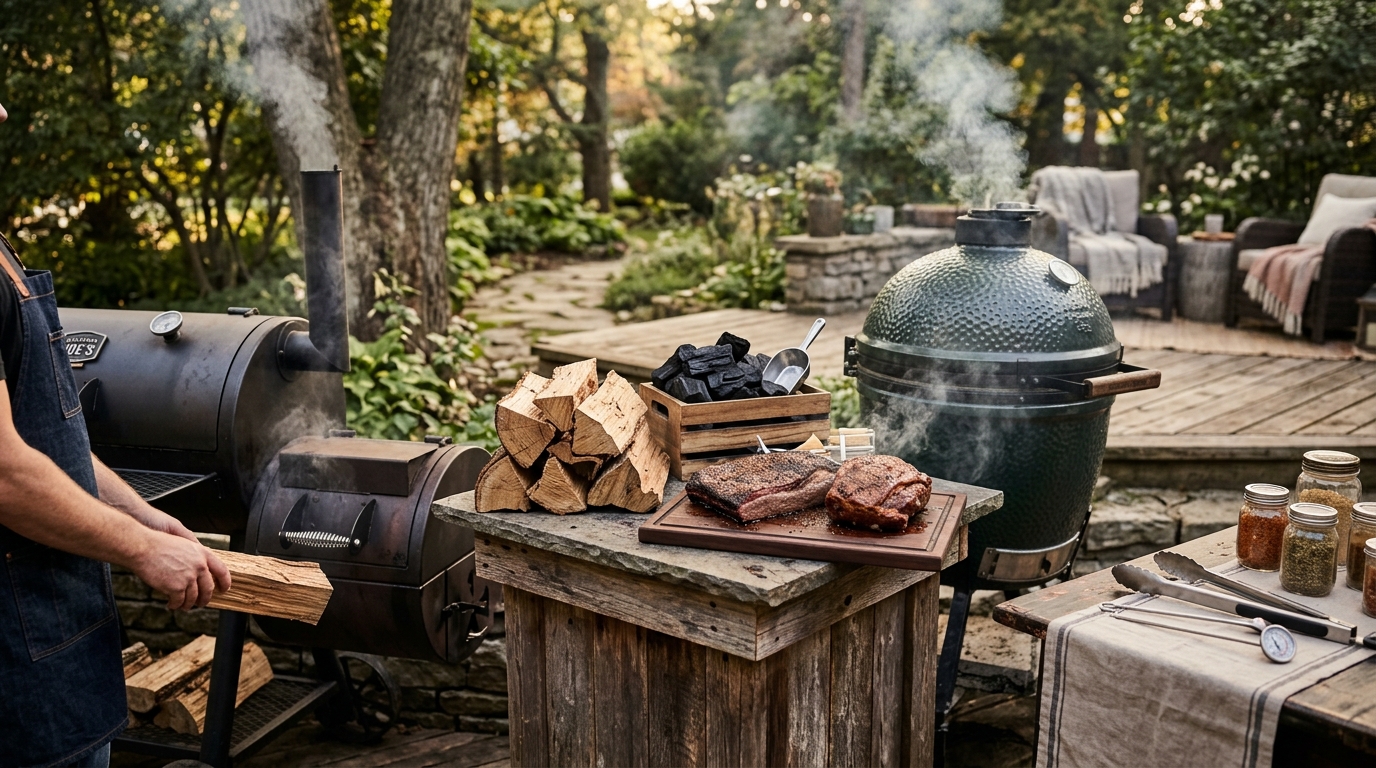
Quick verdict: For home smokers and beginners, charcoal plus wood chunks is the right approach — it holds steady temperatures at 225–250°F without constant tending and delivers excellent smoke flavor. All-wood fires are the choice for experienced pitmasters running full-size offset smokers, where hardwood splits produce the clean blue smoke behind authentic Texas-style brisket and competition BBQ.
Charcoal vs wood for smoking: 7 key differences
| Product | Best for | Rating | Notes | |
|---|---|---|---|---|
| Temperature stability | Charcoal: easier to hold 225-250F. Wood: varies with split size and moisture. | — | Charcoal burns more predictably per unit; wood splits require constant fire management to prevent temperature swings of 50F or more. | — |
| Smoke quality | All-wood: clean blue smoke. Charcoal plus chunks: good, slightly thicker. | — | Properly managed wood fires produce thin blue smoke — the goal of authentic BBQ. Charcoal can produce whiter smoke with more particulate if poorly managed. | — |
| Smoke ring depth | All-wood fires produce a deeper smoke ring in the meat. | — | Wood combustion produces more nitric oxide than charcoal, resulting in a more pronounced pink smoke ring near the meat surface. | — |
| Learning curve | Charcoal: beginner-friendly. Wood: requires skill and years of practice. | — | Managing an all-wood fire in an offset smoker requires experience with split size, moisture level, and airflow. Charcoal is far more forgiving. | — |
| Equipment required | Charcoal works in any smoker. Wood splits require a full-size offset. | — | Bullet smokers, kettle grills, kamados, and most vertical smokers run on charcoal. Stick-burner offset smokers are designed for hardwood splits. | — |
| Cost per cook | Charcoal: $2-5 per cook. Local wood: often $1-3. Shipped wood: $8-15. | — | Local firewood is the cheapest fuel option. Shipping cooking wood is expensive — a 25-lb box of competition splits runs $20-35 delivered. | — |
| Flavor intensity | All-wood: maximum smoke complexity. Charcoal plus chunks: excellent and approachable. | — | Both approaches produce outstanding BBQ. All-wood fires impart more smoke complexity on long cooks; charcoal cooks are cleaner and more consistent. | — |
When to use charcoal plus wood chunks for smoking
The charcoal-plus-wood-chunks approach is the standard for most serious home smokers. Charcoal provides the heat; hardwood chunks placed directly on the coals provide the smoke. This separation of roles is what makes the approach beginner-friendly — you manage the charcoal bed for temperature, then add one or two fist-sized chunks of hardwood to generate smoke. No fire-tending skill required beyond loading the smoker correctly at the start of the cook.
Why charcoal beats all-wood for most home setups
Charcoal produces a consistent, predictable burn that holds target temperatures without constant adjustment. A full charcoal bed in a Weber Smokey Mountain, a Slow ‘N Sear kettle, or a Pit Barrel Cooker holds 225–275°F for 6–10 hours with minimal intervention. That stability is nearly impossible to replicate with an all-wood fire in anything smaller than a properly built offset smoker with a heavy-gauge firebox.
The equipment point matters more than most people realize. A bullet smoker or kettle grill has a small firebox designed for charcoal, not wood splits. Trying to run an all-wood fire in a Weber Smokey Mountain creates problems — small splits burn hot and fast, temperature control becomes reactive rather than proactive, and the results are inconsistent. These same setups run beautifully on quality briquettes or lump charcoal with wood chunks added for smoke character.
Choosing the right charcoal for long smokes
For low-and-slow cooks lasting 8–14 hours, briquettes outperform lump charcoal in consistency. Briquettes burn at lower, more even temperatures for 6–10 hours; lump burns hotter and faster, requiring more frequent fuel additions on a long smoke. The exception is kamado grills — kamado airflow systems work better with lump, and the ceramic walls retain heat so effectively that lump temperature spikes are less of a concern.
Best for Long low-and-slow smokes in bullet smokers, kettle grills, and entry-level offsets
Royal Oak All Natural Hardwood Briquettes
Competition-grade briquettes made from 100% oak with no lighter fluid, sodium nitrate, or filler binders. Burns longer and produces less ash than Kingsford Original, making it a strong choice for 8-12 hour smoking sessions where reliable temperature stability matters most.
★★★★★ 4.6
Check current price on Amazon→Pros
- 100% oak construction with no sodium nitrate or starch fillers that standard briquettes normally contain
- Burns longer per charge than Kingsford Original, important for 10-14 hour overnight brisket cooks
- Less ash output than standard briquettes, reducing vent clogging during long cooks
- Available at major outdoor retailers and hardware stores nationwide
Cons
- Harder to find than Kingsford at grocery stores — typically requires a hardware or specialty outdoor retailer
- Still produces more ash than lump charcoal during very long cooks lasting over 12 hours
- Costs 20-30% more per pound than Kingsford Original Blue Bag briquettes
Adding wood chunks correctly
Place 2–4 fist-sized hardwood chunks directly on top of unlit charcoal before the cook starts. As the charcoal heats up, the chunks begin to smolder and produce smoke. Never soak wood chunks in water — wet wood produces steam and acrid white smoke before it produces the clean, thin blue smoke you want. Dry wood placed directly on the coals delivers dramatically better results.
Avoid wood chips for anything longer than a 2-hour cook. Chips burn up too quickly in a charcoal environment. Chunks (2–4 inches in size) smolder for 45–90 minutes each; 3–4 chunks placed at different depths in the charcoal bed produce consistent smoke for the first 3–4 hours of a smoke, which is when meat absorbs most of the smoke before the bark forms and seals the surface.
Best for Adding smoke flavor to charcoal fires in bullet smokers, kettle grills, and kamados
B&B Oak Wood Chunks for Smoking
Post oak chunks from the Texas Hill Country — the same wood species Central Texas BBQ joints use for brisket. Properly sized at 2-4 inches, they smolder cleanly without flaring up and produce thin blue smoke within the first 15 minutes. The standard wood chunk for charcoal-based smoking setups where consistent smoke output matters.
★★★★★ 4.7
Check current price on Amazon→Pros
- Post oak from Texas Hill Country — the same wood species used by Franklin Barbecue and most Central Texas BBQ restaurants
- Correct chunk sizing at 2-4 inches smolders rather than flares, avoiding temperature spikes in a charcoal bed
- Produces thin blue smoke rather than thick white smoke associated with wet or poor-quality wood
- Dense hardwood burns slowly, providing 45-90 minutes of smoke per chunk placed in a charcoal bed
Cons
- Post oak is milder than hickory — cooks wanting an assertive smoke flavor should use hickory chunks instead
- Higher shipping cost than commodity wood chunks if not available at local retailers
- Bag-to-bag chunk size consistency varies somewhat compared to pre-measured portioned wood products
When to use all-wood fires for smoking
All-wood fires — burning only hardwood splits without any charcoal — are the fuel choice of traditional offset smoker operators, Texas BBQ joints, and competition pitmasters running stick-burner offset smokers. The technique produces the deepest smoke flavor and the most pronounced smoke ring in the meat, but requires a properly designed smoker and significant experience to execute consistently.
What an all-wood fire requires from your smoker
A full-size offset smoker is the non-negotiable starting point for all-wood smoking. The firebox needs to be large enough to hold 2–3 wood splits (typically 14–18 inches long) and provide enough airflow to maintain clean combustion without constant intervention. Offset smokers with thin (under 3/16-inch) steel fireboxes struggle with all-wood fires because the higher heat of a wood fire creates temperature spikes that thin steel cannot moderate the way heavy-gauge steel or insulated fireboxes do.
Fire management in an all-wood setup is active, not passive. You add a split roughly every 45–60 minutes to maintain temperature. Unlike a charcoal-and-chunks setup where you load fuel once and walk away, an all-wood offset smoker requires you to stay present throughout the cook. For competition BBQ, where someone is always managing the fire, this is standard practice. For a home cook doing a solo overnight brisket, the commitment is significant.
The blue smoke standard
The goal in all-wood offset smoking is achieving “thin blue smoke” — the nearly invisible, clean combustion byproduct of properly seasoned hardwood burning at the correct temperature. White or gray smoke means incomplete combustion, which deposits bitter compounds onto the meat surface. This is one reason all-wood offset smoking has a steep learning curve: maintaining thin blue smoke consistently throughout a 12-hour cook is a skill developed over dozens of cooks, not something beginners get right immediately.
Best for All-wood offset smoker fires for brisket, beef ribs, and Central Texas-style BBQ
B&B Post Oak Cooking Wood Splits
Competition-quality post oak splits sized for full-size offset smokers — 14-16 inches long, properly seasoned, and dense enough to produce the clean blue smoke that defines authentic Texas BBQ. The right split if you are running a stick-burner offset and want restaurant-quality smoke output without sourcing local firewood.
★★★★★ 4.6
Check current price on Amazon→Pros
- Pre-seasoned splits eliminate the guesswork of moisture content — green wood produces acrid smoke, not clean blue smoke
- Post oak is the standard for Texas brisket and beef ribs because of its neutral smoke character and steady burn rate
- Sized correctly for full-size offset smoker fireboxes at 14-16 inches, avoiding the awkward re-splitting required with longer firewood
- Dense hardwood produces 45-60 minutes of clean heat per split in a properly managed full-size offset smoker
Cons
- Significantly more expensive per BTU than locally sourced firewood — shipping dense hardwood long distances adds substantial cost
- Requires a full-size offset smoker with a proper firebox to work correctly; unsuitable for bullet smokers or kettle grills
- Requires active fire management every 45-60 minutes — not compatible with any set-and-forget smoking approach
How your smoker type determines your fuel choice
The smoker you own largely determines whether charcoal or all-wood is the appropriate fuel. Here is how the most common smoker types align:
Bullet smokers (Weber Smokey Mountain, Pit Barrel Cooker): Use charcoal plus wood chunks. These units have small fireboxes designed for charcoal. All-wood fires create unmanageable temperature spikes in this form factor.
Kettle grills (Weber 22-inch, PK Grills): Use charcoal plus wood chunks with a 2-zone setup. Set charcoal on one side, place wood chunks on the coals, and position meat on the indirect side with the lid on. Holds 250–300°F for 4–6 hours of excellent low-and-slow cooking.
Kamado grills (Big Green Egg, Kamado Joe): Use quality lump charcoal plus wood chunks. The ceramic walls retain heat so effectively that lump temperature variability is less of a problem; wood chunks are the sole smoke source.
Entry-level offset smokers (Char-Griller, Oklahoma Joe’s Highland): Use charcoal as the primary fuel with wood splits added for heat and smoke. These lighter-gauge offsets struggle with pure all-wood fires because thin steel cannot moderate temperature spikes adequately.
Full-size offset smokers (Lang, Yoder, Franklin, Old Country Pecos): Use hardwood splits exclusively or charcoal with splits. These heavy-gauge units are designed for stick-burning and produce their best results with all-wood fires of properly seasoned hardwood.
Pellet grills (Traeger, Rec Tec, Camp Chef): Run on wood pellets — neither charcoal nor wood splits apply. Temperature control is fully automated; smoke flavor is lighter than either charcoal or wood fire smoking due to the lower combustion temperature of compressed pellet fuel.
Wood species for smoking: same rules for chunks and splits
Whether you use charcoal plus wood chunks or an all-wood fire in an offset smoker, the choice of wood species matters more than most home cooks realize. The same principles apply to both formats:
Post oak: The Central Texas standard. Neutral smoke character works with beef, pork, and poultry without dominating the protein flavor. The most versatile hardwood for any cut or smoking method.
Hickory: More assertive smoke than oak. Classic for pork ribs, shoulder, and bacon. Can overpower delicate proteins like fish or chicken if used in large quantities.
Pecan: Sweeter than hickory, nuttier than oak. Popular in Southern and Texas BBQ for both beef and pork. More complex than oak but less aggressive than hickory.
Apple: Mild and slightly sweet. The best option for poultry, pork, and fish when you want smoke that supports rather than dominates the protein.
Cherry: Mild fruit sweetness with a slightly darker smoke color. Mix with oak to add color and complexity to brisket and pork shoulder; produces attractive mahogany bark.
Mesquite: Burns extremely hot and produces aggressive smoke with a bitter edge on long cooks. Appropriate for short high-heat cooks like steaks and fajitas, but too acrid for 12-hour low-and-slow brisket cooks.
FAQ
Frequently asked questions
Does wood or charcoal give more smoke flavor?
Can I mix charcoal and wood splits in my offset smoker?
Is green wood or seasoned wood better for smoking?
What wood should I use for brisket?
How often should I add wood splits to an offset smoker?
Do I need a specific smoker to run all-wood fires?
Bottom line
For most home smokers, charcoal plus hardwood chunks is the right system. It works in the widest range of equipment, produces outstanding BBQ, and is far more forgiving for the long low-and-slow cooks where temperature stability determines the result. Royal Oak All Natural Briquettes paired with B&B Oak Chunks is a reliable combination for any bullet smoker or kettle setup.
All-wood fires are the choice when you own a full-size offset smoker, have the experience to manage a stick-burning fire through a 12-hour cook, and want to produce the kind of smoke character that defines the best traditional BBQ. B&B Post Oak Splits are the right fuel if you cannot source quality local hardwood — pre-seasoned, correctly sized, and producing the clean blue smoke that offset smokers are designed to run on.
Choose your fuel based on your equipment first, then your experience level. The smoker type is the constraint; the fuel follows from it.
Browse related guides: best offset smokers, best wood chunks for smoking, brisket smoking guide, charcoal vs lump charcoal, and how to use a smoker.