comparisons
Charcoal vs Lump Charcoal: Which Should You Use?
Compare charcoal briquettes vs lump charcoal for grilling and smoking. Find out which burns better for steaks, ribs, and long smokes.
 Cole Whitaker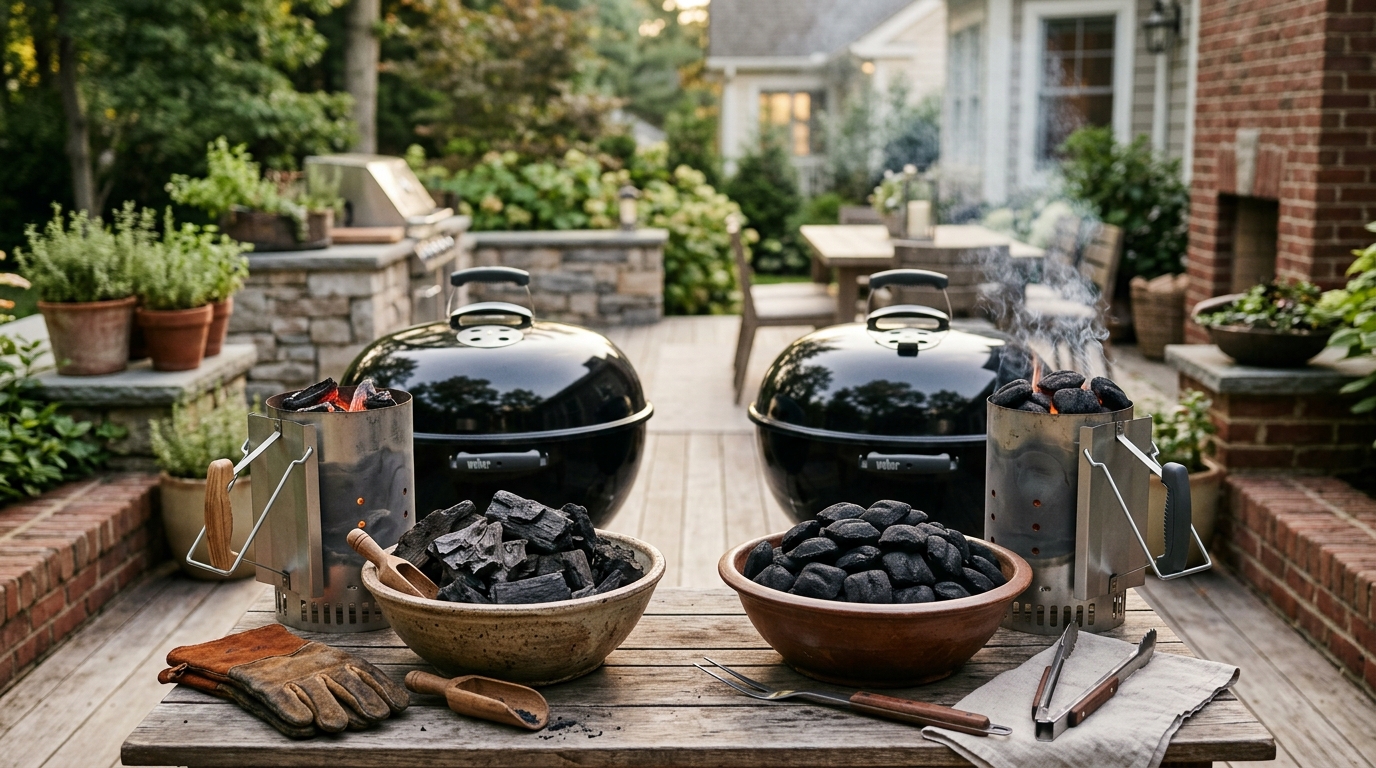
Briquettes vs lump verdict: For high-heat searing and kamado grills, use lump charcoal — it burns 200-300°F hotter and produces less ash. For long low-and-slow smokes lasting 6-12 hours, use briquettes — they burn more consistently and cost 40-60% less per pound. Most serious cooks keep both on hand.
How charcoal briquettes and lump charcoal compare across 7 key dimensions
| Product | Best for | Rating | Notes | |
|---|---|---|---|---|
| Peak temperature | Lump: 700-900F. Briquettes: 500-600F. | — | Lump reaches higher temps faster, critical for steakhouse-quality searing. | — |
| Burn consistency | Briquettes: 9/10. Lump: 6/10. | — | Uniform briquette shape produces steady heat; irregular lump pieces create hot and cool spots. | — |
| Burn duration | Briquettes: 4-8 hours. Lump: 2-4 hours. | — | Briquettes are the practical choice for 10-12 hour smokes without multiple fuel additions. | — |
| Ash production | Lump: minimal. Briquettes: high. | — | Lump leaves 50-70% less ash, reducing vent clogging and cleanup time after long cooks. | — |
| Cost per cook | Briquettes: $1-2. Lump: $2.50-5. | — | Kingsford Blue Bag runs about $0.90 per pound; premium lump runs $1.50-2.50 per pound. | — |
| Additives | Lump: none. Briquettes: binders, sodium nitrate. | — | Briquette binders cause a brief chemical smell at startup before burning off after 15-20 minutes. | — |
| Ignition time | Lump: 10-15 min. Briquettes: 15-20 min. | — | Lump lights faster because irregular shapes allow more airflow between pieces in a chimney. | — |
When to use charcoal briquettes
Briquettes are the right choice when consistency and duration matter more than peak temperature. The uniform shape — cylindrical pillows of compressed charcoal dust and binders — produces predictable, even heat that a bag of irregular lump pieces cannot match.
What briquettes do well
Briquettes excel at:
- Long low-and-slow smokes: A full Slow N Sear basket loaded with briquettes holds 225-250°F for 8-10 hours on a 22-inch kettle without adding more fuel. Lump requires multiple refills over the same cook.
- The Minion Method: Lighting a small amount of coals on top of a large unlit pile works best with briquettes because the uniform shape allows predictable, slow, outward burn progression that keeps temperatures stable for 8-12 hours.
- Predictable fuel planning: One Kingsford 8.6-pound bag handles a 6-hour pork shoulder cook with fuel to spare. Lump consumption varies significantly because pieces are different sizes.
- Budget-friendly everyday cooking: Kingsford Original at around $10 for 8.6 pounds runs roughly $1.50-2 per cook — about half the cost of quality lump charcoal.
The honest limitation of briquettes
Briquettes produce significantly more ash than lump charcoal. On a long smoke, ash falls into the bottom bowl and can clog the bottom vents, choking airflow and dropping cooking temperatures mid-cook. Checking and clearing ash every 3-4 hours on multi-hour cooks is essential when using briquettes.
Briquettes also contain binders — typically starch — and sodium nitrate as a burn accelerant. These burn off in the first 10-15 minutes after lighting and do not affect food flavor, but some cooks object to the brief startup odor and prefer pure wood fuels.
Best for Low-and-slow smoking and everyday backyard grilling
Kingsford Original Charcoal Briquettes
The benchmark briquette. Consistent burn time, reliable ignition from a chimney starter, and wide availability make this the default fuel for competition pitmasters and backyard cooks alike. One 8.6-pound bag handles most single-day smokes.
★★★★★ 4.7
Check current price on Amazon→Pros
- Industry-standard consistency used by competitive pitmasters across every major BBQ circuit
- Burns 4-8 hours per fill on a properly managed kettle or offset smoker
- Available at virtually every grocery store and hardware retailer nationwide
- Affordable at approximately $1-2 per cook for a typical smoke session
Cons
- Produces significantly more ash than lump, requiring vent checks every few hours on long cooks
- Contains sodium nitrate and starch binders that create a brief startup odor before burning off
- Peak temperature tops out around 500-600F, limiting serious high-heat searing performance
Best for Competition BBQ and long smokes requiring premium consistency
Kingsford Competition Charcoal Briquettes
Higher-density briquettes with less filler than Kingsford Original. Burns longer and produces less ash per pound. The step up for cooks who want briquette consistency with performance closer to premium lump.
★★★★★ 4.5
Check current price on Amazon→Pros
- Lower ash output than Kingsford Original due to higher charcoal density per briquette
- Longer individual burn time per briquette compared to the standard blue bag
- Preferred by many competition teams for 10-14 hour overnight brisket cooks
- Lights reliably in a chimney starter in about 15 minutes
Cons
- Costs 20-30% more than Kingsford Original Blue Bag per pound
- Not as widely available as standard Kingsford; often requires online ordering or specialty stores
- Still produces more ash than quality lump charcoal on cooks longer than 4 hours
When to use lump charcoal
Lump charcoal is carbonized whole wood — hardwood logs or chunks burned in a low-oxygen environment until only the carbon skeleton remains. There are no binders, no accelerants, no additives. The result is a fuel that burns hotter, cleaner, and with less ash than briquettes.
What lump charcoal does well
Lump charcoal excels at:
- High-heat searing: A full chimney of quality lump charcoal poured onto a grill grate reaches 700-900°F — the temperature needed for genuine steakhouse-quality crust on thick ribeyes and strips. Most briquettes cannot reach these temperatures.
- Kamado and ceramic grill performance: The Big Green Egg, Kamado Joe, and similar ceramic grills are specifically designed for lump charcoal. The air management systems in kamado grills work better with lump because the irregular pieces allow more airflow per unit of fuel, making temperature control more responsive.
- Fast-ignition grilling: Lump lights 2-3 minutes faster in a chimney starter than briquettes because the irregular shapes create natural airflow channels between pieces. For quick weeknight cooks, lump is ready 10-12 minutes after lighting.
- Clean burn: Because lump is pure carbonized wood with no additives, cooks who prepare delicate proteins — fish, poultry, shellfish — often prefer it to avoid any trace startup odor from briquette binders.
The honest limitation of lump charcoal
Lump charcoal bags are inconsistent. Two bags of the same brand at the same price can contain very different piece sizes — from small chips to large chunks — which changes burn behavior significantly. Larger pieces burn longer and cooler; smaller chips burn hotter and faster. Without sorting, a lump fire can create unpredictable hot and cool zones across the grill surface.
Lump also costs significantly more than briquettes. Royal Oak lump runs approximately $1.50-2 per pound; Kingsford Original runs around $0.90 per pound. For a 12-hour brisket burn, the fuel cost difference is meaningful.
Best for High-heat grilling, searing steaks, and kamado grill fuel
Royal Oak Natural Hardwood Lump Charcoal
The most consistent and widely available lump charcoal on the market. Good piece size distribution, predictable ignition, and a clean burn that does not impart off-flavors. The reliable baseline lump for any charcoal grill or kamado.
★★★★★ 4.6
Check current price on Amazon→Pros
- Consistent piece size distribution relative to competing lump charcoal brands
- Clean burn with no additives or binders — pure carbonized hardwood throughout
- Widely available at major retailers including Walmart, Home Depot, and Ace Hardware
- Lights faster than briquettes in a chimney — about 10-12 minutes to cooking temperature
Cons
- Costs 40-60% more per pound than Kingsford Original briquettes for the same cook weight
- Burns out faster than briquettes, requiring refueling during cooks longer than 3-4 hours
- Bag-to-bag piece size consistency varies more than competing premium lump brands
Best for Kamado grills and cooks requiring premium lump consistency
Big Green Egg Natural Charcoal
Tighter piece size control than most retail lump options. Burns predictably with minimal dust, making it the easiest lump to use in a kamado where controlling airflow is critical. Expensive but the most consistent lump available at retail.
★★★★★ 4.7
Check current price on Amazon→Pros
- Most consistent piece sizing of major retail lump charcoal brands available in the US
- Minimal dust and chip content that would otherwise fall through grill grates and clog ash catchers
- Designed for kamado grill airflow systems and produces predictable temperature control
- Very clean burn with no perceptible off-flavors even on delicate fish and poultry
Cons
- Significantly more expensive than Royal Oak and other retail lump options per pound
- Only sold at specialty BBQ retailers and the Big Green Egg website — not at mass retail chains
- Overkill for kettle grills where piece size consistency matters less than in a kamado
Does charcoal type affect flavor?
The short answer is yes, but not as much as wood type, cook method, or whether you use an actual smoker versus a covered grill. Here is what actually matters:
Briquette startup odor: Briquettes contain sodium nitrate and starch that produce a brief chemical smell when first lit. This burns off completely within 10-15 minutes. Never put food on a grill when briquettes are still showing white chemical smoke — wait until they are fully ashed over and glowing orange before placing food on the grate.
Lump charcoal wood species: Some lump charcoals are made from specific hardwoods — oak, hickory, or mesquite — and can impart a faint smoke character during the cook. This is most noticeable with mesquite lump, which has an assertive flavor profile that works well for beef brisket and skirt steak but can overpower chicken and fish.
Wood chunks for real smoke: For meaningful smoke flavor on any cook, you need hardwood chunks placed directly on the burning charcoal — the charcoal type matters far less than the wood species and amount. Cherry wood chunks add mild fruity smoke; hickory adds the classic BBQ profile; apple wood is subtle and works well for poultry.
The practical takeaway: choose briquettes or lump based on temperature and duration requirements. Then add wood chunks to either fuel type to get the smoke character you want.
Using a chimney starter with both types
A chimney starter is the only proper way to light either charcoal type without lighter fluid. The Weber Rapid-Fire Chimney Starter, available for around $20, lights both briquettes and lump reliably and lasts decades.
Briquettes in a chimney: Fill the chimney completely (about 90 briquettes for a full grill). Use two sheets of crumpled newspaper or a single paraffin lighter cube underneath. Light and wait 15-20 minutes until the top briquettes show gray ash around the edges before pouring.
Lump in a chimney: Fill to about two-thirds capacity — lump is irregular and can spill when overfilled. Light and wait 10-15 minutes. Lump is ready when the top pieces show glowing orange edges and the gray ash color starts to appear. You do not need to wait for full ash coverage as you do with briquettes.
One important difference with lump: Do not pour lump charcoal from a height into a grill. Large pieces falling from 12 inches or more can shatter and create dust and chips that fall through the grate. Lower the chimney as close to the charcoal grate as possible before dumping.
What about instant-light and quick-light charcoals?
Instant-light briquettes — pre-soaked in lighter fluid — are a convenience product that introduces chemical taste into food. The petroleum distillates in lighter fluid never fully burn off and transfer detectable off-flavors, particularly to chicken, fish, and any food cooked over high heat where the residues concentrate.
Avoid instant-light charcoal entirely. Use a chimney starter with either briquettes or lump, and the results will be meaningfully better. The 15-20 minute wait is short, and the chimney itself is a one-time $20 purchase.
FAQ
Frequently asked questions
Is lump charcoal better than briquettes?
Can I mix lump charcoal and briquettes in the same grill?
Why does lump charcoal cost more than briquettes?
Does lump charcoal burn faster than briquettes?
What charcoal do competition BBQ teams use?
Is lump charcoal safer than briquettes?
Bottom line
Use briquettes — specifically Kingsford Original — for long smokes where consistent burn temperature over many hours is the priority. Use lump — specifically Royal Oak — for high-heat grilling, steaks, and kamado grill fuel where peak temperature and clean burn matter more than duration.
For cooks who do both regularly, buying one bag of each and using them appropriately is the right approach. The cost difference per cook is $1-3, and the performance advantage in the right application is significant. Serious BBQ comes from matching fuel to cook method, not from picking one charcoal type and using it for everything.
Browse related guides: how to use a smoker, brisket smoking guide, best wood chunks for smoking, and gas vs charcoal grill.