comparisons
Gas vs Charcoal Grill: Which Should You Buy?
Choosing between gas and charcoal? Compare flavor, convenience, cost, and maintenance to find the right grill for your backyard.
 Cole Whitaker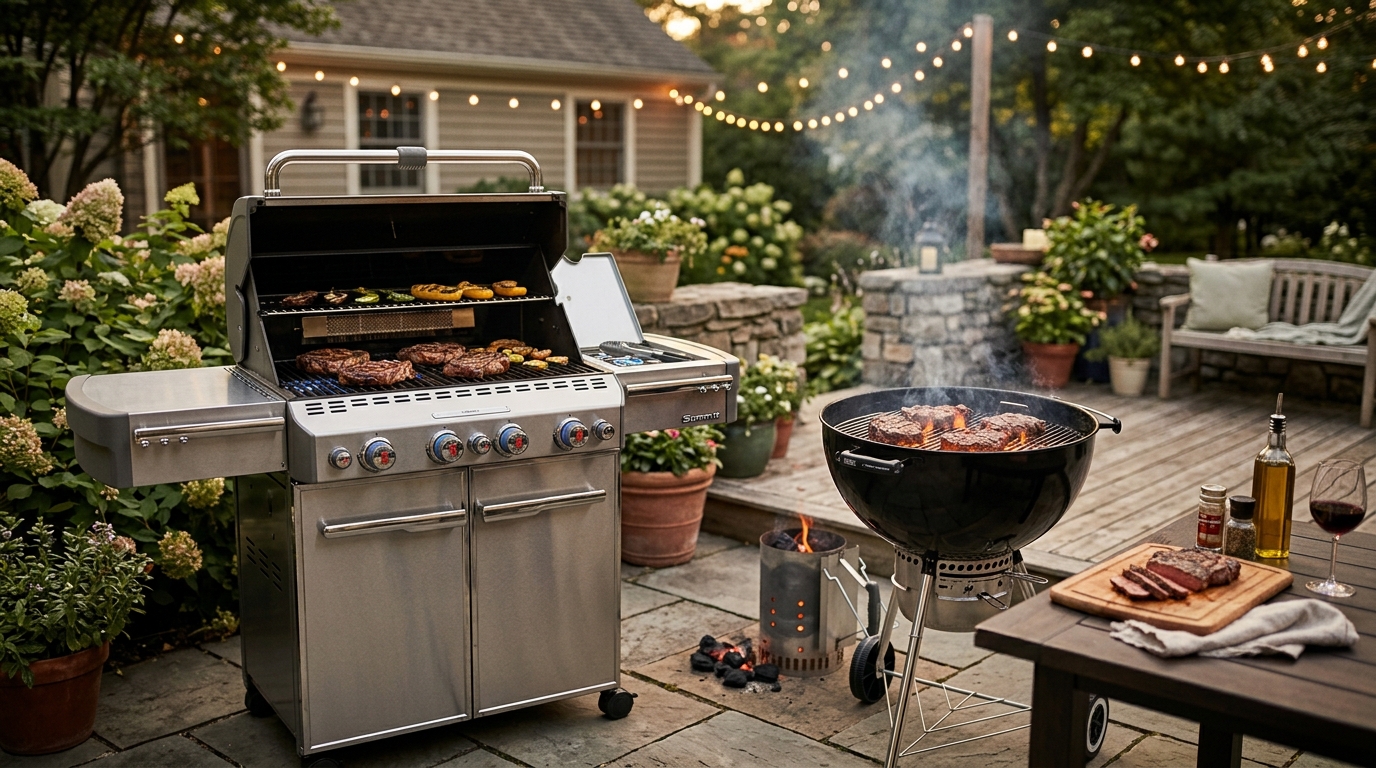
Gas vs charcoal verdict: For weeknight convenience and quick startup, choose gas — the Weber Spirit II E-310 is the benchmark. For deeper smoke flavor and superior peak heat, choose charcoal — the Weber Original Kettle 22-inch costs under $200 and outperforms most grills at twice the price. Most dedicated backyard cooks own both.
How gas and charcoal compare across 8 key dimensions
| Product | Best for | Rating | Notes | |
|---|---|---|---|---|
| Preheat time | Gas: 5-10 min. Charcoal: 15-20 min with chimney. | — | Using lighter fluid cuts charcoal time but leaves off-flavors in food. | — |
| Smoke and flavor depth | Charcoal: 9/10. Gas: 2/10. | — | Charcoal combustion creates smoke compounds; gas burners produce hot air. | — |
| Peak cooking temperature | Charcoal: 700°F+. Gas: 500-600°F. | — | Charcoal is better for steakhouse-quality crust on thick cuts. | — |
| Temperature control | Gas: 9/10. Charcoal: 6/10. | — | Gas knobs give instant, precise adjustment; charcoal uses vent dampers. | — |
| Equipment entry cost | Charcoal from $150 (Weber Kettle). Gas from $400 (Spirit II). | — | A mid-range charcoal setup beats any discount gas grill under $250. | — |
| Fuel cost per cook | Gas: $0.50-1.50. Charcoal: $1-3. | — | Propane is cheaper per cook; charcoal gap closes on short cooks. | — |
| Cleanup difficulty | Gas: easy (no ash). Charcoal: moderate (ash disposal needed). | — | Charcoal produces 1-2 cups of ash per cook requiring cool-down before disposal. | — |
| Portability | Charcoal: 8/10. Gas: 5/10. | — | Kettle grills are lightweight and travel easily; gas requires a heavy tank. | — |
When to choose a gas grill
Gas grills make sense when speed and convenience matter more than smoke flavor. If you grill 4-5 times per week, the 15-20 minute charcoal setup adds up — gas lets you cook on a Tuesday evening without any planning.
What gas does well
Gas grills excel at:
- Speed: Turn the knob, hit the igniter, and you are grilling in under 10 minutes
- Temperature control: Adjust heat precisely across multiple zones with a turn of a knob — useful for cooking chicken and vegetables simultaneously at different temperatures
- Cleanup: No ash means cleanup is just brushing the grates after each cook
- Weather resilience: Propane burners do not get extinguished by wind the way charcoal does
- Multi-zone cooking: Three-burner gas grills maintain a hot direct zone and a low indirect hold zone at the same time without manual adjustment
The honest limitation of gas
Gas grills do not produce real smoke. Wood chip pouches placed on a gas burner produce a thin surface smoke film — it adds marginal flavor but cannot replicate the deep smoke ring and charcoal bark that make BBQ barbecue. If smoked ribs and brisket are your primary cooks, gas is the wrong tool for the job.
Best for Weeknight grilling and year-round convenience
Weber Spirit II E-310 Gas Grill
The three-burner standard for quality gas grills. Comes with a 10-year warranty, reliable ignition that works in cold weather, and even heat distribution across the grates. Built to last in a way that $250 discount grills are not.
★★★★★ 4.7
Check current price on Amazon→Pros
- 10-year warranty on most components
- Electronic ignition that reliably fires in cold and wet conditions
- Even heat distribution across all three burners
- Compact footprint relative to its cooking area
Cons
- No real smoke flavor without supplemental wood chips
- Propane tank sold separately
- Higher entry price than a comparable charcoal kettle
Best for Families who grill five or more times per week
Weber Genesis II E-335 Gas Grill
Adds a dedicated sear station burner that hits proper searing temperatures — the main performance gap between Spirit and Genesis. Worth the premium if steak is a regular weekend cook.
★★★★★ 4.6
Check current price on Amazon→Pros
- Dedicated sear station for proper steak crust without charcoal
- Side burner for sauces and sides while the grill runs
- Large cooking area handles big family cooks
- Compatible with iGrill wireless temperature monitoring
Cons
- Significantly more expensive than the Spirit II
- Larger footprint requires more patio or deck space
- Overkill for cooks who grill fewer than twice a week
When to choose a charcoal grill
Charcoal is for cooks who prioritize flavor and are willing to invest 15-20 minutes in fire prep before every cook. The combustion of charcoal and dripping fat produces hundreds of flavor compounds — pyrazines, furans, phenols — that transfer into the food. This is the mechanism behind the BBQ smell and flavor that gas cannot replicate.
What charcoal does well
Charcoal excels at:
- Smoke and char flavor: Real combustion produces real smoke that penetrates the food throughout the cook, not just the surface
- Peak searing heat: A full charcoal chimney reaches 700°F+, creating a steakhouse-quality crust on a $150 kettle that most gas grills cannot match
- Versatility: A single kettle grill can grill, smoke low-and-slow, and even bake with the right charcoal arrangements and accessories
- Equipment longevity: A Weber Kettle with basic care lasts 20+ years — longer than any gas grill
- Lower equipment cost: The best-in-class charcoal setup (Weber Kettle plus a Slow N Sear insert) costs under $250 total
The honest friction of charcoal
You must plan ahead. Charcoal needs 15-20 minutes from chimney-lit to cooking temperature. You manage airflow through dampers during the cook rather than turning a knob. You dispose of ash after every session once it has fully cooled. For cooks who grill spontaneously on weeknights after long workdays, this friction is real and cumulative.
Best for First charcoal grill and lifetime standard for serious cooks
Weber Original Kettle 22-Inch Charcoal Grill
The benchmark charcoal grill. A two-zone charcoal arrangement handles everything from 2-minute burger flips to 6-hour rib smokes. The one-touch ash removal system reduces the worst part of charcoal cleanup. Built to last decades, not seasons.
★★★★★ 4.8
Check current price on Amazon→Pros
- Industry-leading build quality at an accessible entry price
- Real smoke and char flavor from genuine charcoal combustion
- One-touch ash removal system reduces post-cook cleanup friction
- Handles both direct grilling and indirect low-and-slow smoking with a two-zone setup
Cons
- 15-20 minute preheat required every session before cooking
- No precise temperature control — adjustments made with vent dampers
- Ash disposal required after every cook once the grill fully cools
Best for Upgrading the kettle experience for frequent cooks
Weber Master-Touch 22-Inch Charcoal Grill
Same 22-inch porcelain bowl as the Original Kettle, but adds the Gourmet BBQ System grate with a center insert ring for cast-iron and wok accessories, a tuck-away lid holder, and a higher-capacity ash catcher. A meaningful upgrade for cooks who use the grill three or more times per week.
★★★★★ 4.7
Check current price on Amazon→Pros
- GBS grate accepts cast-iron inserts, pizza stones, and wok accessories
- Improved ash catcher holds more ash between emptying sessions
- Tuck-away lid holder keeps the lid clean and off the ground
- Same durable porcelain-enameled bowl as the Original Kettle
Cons
- $50-80 premium over the Original Kettle for incremental improvements
- GBS accessory inserts sold separately at additional cost
- Charcoal prep time is identical to the base kettle
The case for owning both
Most committed outdoor cooks eventually own both a charcoal kettle and a gas grill. The combined investment for quality versions of both runs $600-700, and the result covers every scenario without compromise:
- Weeknight after work: Gas grill, 8-minute preheat, burgers and zucchini done in 20 minutes from cold grill to plate
- Saturday afternoon: Charcoal kettle with a two-zone setup, baby back ribs at 275°F for 5 hours while you watch the game
- Sunday morning: Charcoal for smoked chicken thighs; gas side burner for a finishing sauce
- Rainy Tuesday: Gas, because you are not managing charcoal fire in a downpour
If budget limits you to one grill, the decision is straightforward: choose based on your actual cooking pattern. If most of your cooks are spontaneous weeknight meals where speed matters, buy gas. If most of your cooks are planned weekend events where you want real smoke flavor and do not mind prep time, buy charcoal.
Choosing the right charcoal for your kettle
If you go the charcoal route, charcoal type matters:
Lump charcoal burns hotter and cleaner with less ash. It is preferred for high-heat searing, kamado grills, and cooks where you want maximum temperature. Kingsford Competition Charcoal and Big Green Egg Natural Charcoal are reliable options at around $20-25 for 8-10 pounds.
Charcoal briquettes burn more consistently at lower, more stable temperatures. They are ideal for long low-and-slow cooks — a 12-hour brisket or 6-hour pork shoulder — where steady heat rate matters more than peak temperature. Kingsford Original Blue Bag is the default for a reason: consistent, reliable, widely available.
Most experienced cooks use both: lump for steaks and high-heat grilling, briquettes for overnight smokes.
What about combination gas-and-charcoal grills?
Combo units exist — the Char-Griller Duo is the most common — and they compromise both disciplines. The charcoal side is smaller than a dedicated kettle; the gas side is smaller than a proper three-burner. Build quality on combo grills is almost always lower than on dedicated units at the same price.
If patio space is severely limited and you truly cannot fit two grills, a combo unit is a reasonable second choice. In any other scenario, two dedicated grills (Weber Kettle + Weber Spirit II) outperform any combo at similar or lower total cost.
FAQ
Frequently asked questions
Is charcoal really better than gas for flavor?
Which is cheaper to own and operate over 5 years?
Can a gas grill smoke meat?
What is the best first grill for a beginner?
How do I light charcoal without lighter fluid?
How long does a propane tank last?
Bottom line
Gas grills win on convenience, cleanup, speed, and temperature precision. Charcoal wins on flavor, peak searing heat, equipment longevity, and value at the entry level. For weeknight-focused households, the Weber Spirit II E-310 is the answer. For flavor-focused weekend cooks, the Weber Original Kettle 22-inch at under $200 is one of the best-value purchases in outdoor cooking.
If your budget allows two grills, own both — no single cooker covers every scenario as well as a kettle-plus-gas-grill combination.
Browse specific picks: best charcoal grills, best gas grills, charcoal vs pellet vs gas, and best smokers.