roundups
Best Offset Smokers 2026
Top offset smokers ranked by firebox design, heat retention, and build quality — from budget barrel pits to pro-grade American-made smokers.
 Cole Whitaker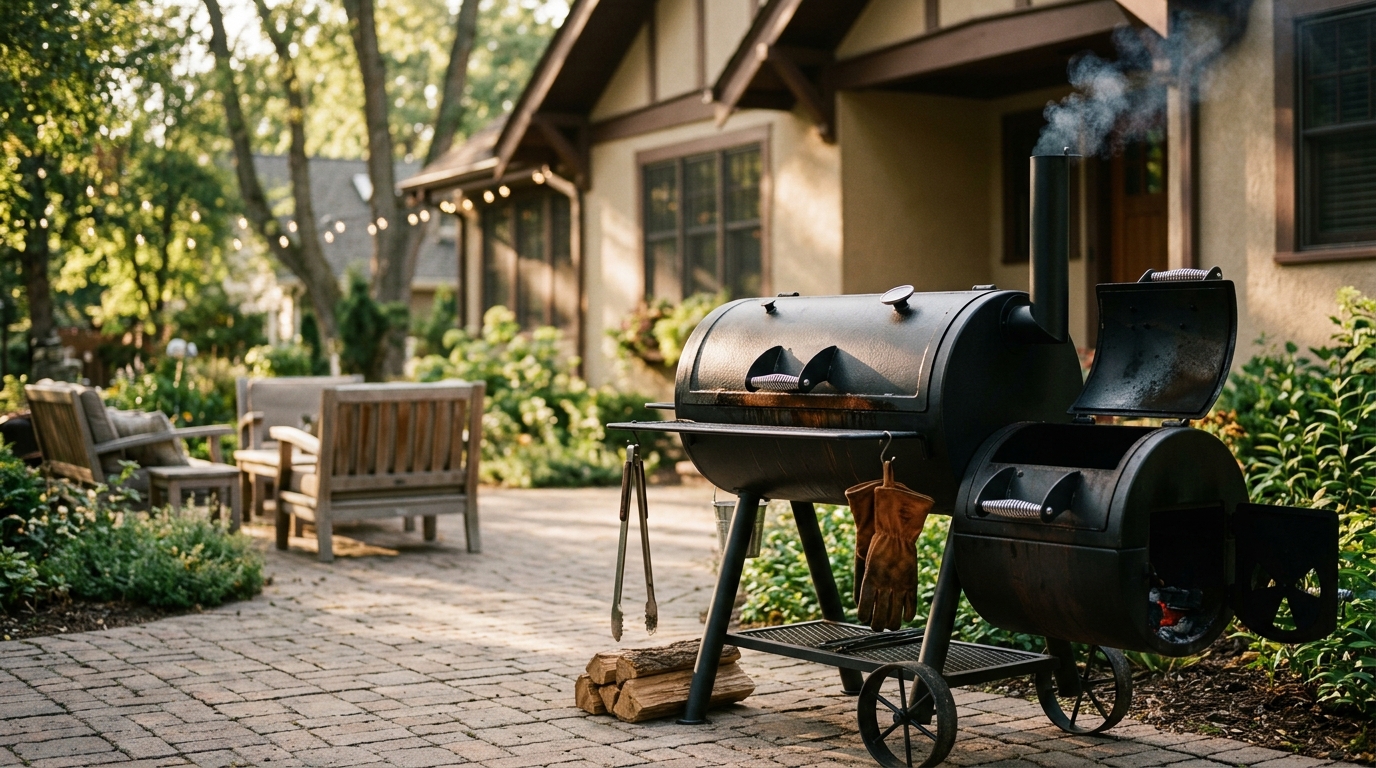
The best offset smoker for most backyard pitmasters is the Oklahoma Joe’s Highland — a 900 sq in charcoal offset with a solid 1/8-inch steel build, a well-sized side firebox, and a price around $350 that makes it the most popular entry-level offset on the market. For more even heat distribution without custom mods, the Oklahoma Joe’s Longhorn Reverse Flow adds four baffle plates that route smoke under the grates from firebox to chimney, eliminating the hot-side temperature drop that plagues standard offset designs.
Offset smokers use a separate firebox mounted to the side of the main cooking chamber to generate smoke and indirect heat. That physical separation is what creates authentic low-and-slow BBQ: you manage the fire without disturbing the cook chamber, smoke travels across the grates at steady 225–275°F temperatures, and proteins absorb the wood smoke compounds that pellet grills and gas units cannot fully replicate. The tradeoff is active fire management — a 14-hour brisket cook means adding wood splits every 45 to 60 minutes — but that engagement is exactly what makes offset smoking a distinct skill with a devoted following. The five picks below cover every use case from a beginner’s first barrel smoker to a competition-grade pit.
Quick comparison
| Product | Best for | Rating | Notes | |
|---|---|---|---|---|
| Oklahoma Joe's Highland | best overall — 900 sq in main chamber, solid build, top entry-level offset | ★★★★★ | Around $350. 900 sq in main chamber plus 309 sq in firebox. 1/8-in steel. Most popular offset at this price. | Check price |
| Char-Griller 1224 Smokin Pro | best budget — under $250, entry-level offset for first-time buyers | ★★★★☆ | Under $250. 830 sq in total cooking space. Side firebox included. Good starting point before upgrading. | Check price |
| Oklahoma Joe's Longhorn Reverse Flow | best reverse flow — even heat from firebox to chimney end | ★★★★★ | Around $500. Four reversible baffle plates. 1060 sq in total cooking area. Converts to standard offset. | Check price |
| Dyna-Glo DGSS1382VCS-D | best large capacity — 1382 sq in for big cooks and backyard events | ★★★★★ | Under $400. 1382 sq in total across six grates. Vertical barrel design with side offset firebox. | Check price |
| Yoder Smokers Loaded Wichita | best premium — 1/4-in American-made steel for competition and serious cooks | ★★★★★ | Around $1,700. 1/4-in steel. Made in USA. Exceptional heat retention and fit-and-finish for serious pitmasters. | Check price |
The picks
Best overall: Oklahoma Joe’s Highland
Best for backyard pitmasters buying their first dedicated offset who want a proven design with a large community and plenty of modification guides
Oklahoma Joe's Highland Charcoal Smoker
The Oklahoma Joe's Highland has been the benchmark entry-level offset smoker for more than a decade, and its dominance at the $350 price point remains unchallenged in 2026. The 900 sq in main cooking chamber fits two full packer briskets side by side, and the 309 sq in firebox is large enough to sustain a proper wood-and-charcoal fire for a full low-and-slow session without forcing constant micro-adjustments. The 1/8-inch steel construction is the thickest available at this price — competing budget offsets use thinner-gauge steel that dents more easily and loses heat faster between fuel additions. The standard offset design routes heat and smoke in a single direction from firebox to chimney, creating a natural temperature gradient across the barrel: the firebox end runs hotter, the chimney end runs cooler. This gradient is manageable with grate rotation and fuel placement, and the Oklahoma Joe's community has produced hundreds of guides on handling it. The most popular Highland modification — adding a deflector plate to direct heat downward in the main chamber — costs under $20 in materials and dramatically improves temperature evenness. The Highland ships with an adjustable flue baffle, cool-touch door handles, a built-in thermometer, and two cooking grates. At 180 pounds it is heavy enough to feel permanent while still movable with a helper. For a first offset smoker that will last a decade with basic care, the Oklahoma Joe's Highland is the most reliable purchase at this price.
★★★★★ 4.7 · 18,400 reviews
Check current price on Amazon→Pros
- 900 sq in main chamber fits two full packer briskets side by side — more space than any competing offset at this price
- 1/8-in steel is the thickest gauge available under $400 — better heat retention than budget offsets using thinner material
- Massive community support with established mod guides — deflector plates, gasket seals, and damper upgrades are well documented
- Adjustable chimney baffle and multiple dampers give precise smoke and heat control once you dial in the pit
- Proven 10-plus year track record at this price point — one of the most tested entry offsets available
Cons
- Standard offset design creates a natural hot-to-cold gradient from firebox to chimney — requires grate rotation for even cooking without mods
- 1/8-in steel is adequate but not as heat-retentive as the 1/4-in steel found on premium offsets like the Yoder — more fuel required in cold weather
- Ships in a large box requiring assembly of 20 to 30 parts — expect 2 to 3 hours to assemble and seal all joints
- Factory door and firebox seals often gap, allowing smoke to escape — adding high-temp gasket tape is a recommended first modification
Best budget: Char-Griller 1224 Smokin’ Pro
Best for buyers who want an entry-level offset smoker under $250 to learn fire management and low-and-slow technique before investing in a mid-range pit
Char-Griller 1224 Smokin' Pro Offset Smoker
The Char-Griller 1224 Smokin' Pro is the most practical offset smoker under $250 for a buyer who wants to test the format before committing to a larger investment. The 580 sq in main cooking surface fits a brisket flat, a pork shoulder, and a rack of ribs simultaneously — not abundant by offset standards, but sufficient for a household of four to six on a weekend cook. The side firebox attaches cleanly and draws reasonably well out of the box, which is the single most important functional variable on a budget offset: a firebox that does not draw heat efficiently forces constant fiddling and makes fire management frustrating enough to abandon the format entirely. The 830 sq in total cooking area (580 main plus 250 firebox) and the included side firebox make this a complete smoking setup without additional purchases. The steel gauge is thinner than the Oklahoma Joe's Highland, which means more fuel consumption in cold weather and faster cooling between fuel additions, but for a three-season backyard smoker used primarily spring through fall this is a manageable limitation. The Smokin' Pro also functions as a charcoal grill by cooking over direct coals in the main chamber — a dual-use capability that justifies the purchase for buyers who want a grill and a smoker without buying two separate units. For a first offset purchase where the goal is learning the fundamentals of fire management and low-and-slow technique, the Char-Griller 1224 is the most cost-effective entry point available.
★★★★☆ 4.4 · 11,200 reviews
Check current price on Amazon→Pros
- Under $250 — the most accessible offset smoker price point for first-time buyers testing the format
- 830 sq in total cooking area (580 main plus 250 firebox) — fits a brisket flat, pork shoulder, and ribs in one session
- Functions as both an offset smoker and a direct-heat charcoal grill — two tools at one price
- Side firebox draws reasonably well out of the box without significant adjustment needed
- Low purchase risk for first-time offset buyers who want to learn before investing further
Cons
- Thinner steel than the Oklahoma Joe's Highland — more fuel required in cold weather and between fuel additions
- 580 sq in main chamber is smaller than the Highland — cannot fit two full packer briskets simultaneously
- Thinner construction is less durable over multiple seasons than mid-range offsets — expect a shorter total lifespan
- Factory seals and gaskets require improvement — smoke loss from door gaps is more pronounced than on the Highland
Best reverse flow: Oklahoma Joe’s Longhorn Reverse Flow
Best for experienced cooks upgrading from a standard offset who want more even heat distribution across the barrel without building custom baffle mods
Oklahoma Joe's Longhorn Reverse Flow Smoker
The Oklahoma Joe's Longhorn Reverse Flow addresses the primary complaint about standard offset smokers — the firebox-end-hot, chimney-end-cold temperature gradient — by routing heat and smoke under the main cooking grate via four baffle plates before circulating back across the top and exiting the chimney at the same end as the firebox. This reverse-flow path requires heat to travel the full length of the barrel twice before exiting, producing significantly more even temperatures from one end of the cooking surface to the other compared to a standard offset. In practice, a correctly maintained Longhorn Reverse Flow holds temperatures within 15 to 20 degrees Fahrenheit across the entire 1060 sq in cooking surface, compared to the 50 to 75 degree gradients common on the Highland without modification. The baffle system is reversible: four plates can be adjusted to switch between reverse-flow and standard-offset operation, giving you the option to create intentional temperature zones when cooking multiple proteins at different target temperatures simultaneously. The 1060 sq in total cooking area across the main chamber and top shelf accommodates a full packer brisket, a pork shoulder, and two racks of ribs in a single session. The firebox dimensions are large enough for full-size hardwood splits, which produce the cleanest smoke for long cooks. At around $500, the Longhorn Reverse Flow costs roughly $150 more than the Highland and delivers meaningfully better heat evenness in return — a worthwhile upgrade for a cook who has mastered fire management and wants to eliminate the constant grate rotation required on standard offsets.
★★★★★ 4.6 · 9,700 reviews
Check current price on Amazon→Pros
- Reverse-flow baffle system holds temperatures within 15 to 20 degrees across the entire cooking surface — far more even than standard offsets
- 1060 sq in total cooking area across main chamber and top shelf — more capacity than the Highland
- Baffle system is reversible — switch between reverse-flow and standard offset operation by adjusting four plates
- Large firebox accepts hardwood splits for cleaner, longer-burning fuel than small-chunk or charcoal-only setups
- At around $500, a meaningful performance upgrade over the Highland for $150 more
Cons
- Reverse-flow design makes the area near the chimney (at the firebox end) slightly hotter than true mid-barrel — not a perfect temperature equalizer
- Heavier than the Highland at around 220 pounds — requires two people to move and position
- Same 1/8-in steel construction as the Highland — premium heat retention requires upgrading to a 1/4-in option like the Yoder
- Assembly is more complex than the Highland — more components and tighter fits require patience and extra sealing
Best for large cooks: Dyna-Glo Signature Series DGSS1382VCS-D
Best for backyard hosts who cook for large groups and need the most total cooking area available under $400 in a single offset smoker
Dyna-Glo Signature Series DGSS1382VCS-D Heavy-Duty Barrel Smoker
The Dyna-Glo Signature Series DGSS1382VCS-D is the capacity leader in the under-$400 offset smoker category, with 1,382 sq in of total cooking space distributed across six chrome-plated steel grates inside the vertical barrel and the offset firebox. Where horizontal barrel offsets like the Oklahoma Joe's Highland prioritize length for full packer briskets end-to-end, the Dyna-Glo's vertical barrel design stacks grates vertically, making it particularly efficient for cooking large quantities of ribs, chicken thighs, pork butts, and sausage simultaneously. Six grates in the vertical chamber means you can smoke 100 chicken thighs, 20 racks of ribs, or a dozen pork shoulders in one session — a capacity no horizontal offset under $400 comes close to matching. The side offset firebox generates heat and smoke that enter at the bottom of the vertical chamber, rise through the stacked grates, and exit through a top vent — creating a natural upward smoke draft and reasonable heat distribution across the multiple grate levels. Temperature variation between the lowest and highest grates is the primary functional tradeoff of the vertical stacking design: the bottom grate runs hotter than the top grate by 25 to 40 degrees, requiring rotation of food across grate levels during a long cook. Adjustable air dampers and a stainless steel temperature gauge allow reasonable temperature control. At under $400, the DGSS1382VCS-D is the most compelling choice for a buyer whose primary use case is cooking for large backyard events where total food volume matters most.
★★★★★ 4.5 · 7,300 reviews
Check current price on Amazon→Pros
- 1382 sq in total cooking area across six grates — best capacity under $400 for large-group cooks
- Vertical barrel design stacks multiple grates efficiently — ideal for ribs, chicken, and sausage volume production
- Side offset firebox keeps the fire separate from the cook chamber for true indirect low-and-slow smoking
- Under $400 for a smoking capacity that would require a much larger investment in a horizontal offset
- Six individually adjustable chrome grates allow flexible food placement across the vertical chamber
Cons
- 25 to 40 degree temperature variation between lowest and highest grates — requires food rotation during long cooks
- Vertical design cannot accommodate a full packer brisket the way a horizontal barrel offset can
- Thinner steel gauge than the Oklahoma Joe's Highland — reduced heat retention in cold weather
- Chrome-plated grates require careful seasoning and maintenance to prevent rust in outdoor storage between sessions
Best premium: Yoder Smokers Loaded Wichita
Best for serious pitmasters who cook competitively or multiple times per week and want an American-made 1/4-inch steel offset that will outlast every other smoker in this roundup
Yoder Smokers Loaded Wichita Offset Smoker
The Yoder Smokers Loaded Wichita is in a different category from every other offset in this roundup. Where the Oklahoma Joe's and Char-Griller units use 1/8-inch steel that is adequate for recreational use, the Wichita uses 1/4-inch steel plate — walls twice as thick — that radically changes the thermal properties of the cook chamber. At 1/4-inch thickness, the steel stores enough thermal mass that the chamber temperature barely responds to a cold wind, opening the cook chamber lid, or adding fuel. On a 1/8-inch offset in winter, each of those events drops cook chamber temperature by 15 to 25 degrees and requires 10 to 20 minutes to recover. The Wichita recovers in 3 to 5 minutes under the same conditions. That stability translates directly to more consistent bark development, more predictable cook times, and less active management per session — the quality-of-life improvement that experienced pitmasters value most. The Wichita is manufactured in Yoder, Kansas by craftsmen who have been building competition-grade pits for decades. Every weld is external, every seam is tight, and the door fits are precise enough that the factory gaskets seal properly without modification. The cooking surface totals over 800 sq in in the main chamber with an optional upper shelf adding another 200 sq in. At around $1,700, the Loaded Wichita is not an impulse purchase. It is the last offset smoker most pitmasters will ever buy — a tool that improves with seasoning over decades rather than degrading year over year the way budget steel does.
★★★★★ 4.9 · 3,400 reviews
Check current price on Amazon→Pros
- 1/4-in American steel — twice the wall thickness of budget offsets for dramatically better heat retention and temperature stability
- Factory door seals are precise enough to work without modification — saves the gasket upgrade step required on budget offsets
- Made in Yoder, Kansas by craftsmen with decades of competition-pit experience
- Temperature recovery after opening the lid is 3 to 5 minutes vs. 10 to 20 minutes on a 1/8-in offset
- Built to last decades — a properly maintained Wichita outlasts multiple replacement cycles of budget offsets
Cons
- Around $1,700 — the most expensive offset in this roundup by a wide margin
- At 315 pounds with the firebox, the Wichita requires a permanent storage location and cannot be easily moved once set up
- The quality justifies the price only for serious cooks — an occasional-use buyer will not capture enough of its advantage to recover the cost
- Availability may require ordering direct from Yoder or a specialty BBQ retailer — less accessible than Amazon-stocked options
What to skip
Thin-walled offset smokers under $150. The offset smoker category has a realistic price floor below which quality becomes unreliable. Units priced under $150 typically use steel thinner than 1/8-inch — sometimes 18 or 20-gauge sheet metal — that warps under heat cycling after a season or two of regular use. Warped steel creates gaps in door seams and firebox joints that bleed smoke and make temperature control impossible. Avoid any offset smoker that does not specify its steel gauge, and be skeptical of any unit under $150 claiming professional-grade performance. The Char-Griller 1224 at the bottom of this roundup represents the realistic functional entry point.
Offset smokers with undersized fireboxes. A firebox that is too small forces you to use small pieces of wood that burn fast and require additions every 20 to 30 minutes — defeating the low-maintenance appeal of offset smoking. Look for a firebox that can accept 4 to 5 pieces of hardwood split simultaneously, with room for an active coal base beneath. The Oklahoma Joe’s Highland firebox is the minimum acceptable size at this price; budget units with shallower, narrower fireboxes produce frustration within the first cook.
Vertical cabinet smokers marketed as offset smokers. Vertical cabinet smokers where the firebox is directly below the cook chamber are a distinct product from true offset smokers. True offsets position the firebox to the side so that heat and smoke do not rise directly through food during the cook. Vertical smokers with a bottom firebox or a propane burner beneath the cook chamber are not offset smokers regardless of how they are marketed. The Dyna-Glo DGSS1382VCS-D in this roundup is the correct product category — vertical barrel with a true side offset firebox; avoid products that only have a bottom firebox.
FAQ
Frequently asked questions
What is the difference between an offset smoker and a pellet grill?
How long does an offset smoker take to reach cooking temperature?
What wood should I use in an offset smoker?
Is a reverse flow offset smoker better than a standard offset?
How do I prevent rust on my offset smoker?
How much cooking area do I need in an offset smoker?
Bottom line
Best overall: Oklahoma Joe’s Highland for the best balance of cooking area, build quality, and price in the under-$400 category — the most proven entry-level offset with a decade of community support behind it. Best budget: Char-Griller 1224 Smokin’ Pro for buyers who want a functional offset under $250 to learn fire management before investing further. Best reverse flow: Oklahoma Joe’s Longhorn Reverse Flow for more even heat distribution across the full cook surface without DIY modifications. Best large capacity: Dyna-Glo DGSS1382VCS-D for the most total cooking area under $400 for large-group sessions. Best premium: Yoder Smokers Loaded Wichita for serious pitmasters who cook weekly and want 1/4-inch American steel that lasts decades.
For most backyard cooks buying a first offset, the Oklahoma Joe’s Highland is the starting point — large enough to be useful, durable enough to last years, and backed by enough community knowledge to answer any question that comes up during a brisket cook. Experienced pitmasters ready to stop modding a budget pit should go straight to the Yoder Wichita.
Complete your offset setup: how to use a smoker, offset vs pellet smoker, brisket smoking guide, best instant-read thermometers.