comparisons
Offset vs Pellet Smoker: Which Is Right for You?
Offset smokers deliver deeper smoke flavor and bark; pellet smokers offer hands-off convenience and digital temperature control. Find your match here.
 Cole Whitaker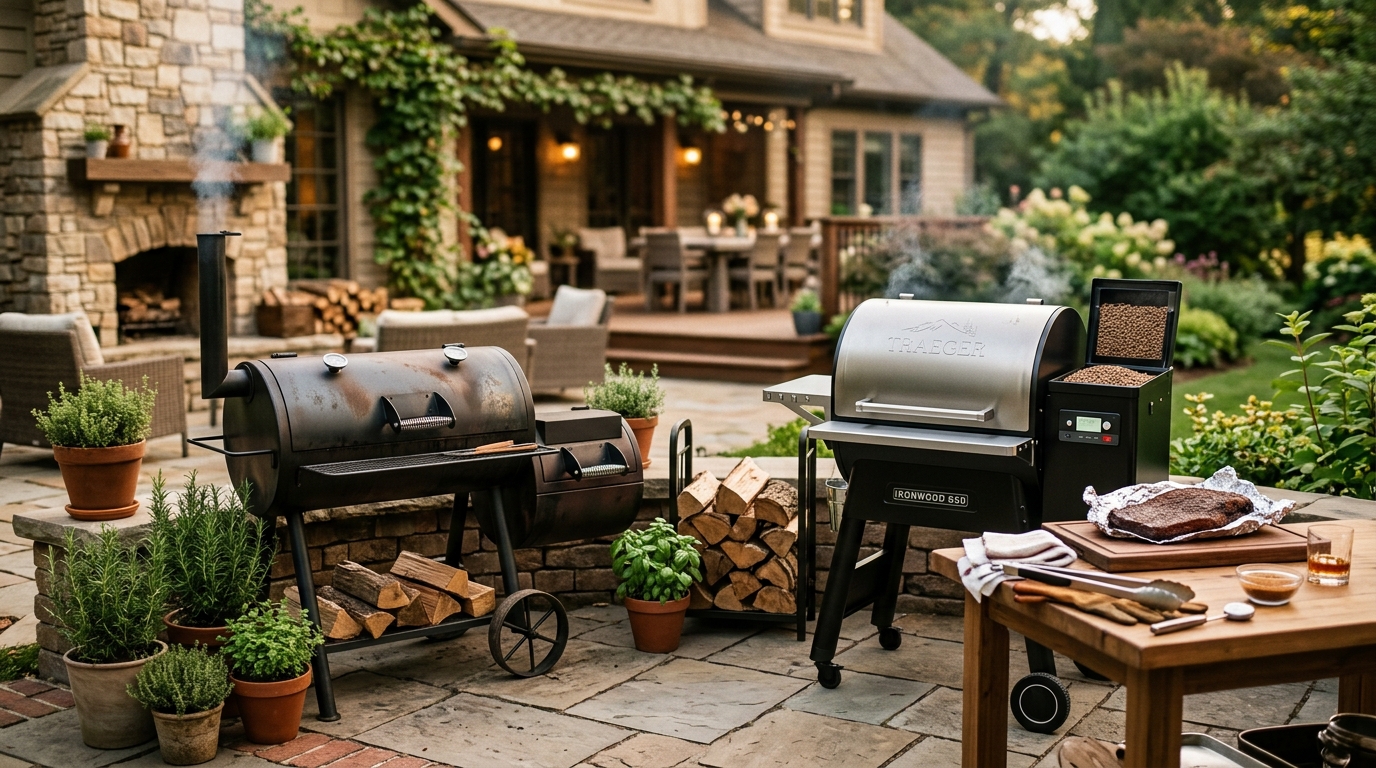
Offset vs pellet smoker verdict: For competition-grade smoke rings, deep bark, and maximum smoke flavor, the Oklahoma Joe Highland offset smoker is the benchmark at $350-450. For consistent hands-off results from session one, the Traeger Ironwood 885 or Recteq RT-700 deliver excellent BBQ with no fire management experience required. Most dedicated pitmasters eventually own one of each.
How offset and pellet smokers compare across 10 dimensions
| Product | Best for | Rating | Notes | |
|---|---|---|---|---|
| Smoke flavor depth | Offset: 9/10. Pellet: 6/10. | — | Real log combustion at low oxygen produces higher concentrations of smoke aromatic compounds than a pellet auger feed. | — |
| Ease of use | Pellet: 9/10. Offset: 4/10. | — | Pellet smokers are digital set-and-forget; offset smokers require active fire management throughout the cook. | — |
| Fire startup time | Pellet: 10-15 min. Offset: 45-60 min. | — | An offset smoker needs a full log fire established and producing clean smoke before any food goes on. | — |
| Active management during cook | Pellet: minimal. Offset: every 45-90 min. | — | Offset smokers need new log additions and damper adjustments throughout a long brisket or pork shoulder cook. | — |
| Temperature precision | Pellet: plus/minus 5-10F (PID). Offset: plus/minus 15-25F (dampers). | — | Pellet grills hold within a tight range via electronic controller; offset temperature varies with each log addition. | — |
| Entry cost | Offset: $350-500. Pellet: $500+. | — | Solid offset smokers exist under $500; quality pellet smokers with reliable PID control start higher. | — |
| Electricity required | Offset: none. Pellet: 110V outlet required. | — | Pellet smokers need power for the auger motor, igniter, PID controller, and combustion fan. | — |
| Smoke ring depth | Offset: 8-12mm. Pellet: 3-5mm. | — | Smoke ring depth is a direct result of smoke compound concentration during the first two hours of the cook. | — |
| Fuel flexibility | Offset: any hardwood log or chunk. Pellet: pellet form only. | — | Offset smokers accept post oak, hickory, pecan, cherry, or any hardwood. Pellet smokers require the pellet form factor. | — |
| Portability | Offset: good (no power needed). Pellet: limited (needs outlet). | — | Offset smokers work at campsites, remote properties, and tailgates without any electrical access. | — |
When is an offset smoker the right choice?
An offset smoker is the tool that competition pitmasters, barbecue restaurants, and flavor-first home cooks choose when smoke quality is non-negotiable. The design is straightforward: a separate firebox attached to the side of the main cooking chamber burns wood logs at incomplete combustion, generating dense aromatic smoke that flows across the meat before exiting through a chimney vent. The cooking chamber holds 225-275°F for the duration of a long smoke — 8-16 hours for a full packer brisket, 5-7 hours for pork ribs, 3-4 hours for chicken.
What offset smokers do particularly well
- Deep smoke ring and bark formation: Real log combustion generates guaiacol, syringol, and related aromatic compounds at high concentration. These penetrate the meat surface and react with proteins to create an 8-12mm pink smoke ring — the visual benchmark of authentic low-and-slow BBQ. Pellet smoke rings run 3-5mm by comparison.
- Full fuel flexibility: Load any hardwood you want — post oak for Texas-style brisket, hickory for aggressive pork smoke, apple for a milder sweet smoke on chicken. You are not limited to a product catalog of pre-made pellets in fixed bag sizes.
- No electricity required: An offset smoker works at a remote cabin, a tailgate, a campsite, or anywhere you can build a fire. No extension cord, no inverter, no generator needed.
- Lower equipment entry cost: A capable offset smoker — the Oklahoma Joe Highland — costs $350-450 and produces legitimate competition-quality BBQ with practice. The best-value pellet smokers start $100-200 higher for equivalent cooking area.
The honest friction of offset smokers
Offset smoking demands hands-on engagement. Startup takes 45-60 minutes: you build a fire in the firebox, let it establish into clean-burning coals, bring the cooking chamber to temperature, and verify the smoke is running clean — thin blue smoke, not thick white billowing smoke — before food goes on. Once cooking, you add a split log every 45-90 minutes to maintain temperature, adjusting intake dampers as needed.
Entry-level offset smokers under $400 often have metal warping and lid leakage that affects temperature consistency. Modifications — smoker tape on the lid seam, a convection baffle plate to even out the hot spots near the firebox — dramatically improve performance and are widely documented online. Budget $350-500 minimum for an offset that performs well without frustration, and plan on two or three cooks before the fire management rhythm becomes natural.
Best for First offset smoker for learning real fire management technique
Oklahoma Joe Highland Offset Smoker
The most recognized entry-level offset smoker in the US. Not perfect out of the box — smoker tape on the lid seam and an aftermarket baffle plate improve temperature evenness — but at $350-450 it delivers authentic offset smoke quality and teaches real log fire skills. The learning curve pays off in smoke flavor that no pellet smoker at any price fully replicates.
★★★★☆ 4.4
Check current price on Amazon→Pros
- Authentic offset firebox design produces dense smoke and competition-grade bark and ring depth
- Lower entry cost than any equivalent pellet smoker that produces comparable smoke intensity
- Large main cooking chamber handles full packer briskets and multiple rib racks simultaneously
- Well-documented mod path — baffle plate and lid gasket upgrades are covered extensively online
Cons
- Requires log additions and damper adjustments every 45-90 minutes during long cooks
- Minor lid seam leakage benefits from smoker tape modification before the first serious cook
- Heavier and larger than it appears — plan placement on your patio or deck before assembly
Best for Experienced offset cooks who want more even temperature distribution
Oklahoma Joe Longhorn Reverse Flow Offset Smoker
The Longhorn adds a reverse-flow baffle plate that routes smoke under the cook grate and back across the food before exiting the chimney. This eliminates the hot end near the firebox that affects standard offset designs and produces noticeably more even temperatures across the full 1,060 sq in cooking surface. A serious step up from the Highland for dedicated offset cooks who want less babysitting.
★★★★★ 4.5
Check current price on Amazon→Pros
- Reverse flow baffle plate eliminates the hot firebox end and produces consistent temperatures across the full grate
- Four removable baffles allow standard-flow or reverse-flow configuration depending on the cook type
- 1,060 sq in of total cooking space handles large competition-scale cooks comfortably
- More premium build quality and heavier steel gauge than the Highland
Cons
- Higher price than the Highland — a meaningful jump for a first offset purchase
- Still requires active fire management like all offset smokers — not a hands-off setup
- Heavier and more difficult to move than standard-flow offset alternatives
When is a pellet smoker the right choice?
A pellet smoker bridges the gap between gas grilling convenience and real-wood smoke flavor. Compressed hardwood pellets — no fillers, no artificial flavoring, 100% wood — feed automatically via an auger motor into a small firepot. A digital PID controller reads a temperature probe inside the cooking chamber and adjusts the auger feed rate to hold your target temperature within 5-10°F. Set 225°F, load a brisket, and the smoker maintains that temperature without you touching it again for 12 hours.
What pellet smokers do particularly well
- Set-and-forget temperature management: WiFi-connected models let you monitor temperature, internal meat temperature, and adjust settings from your phone while you sleep, watch a game, or run errands — without stepping outside
- Beginner-friendly results from session one: There is no fire management learning curve. Dozens of successful cooks happen before you develop any real technique — and the BBQ is genuinely excellent from the start
- Easy flavor switching: Pour a different pellet variety into the hopper to change the smoke profile. Switching from hickory to applewood takes minutes without any equipment change
- Reliable overnight cooks: A full hopper holds enough pellets for 20-40 hours depending on the model. Brisket cooks that start at 10 PM finish by 10 AM without you touching anything
The honest limitation of pellet smokers
Pellet smoke is measurably lighter than traditional offset smoke. The firepot burns pellets with better airflow than an offset firebox, producing a thinner, cleaner smoke stream with lower concentrations of the aromatic compounds that create deep smoke rings and bark. A side-by-side comparison of pellet-smoked and offset-smoked brisket shows a real difference in ring depth (3-5mm vs 8-12mm), bark color, and overall smoke intensity.
This is a real gap, not a dealbreaker. A well-cooked pellet smoker brisket is genuinely excellent — most guests will not notice or care about the ring depth. The gap matters most in competition BBQ contexts where judges specifically evaluate smoke quality by ring depth and bark darkness. For home entertaining, the pellet smoker result is restaurant-quality BBQ with essentially no management overhead.
Best for Serious home cooks who want maximum smoke output from a pellet grill
Traeger Ironwood 885 Pellet Grill
The Ironwood 885 adds Traeger Super Smoke mode — a low-airflow algorithm that maximizes smoke density at the cost of slight temperature precision — giving noticeably deeper flavor than the Pro series. At 885 sq in of cooking space and full WiFire app integration, this is the pellet smoker for cooks who want maximum smoke output without the offset learning curve.
★★★★★ 4.7
Check current price on Amazon→Pros
- Super Smoke mode produces denser smoke output than standard pellet grill operation at temperatures below 225F
- WiFire app provides full remote temperature monitoring and adjustment from any location
- 885 sq in of cooking space handles multiple full-size briskets or eight full rib racks
- Downdraft exhaust system recirculates smoke through the chamber for more even smoke exposure across the grate
Cons
- More expensive than the Pro 575 for a smoke improvement that requires side-by-side testing to fully appreciate
- Still produces lighter smoke ring and bark than a well-managed offset smoker running post oak
- Super Smoke mode only operates below 225F — unavailable at higher temperatures for searing
Best for High-capacity family cooks and serious weekend smokers wanting reliability and value
Recteq RT-700 Pellet Grill
702 sq in of stainless steel cooking grates, a 40-pound hopper for marathon overnight runs, and a PID controller accurate to plus or minus 5 degrees. The RT-700 matches or beats the Ironwood 885 on build quality and capacity at a comparable price. The brand is less visible at retail but the stainless steel construction holds up measurably better than powder-coated alternatives over years of outdoor use.
★★★★★ 4.7
Check current price on Amazon→Pros
- 40-pound hopper capacity eliminates pellet refill anxiety on 20-plus-hour brisket cooks
- Stainless steel cooking grates and components resist rust far better than powder-coated alternatives
- PID controller holds within plus or minus 5 degrees — tighter than most competing pellet grills
- Built-in WiFi and app connectivity for full remote monitoring and temperature adjustment
Cons
- Larger footprint than most pellet grills — requires more dedicated patio or deck space
- Less retail availability than Traeger makes in-person troubleshooting support harder to find
- Higher upfront cost than entry-tier pellet smoker options
The smoke science: why offset smokers produce deeper flavor
The flavor difference between offset and pellet smoking is measurable chemistry, not preference mythology. Traditional wood combustion at limited oxygen — the smoldering state inside an offset firebox when running clean — produces guaiacol, syringol, 4-methylguaiacol, and a range of aromatic compounds at high concentrations. These molecules transfer to meat surface proteins during the first two hours of a cook, when the meat is coolest and most permeable to smoke absorption. They react with myoglobin near the meat surface and create the visible pink smoke ring alongside deep flavor complexity that builds throughout the cook.
Pellet smokers burn pellets in a firepot designed for efficient, clean combustion — which is better for air quality and long-term reliability but produces the same aromatic compounds at lower concentrations. The thin blue smoke stream from a pellet smoker is real wood smoke, but lighter than the output of an offset running properly-split post oak or hickory logs.
The practical result: a competition-judged brisket from a well-managed offset routinely outscores a pellet smoker brisket in the appearance and taste categories that directly evaluate smoke intensity and ring development. A home dinner party brisket from either is excellent by any standard — the offset version simply has a deeper, more complex smoke profile.
Can you increase smoke output on a pellet smoker?
Yes — a pellet tube smoker is the single best low-cost upgrade for any pellet grill. A stainless tube packed with compressed wood pellets or wood chips creates a separate cold-smoke source inside the cooking chamber. It adds 2-4 hours of denser smoke on top of the normal pellet grill output, deepening flavor and improving bark formation on long cooks. A 6-inch pellet tube costs $15-20 and fits any pellet grill model. Light the tube during the preheat phase and place it toward the back of the grill to maximize smoke concentration during the first two hours — when meat absorbs smoke most efficiently.
Models with a Super Smoke mode (Traeger Ironwood series and higher) also run a low-airflow algorithm specifically designed to increase smoke output at temperatures below 225°F. Using both a smoke tube and Super Smoke mode simultaneously produces the deepest flavor a pellet smoker can achieve — closer to offset output than standard pellet operation, though still a step behind.
Who should buy an offset smoker?
Choose an offset smoker if:
- Maximum smoke depth, dark bark, and competition-quality smoke rings are the primary goal
- You genuinely enjoy the process of fire management as part of the cooking ritual, not just the finished result
- You cook at locations without reliable electricity — remote property, tailgate, campsite
- Your budget is $350-500 and you want the most smoke flavor per dollar spent
- Competition BBQ is on the horizon and smoke quality will be judged and scored
Who should buy a pellet smoker?
Choose a pellet smoker if:
- You want genuine wood smoke flavor without investing time in fire management every cook
- You cook on weeknights or weekends when a 12-hour active fire management session is not realistic
- Overnight brisket cooks appeal to you but sleeping through them without interruption is non-negotiable
- You are new to smoking and want reliable, forgiving results from your very first session
- Consistent, repeatable results across every cook matter more than maximum smoke intensity
FAQ
Frequently asked questions
Does an offset smoker produce better BBQ than a pellet smoker?
What is reverse flow design on an offset smoker?
How often do you need to add wood to an offset smoker?
Can a pellet smoker produce a smoke ring?
What wood pellets produce the most smoke flavor?
What is the best offset smoker for beginners?
Bottom line
Offset smokers deliver the smoke flavor, ring depth, and bark formation that pellet smokers approach but cannot fully match — at the cost of 45-60 minutes of startup time and active fire management throughout the cook. The Oklahoma Joe Highland or Longhorn Reverse Flow are the accessible entry points for real offset technique; the reward is competition-grade results that develop steadily with practice.
Pellet smokers — the Traeger Ironwood 885 or Recteq RT-700 — produce excellent real-wood BBQ with set-and-forget temperature management and zero learning curve. If consistent, hands-off results across every cook matter more than maximum smoke intensity, the pellet smoker is the right tool.
For more: pellet grill vs smoker guide, how to use a smoker, best smokers, and gas vs charcoal grill.