comparisons
Pellet Grill vs Smoker: Which Should You Buy?
Pellet grills offer set-and-forget convenience; traditional smokers deliver deeper smoke flavor. Compare both to find your perfect low-and-slow setup.
 Cole Whitaker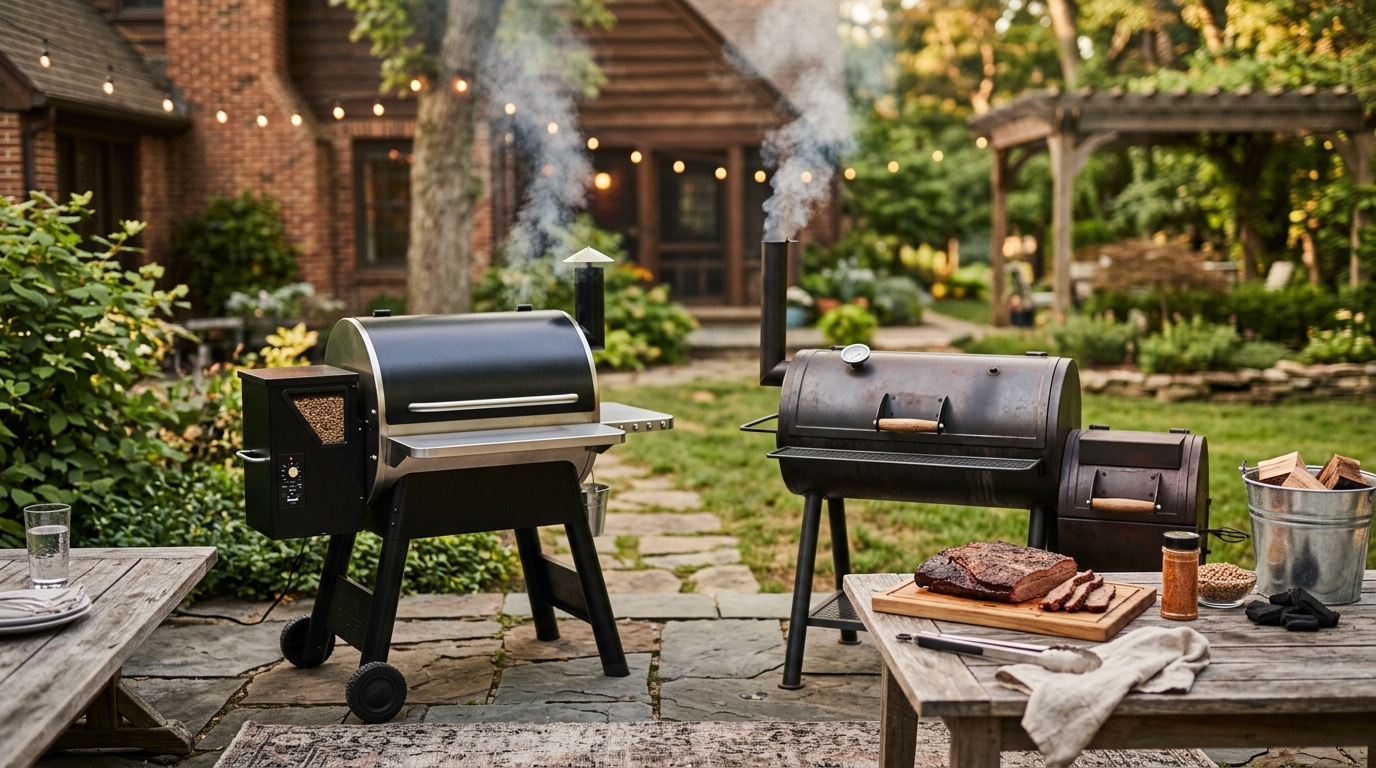
Pellet grill vs smoker verdict: For low-and-slow BBQ without the learning curve, choose a pellet grill — the Traeger Pro 575 or Recteq RT-700 let you set a temperature and walk away for hours. For the deepest smoke flavor, darkest bark, and competition-ready results, choose a traditional charcoal or offset smoker. Most serious pitmasters eventually own one of each.
How pellet grills and traditional smokers compare across 10 dimensions
| Product | Best for | Rating | Notes | |
|---|---|---|---|---|
| Smoke flavor depth | Traditional: 9/10. Pellet: 6/10. | — | Charcoal and wood combustion produces denser smoke compounds than a pellet auger feed. | — |
| Ease of use | Pellet: 9/10. Traditional: 4/10. | — | Pellet is digital set-and-forget; traditional requires active fire management. | — |
| Startup time | Pellet: 10-15 min. Traditional offset: 45-60 min. | — | Offset smokers need a full log fire established before food goes on. | — |
| Temperature precision | Pellet: 9/10 (PID controller). Traditional: 5/10 (dampers). | — | Pellet grills hold within 5-10°F of target; offsets fluctuate more with log additions. | — |
| Equipment entry cost | Traditional offset: $200-400. Pellet: $500+. | — | Quality pellet grills start higher; traditional smokers have a lower entry floor. | — |
| Fuel cost per cook | Traditional: $1-3. Pellet: $1.50-4. | — | Long smokes use more pellets by volume; charcoal and wood cost less per pound. | — |
| Electricity required | Traditional: no. Pellet: yes (110V outlet). | — | Pellets need power for the auger motor, controller, and combustion fan. | — |
| Overnight cook reliability | Pellet: 9/10. Traditional: 6/10. | — | Pellet holds temperature automatically; offset needs log additions every 45-90 min. | — |
| Competition BBQ viability | Traditional: 9/10. Pellet: 7/10. | — | Top-tier judges can often distinguish offset smoke from pellet smoke by ring depth. | — |
| Portability | Traditional kettle: 8/10. Pellet: 4/10. | — | Pellet grills are heavy and need electricity; kettle smokers travel easily. | — |
When is a pellet grill the right choice?
A pellet grill makes sense when you want real wood smoke without the active management that traditional smoking demands. Pellets are compressed 100% hardwood — no fillers, no artificial flavoring — and a digital PID controller maintains your set temperature automatically by feeding pellets into the firepot at a calculated rate. Load the hopper, set 225°F, put a brisket on at 10 PM, and wake up to a probe-tender result at 6 AM without touching anything.
What pellet grills do particularly well
- Set-and-forget overnight cooks: WiFi-connected models let you monitor and adjust temperature from your phone while you sleep
- Consistent results from session one: No fire management skills required — beginners cook competition-quality ribs on their second or third cook
- Smoke wood variety: Switch between hickory, apple, cherry, or mesquite pellets to change flavor profiles without any equipment change
- Dual-purpose cooking: High-end models with a direct-flame insert can sear steaks at 650-700°F in addition to slow smoking
The honest limitation of pellet grills
Pellet smoke is lighter than traditional smoke. A side-by-side brisket cooked on a pellet grill versus a well-managed offset smoker will show measurable differences in smoke ring depth, bark color, and overall smoke intensity. The pellet grill result is genuinely good — most dinner guests will love it — but a pitmaster running an offset with post oak will have more pronounced results.
Pellet grills also have more failure points than a simple charcoal smoker: the auger motor, the temperature controller, the igniter rod, and the combustion fan can all fail. An offset smoker or Weber Smokey Mountain has no electronics to diagnose.
Best for First pellet grill and reliable workhorse for weekly smoking
Traeger Pro 575 Pellet Grill
The grill that introduced mainstream America to pellet smoking. WiFire app control, 575 sq in of cooking space, and consistent 6-degree temperature swings make it the approachable benchmark. Brand ecosystem, customer support, and parts availability are unmatched for beginners starting their pellet journey.
★★★★★ 4.6
Check current price on Amazon→Pros
- WiFire app control lets you monitor and adjust temperature from anywhere
- Consistent temperature within 6 degrees of set point across the full cook surface
- Large pellet hopper holds enough for 20-hour cooks without a refill
- Massive ecosystem of accessories, covers, and cookware all designed for the platform
Cons
- Higher price than competing brands with similar specs and features
- No direct-flame sear capability — steaks lack the crust of a charcoal grill
- Electronics add long-term maintenance complexity versus a traditional smoker
Best for High-capacity family cooks and serious weekend smokers
Recteq RT-700 Pellet Grill
702 sq in of stainless cooking grates, a 40-pound hopper for 40-hour runs, and a PID controller accurate to 5 degrees. The RT-700 beats Traeger on build quality and capacity at a similar price. The brand is less visible at retail, but the hardware is notably more robust than powder-coated alternatives.
★★★★★ 4.7
Check current price on Amazon→Pros
- 40-pound hopper eliminates overnight pellet refill anxiety on long brisket cooks
- Stainless steel construction resists rust far better than powder-coated alternatives
- PID controller holds temperature within 5 degrees — tighter than most competitors
- Handles multiple full packer briskets or rib racks simultaneously
Cons
- Larger footprint than the Pro 575 — requires more patio or deck real estate
- Less retail presence than Traeger for in-person troubleshooting support
- Higher upfront cost than entry-tier pellet options
Best for Pellet smokers who also want genuine high-heat sear capability
Camp Chef Woodwind Pro 24 Pellet Grill
The Woodwind Pro adds a slide-and-grill direct-flame insert that exposes food to open fire for searing — filling the biggest gap in standard pellet grills. If you want one cooker that smokes brisket at 225°F and sears a ribeye at 700°F, the Woodwind Pro is the only major pellet grill that does both credibly.
★★★★★ 4.5
Check current price on Amazon→Pros
- Slide-and-grill direct-flame insert reaches 650°F for genuine searing results
- Ash cleanout system makes post-cook maintenance significantly faster
- WiFi and Bluetooth control via the Camp Chef app with full temperature history
- Propane sidekick burner attachment available for sauce work and sides
Cons
- More expensive than either the Traeger Pro 575 or Recteq RT-700
- Smaller overall cooking surface than the RT-700 in a similar price bracket
- Direct-flame sear zone is limited to the center insert area only
When is a traditional smoker the right choice?
Traditional smokers — offset, charcoal drum, Weber Smokey Mountain, kamado — produce the smoke profile that competition BBQ judges score highest and that serious home pitmasters describe as the benchmark. The mechanism is different from pellet smoking: burning real logs or charcoal at incomplete combustion generates hundreds of aromatic compounds (phenols, guaiacols, syringols) that transfer to the meat, create a deep pink smoke ring, form a dark mahogany bark, and produce the flavor complexity that pellet smoke approaches but cannot fully replicate.
What traditional smokers do particularly well
- Deep smoke ring and bark formation: Wood and charcoal combustion chemistry creates compounds that react with meat myoglobin to form an 8-12mm pink smoke ring — the marker of real BBQ
- No electricity dependency: An offset or drum smoker works anywhere — remote cabin, tailgate, beach, power outage
- Lower entry cost: A solid charcoal smoker starts under $500; a Weber Smokey Mountain 18-inch costs around $350 and lasts 20 years
- The skill that transfers: Managing a fire over 12 hours is a genuine cooking skill — you learn heat dynamics, airflow, fuel behavior, and timing that makes you better at every cooking format
The honest friction of traditional smokers
Traditional smoking is genuinely demanding. An offset smoker requires a log fire that takes 45-60 minutes to establish before food goes on. During a 14-hour brisket cook, you add wood every 45-90 minutes and manage temperature via damper adjustments. Overnight cooks mean interrupted sleep. Entry-level offset smokers under $300 often have metal warping and leakage issues requiring mods like smoker tape and baffle plates before they perform reliably — budget $350-500 minimum for an offset that works well out of the box.
Best for First traditional smoker and backyard BBQ workhorse
Weber Smokey Mountain 22-Inch Charcoal Smoker
The most popular traditional charcoal smoker in the country for good reason. The WSM 22-inch maintains 225-275°F for 8-12 hours on a full charcoal load using the minion method, with minimal adjustments. Two cooking grates handle a full packer brisket or six racks of ribs. Weber build quality means this smoker will outlast any pellet grill you buy.
★★★★★ 4.8
Check current price on Amazon→Pros
- Holds 225-275°F for 8-12 hours with a properly loaded charcoal ring and water pan
- Two cooking grates handle a full brisket and two rib racks simultaneously
- Weber build quality lasts 15-20 years with basic care and occasional grate replacement
- Massive community and documentation base for new smokers learning the minion method
Cons
- Still requires charcoal management — not as hands-off as any pellet grill
- No temperature display included — a third-party wireless thermometer is a necessary add-on
- 45-60 minute startup time before food goes on the grates
Best for Learning real offset technique on an accessible budget
Oklahoma Joe Highland Offset Smoker
The entry point for offset smoking in the US. Not flawless out of the box — smoker tape on the lid seam and a baffle plate improve performance significantly — but at $350-450 it teaches real log fire management. The cooking experience gained here transfers directly to higher-end offset work. Start here, master it, then upgrade if competition is the goal.
★★★★☆ 4.4
Check current price on Amazon→Pros
- Genuine offset firebox design teaches real log fire and airflow management
- Large main chamber handles full packer briskets and multiple rib racks
- Heavy-gauge steel holds heat better than lighter-duty budget offset alternatives
- Well-documented upgrade path — baffle plate and gasket mods are widely covered online
Cons
- Ships with minor leak points that benefit from smoker tape around the lid seam
- Requires log additions and damper adjustments every 45-90 minutes during long cooks
- Heavier than it appears — placement on your patio should be planned before assembly
The smoke flavor gap: what actually causes it
The pellet vs traditional smoke difference is measurable and real. Traditional wood combustion at low oxygen levels — the smoldering state inside an offset or charcoal smoker — produces guaiacol, syringol, and 4-methylguaiacol at higher concentrations. These aromatic compounds penetrate the meat surface and react with proteins during the cook. The result is a pronounced smoke ring, deep mahogany bark, and layered smoke flavor that develops over many hours.
Pellet grills burn pellets in a firepot with better airflow, producing a cleaner, thinner smoke stream. The same compounds form, but at lower concentrations. A pellet-smoked brisket develops a 3-5mm smoke ring; an offset-smoked equivalent produces an 8-12mm ring under the right conditions.
For most home cooks feeding family and friends, this difference is real but not dealbreaking. For competition BBQ judges evaluating hundreds of entries, the gap shows up consistently.
Can you add a smoke tube to a pellet grill to improve flavor?
Yes — and it is one of the best low-cost upgrades available. A pellet tube smoker loaded with compressed wood pellets or wood chips creates a second cold-smoke source inside the cooking chamber. It adds 2-4 hours of denser smoke on top of what the pellet grill generates, deepening flavor and improving bark development on long cooks. A 6-inch pellet smoke tube costs around $15-20 and fits any pellet grill. Start the tube before adding food during the preheat phase for maximum smoke absorption in the first two hours of the cook — when meat absorbs smoke most efficiently.
Who should buy a pellet grill?
Choose a pellet grill if:
- You want real wood smoke without the active fire management that traditional smoking demands
- You cook 1-3 times per week and cannot dedicate 12 hours of active fire management to a cook
- Overnight brisket cooks are appealing but sleeping through them is non-negotiable
- You are new to smoking and want reliable, forgiving results from your first session
- You have access to a 110V electrical outlet where you want to cook
Who should buy a traditional smoker?
Choose a traditional charcoal or offset smoker if:
- Deep smoke ring, dark bark, and maximum smoke intensity are the primary goal
- You genuinely enjoy fire management as part of the cooking ritual, not just the result
- You cook at locations without reliable electricity — campsite, tailgate, remote property
- Competition BBQ is on the horizon and smoke quality will be scored
- Your budget is under $500 — the Weber Smokey Mountain 18-inch delivers more smoke quality per dollar than any pellet grill in the same price range
FAQ
Frequently asked questions
Does a pellet grill produce real smoke flavor?
Can I use a pellet grill without electricity?
What is the best smoker for beginners?
How much do pellets cost compared to charcoal for smoking?
Is an offset smoker better than a pellet grill for brisket?
Do pellet grills work as regular grills for searing steaks?
Bottom line
Pellet grills win on convenience, consistency, and beginner-friendliness. The Traeger Pro 575 or Recteq RT-700 produce excellent smoked brisket, ribs, and chicken with minimal learning — set the temperature and walk away. Traditional smokers — the Weber Smokey Mountain 22-inch or Oklahoma Joe Highland — produce deeper smoke flavor and better competition-grade results at the cost of more active fire management and longer startup times.
Most dedicated backyard pitmasters eventually own one of each. If you are starting out and want reliable results from session one, the pellet grill is the right first smoker. If the craft of fire management and maximum smoke depth are the goal, start with a Weber Smokey Mountain.
For more: how to use a smoker, best smokers, charcoal vs pellet vs gas, and gas vs charcoal grill.