guides
How to Smoke Pork Belly: Step-by-Step
Learn how to smoke pork belly low and slow to juicy perfection. Covers temp, timing, skin-on vs skin-off, wood choice, and how to finish as burnt ends.
 Cole Whitaker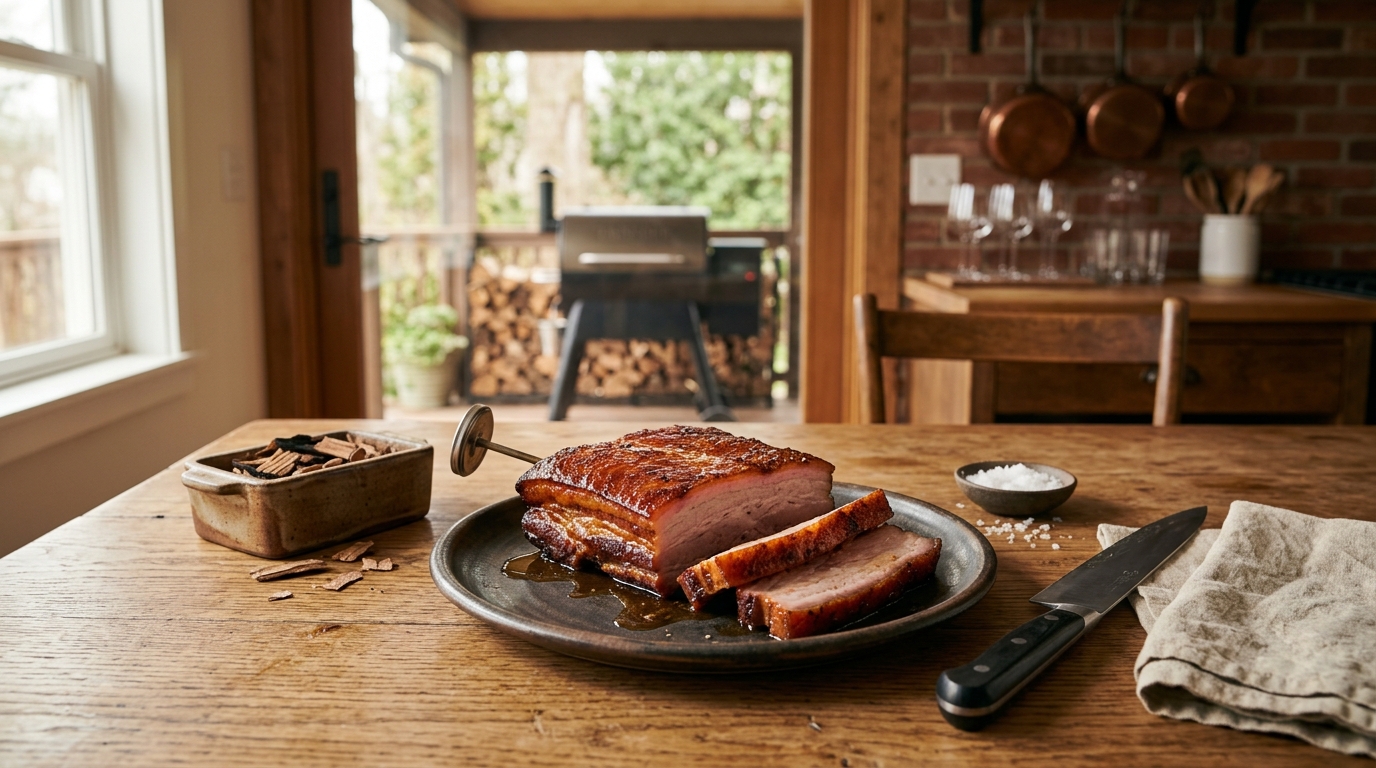
The best way to smoke pork belly: run your smoker at 225–250°F, score the fat cap, season generously, and cook uncovered for 3–4 hours until the internal temperature hits 165°F. Rest for 20 minutes and slice — or cook to 195–205°F, cube it, toss with BBQ sauce and butter, and return it to the smoker at 275°F for 45 minutes to finish as pork belly burnt ends.
What is smoked pork belly and why cook it?
Pork belly is the boneless, fatty cut from the underside of the pig — the same cut that becomes bacon after curing and smoking. Unprocessed and cooked low and slow, it is one of the richest and most rewarding things you can put on a smoker. The layered fat and meat absorbs smoke beautifully and renders into something extraordinarily juicy.
There are three common ways to serve it:
- Sliced pork belly: Smoked whole and sliced thick, served like brisket. Rich, fatty, and boldly smoky with a bark-covered exterior.
- Pork belly burnt ends: Cubed, sauced, and finished at higher heat until glazed and caramelized. One of the most sought-after items in modern backyard BBQ.
- Smoked pork belly strips: Cut into strips before smoking, similar to thick-cut uncured bacon slices — great for appetizers or topping burgers.
This guide covers the whole-slab approach and how to finish it as slices or burnt ends.
Skin-on vs skin-off: which is better for smoking?
| Product | Best for | Rating | Notes | |
|---|---|---|---|---|
| Skin-off | Tender slices and burnt ends | ★★★★★ | Allows smoke and rub to penetrate directly into the fat cap. Fat renders as it cooks and bastes the meat from above. Best for most home cooks aiming for melt-in-your-mouth texture and good bark formation. | — |
| Skin-on | Crackling finish or display cooks | ★★★★☆ | The skin does not crisp at 225°F — it stays rubbery. Only worth keeping if you plan to torch the skin separately after smoking. Not recommended for a standard BBQ smoke cook. | — |
Remove the skin before smoking. Ask your butcher, or do it yourself: place the slab skin-side down, slide a sharp boning knife between the skin and fat layer at one end, and work in long, confident strokes while pulling the skin taut. It takes about three minutes once you find the right angle and is easier than it looks.
Equipment you need
You do not need specialty gear to smoke pork belly well. The essentials:
- A smoker (offset, pellet, kettle, or kamado all produce excellent results)
- A reliable dual-probe thermometer — one probe at grate level, one in the meat
- A sharp boning or chef’s knife for scoring the fat cap and slicing after
- Heavy-duty aluminum foil for the optional wrap phase
- A disposable aluminum pan if finishing as burnt ends
- Heat-resistant gloves
A dual-probe wireless thermometer for tracking smoker and meat temperature simultaneously: wireless dual probe meat thermometer on Amazon
Step 1: Buy and prep the pork belly
A full slab runs 8 to 12 pounds. For most home cooks, 4 to 6 pounds is the right size — it fits standard smoker grates and finishes in a practical 3–5 hour window.
What to look for:
- Roughly even thickness (2 to 3 inches) across the slab for uniform cooking
- Good balance of fat layers and lean meat — avoid slabs that are mostly fat with thin streaks of lean
- Pink-red meat color with white, firm fat (no gray or yellow discoloration)
Prep steps:
1. Remove the skin if still attached (see above).
2. Score the fat cap. Using a sharp knife, cut a crosshatch pattern across the fat cap — cuts about 1 inch apart and 1/4 inch deep. This is the step most home cooks skip and later regret. Scoring allows the rub to penetrate the fat, helps the fat render more evenly, and gives the bark more surface area to form on.
3. Pat dry. Blot all surfaces dry with paper towels. Dry surfaces form bark; wet surfaces steam.
4. Apply a binder. Coat all sides lightly with yellow mustard or olive oil. This helps the rub stick without contributing any noticeable flavor after the long cook.
5. Season generously. Apply a dry rub on all surfaces, pressing it into the scored fat cap with your palm. A pork-forward rub with brown sugar, kosher salt, black pepper, smoked paprika, garlic powder, onion powder, and a touch of cayenne works well. The fat cap needs a heavier hand than the meat sides — it is thick and the rub can get lost in a thin application.
A competition-style pork rub: BBQ dry rub for pork belly on Amazon
Optional: dry brine overnight. Season with kosher salt 12–24 hours ahead and refrigerate uncovered. The salt draws moisture to the surface, which then reabsorbs into the meat carrying seasoning deeper. Apply the rub and binder right before the cook the next day.
Step 2: Set up the smoker
Preheat the smoker to 225–250°F and let it stabilize for at least 15–20 minutes before adding the meat. Fluctuating temperatures in the first hour produce uneven bark and inconsistent smoke penetration.
Wood selection:
- Pellet smoker: Apple, cherry, or competition blend pellets.
- Offset or kettle: Apple or cherry wood chunks, fist-sized. Add one or two at the start and one more after the first hour.
- Kamado: Lump charcoal with two apple or pecan wood chunks near the top of the coal pile.
Pork belly absorbs smoke readily because of its fat content — two or three moderate additions over the full cook is plenty. Continuous heavy smoke addition through 4–5 hours produces harsh, acrid flavors in fatty cuts.
Step 3: Smoke the pork belly
Place the seasoned pork belly fat-side up on the smoker grate. This orientation is not optional — as the fat cap renders throughout the cook, it bastes the meat below it. Fat-side down sends that rendered fat into the coals instead of over the meat.
Approximate timeline for a 4–6 lb skin-off slab at 225°F:
- 0–90 minutes: Bark begins forming. The fat cap starts to sweat and the surface deepens in color. Do not open the smoker.
- 90 minutes – 2.5 hours: Spritz every 60 minutes with apple juice or a 50/50 blend of apple juice and apple cider vinegar. The bark continues to develop and the scored fat cap softens visibly.
- 2.5–4 hours: For sliced pork belly, target 165°F internal. For burnt ends, continue to 195–205°F. Check temperature at the 3-hour mark and adjust expectations based on your specific slab thickness.
Optional wrap: If the bark looks dark and well-set after 2.5–3 hours, you can wrap the slab tightly in heavy-duty foil and return it to the smoker. Wrapping speeds up the cook by 30–45 minutes and produces a softer, more braised interior texture — excellent for burnt ends. Skip the wrap if you prefer firmer slices and a hard, crunchy bark.
Step 4a: Finish as sliced pork belly
Remove the slab when the internal temperature reads 165°F in the thickest part of the lean meat (avoiding fat pockets, which read lower). Rest it on a cutting board, loosely tented with foil, for 15–20 minutes. The fat sets as it rests and the slices hold together much better after resting.
Slice into 3/4-inch to 1-inch thick portions perpendicular to the fat layers. Each slice should show distinct layers of dark bark, rendered fat, and smoke-ringed lean meat. Serve immediately — smoked pork belly cools and firms quickly, so it is best eaten hot and fresh from the cutting board.
Step 4b: Finish as pork belly burnt ends
Pork belly burnt ends have become one of the most popular dishes in backyard BBQ, and for good reason — they are sticky, caramelized, smoky, and deeply rich in a way that is hard to replicate with any other cut.
The process after the slab hits 195–205°F:
- Remove the slab from the smoker and let it rest for 10 minutes. This firms the exterior slightly and makes cubing much cleaner.
- Cut the belly into 1.5-inch cubes. Consistent size means consistent cooking — cubes that vary widely will have some done and some still underdone when you pull the pan.
- Arrange the cubes in a single layer in a disposable aluminum half pan or a large cast iron skillet. Do not pile them — they need airflow to caramelize rather than steam.
- Toss with approximately 1/2 cup of BBQ sauce per 2 pounds of cubed belly, plus 2 tablespoons of unsalted butter (cut into small pieces) distributed across the pan.
- Optional additions: a drizzle of honey, a sprinkle of brown sugar, or a splash of bourbon all work well.
- Return the pan to the smoker uncovered at 275°F for 45–60 minutes. Stir or toss the cubes every 20 minutes.
- Burnt ends are done when the sauce has tightened and caramelized to a glossy glaze, the cubes are deep reddish-brown, and they have a slight bounce when you press one gently.
A good disposable aluminum half pan for burnt ends: disposable aluminum roasting pans on Amazon
The best wood choices for smoked pork belly
Pork belly is rich enough to stand up to moderate smoke, but the high fat content absorbs smoke readily — too much wood produces a heavy, harsh result.
Apple is the best all-round option. Mild, subtly sweet, produces a beautiful mahogany bark color, and is nearly impossible to overdo. It is the safest choice for your first smoke and pairs with pork as naturally as any wood does.
Cherry deepens the bark color and adds a slightly more complex, fruity sweetness. Often blended with apple — two apple chunks to one cherry chunk — for the best combination of color and flavor depth.
Pecan delivers a nutty richness that bridges fruit woods and hickory. Excellent with fatty cuts, and a good choice when you want more depth than apple without going full hickory.
Hickory works well with pork belly in small amounts. A single chunk or one addition mid-cook adds the classic American BBQ depth. More than that in a 4–5 hour cook, and the heavy smoke overwhelms the natural pork flavor.
Avoid mesquite for pork belly. It burns aggressively hot, produces intense earthy smoke, and is far too strong for a long low-and-slow cook on a fatty cut.
How to tell when smoked pork belly is done
Unlike ribs, pork belly has a reliable internal temperature target because the cut is thick and consistent enough for accurate probe readings.
For sliced pork belly: Pull at 165°F in the thickest part of the lean meat. The fat is rendered, the meat is fully cooked, and the exterior has developed good bark. The slab still holds its shape and slices cleanly at this temperature.
For burnt ends: Take the slab all the way to 195–205°F before cubing. At this range, the collagen and fat have broken down further, producing the melt-in-your-mouth interior texture that makes burnt ends distinctive. Pulling at 165°F and then cubing for burnt ends results in firmer, chewier cubes.
Insert the probe into the thickest part of the lean meat, avoiding fat pockets — fat registers lower than the surrounding muscle and will give a falsely low reading.
Common mistakes when smoking pork belly
Leaving the skin on. The skin does not soften, crisp, or render at low smoking temperatures — it stays rubbery and chewy no matter how long you cook it. Remove it before the cook every time.
Skipping the fat cap score. The fat cap is often 1/2 inch or more thick. Without scoring, the rub sits only on the surface, the fat renders unevenly, and some areas stay waxy and dense. Three minutes of crosshatch work before seasoning makes a significant difference.
Not going high enough for burnt ends. Pulling the slab at 165°F and then cubing produces firm, slightly dry cubes that lack the silky interior texture burnt ends are known for. Target 195–205°F before cubing.
Too much smoke wood. Pork belly absorbs smoke aggressively. Two or three wood additions over a 4–5 hour cook is sufficient. Adding wood every hour or using a heavy wood load throughout produces a bitter, overpowering result.
Cutting without resting. Sliced pork belly loses juices rapidly when cut without resting. Ten to twenty minutes of loosely tented rest after pulling makes slices cleaner and juicier.
Piling the burnt ends cubes. Cubes stacked in the pan steam rather than caramelize. A single layer in the pan, with tossing every 20 minutes, is what produces the sticky, glazed exterior that defines good burnt ends.
FAQ
Frequently asked questions
How long does it take to smoke pork belly?
What temperature do you smoke pork belly at?
Do you smoke pork belly fat side up or down?
Should you wrap pork belly when smoking?
What wood is best for smoking pork belly?
Can you smoke pork belly on a pellet grill?
What is the difference between smoked pork belly and bacon?
Bottom line
Smoked pork belly rewards patience more than technique. The high fat content makes the cut genuinely forgiving — it is hard to dry out and easy to dial in once you understand the temperature targets. Key points to remember: remove the skin, score the fat cap, smoke fat-side up at 225–250°F with apple or cherry wood, and rest before slicing. If your goal is burnt ends, take the slab all the way to 195–205°F, cube consistently, and finish in a single-layer pan at 275°F until the sauce caramelizes into a glossy glaze. It is one of the most impressive things to set on a table at a backyard cookout, and the process is far more accessible than the results suggest.
For related reading: how to use a smoker: complete beginner guide, how to smoke pork ribs step-by-step, best smokers at every price point, or brisket smoking guide: full step-by-step.