guides
How to Smoke a Brisket Flat
Learn how to smoke a brisket flat to juicy perfection: trimming, seasoning, wrapping at the stall, and slicing the lean cut without drying it out.
 Cole Whitaker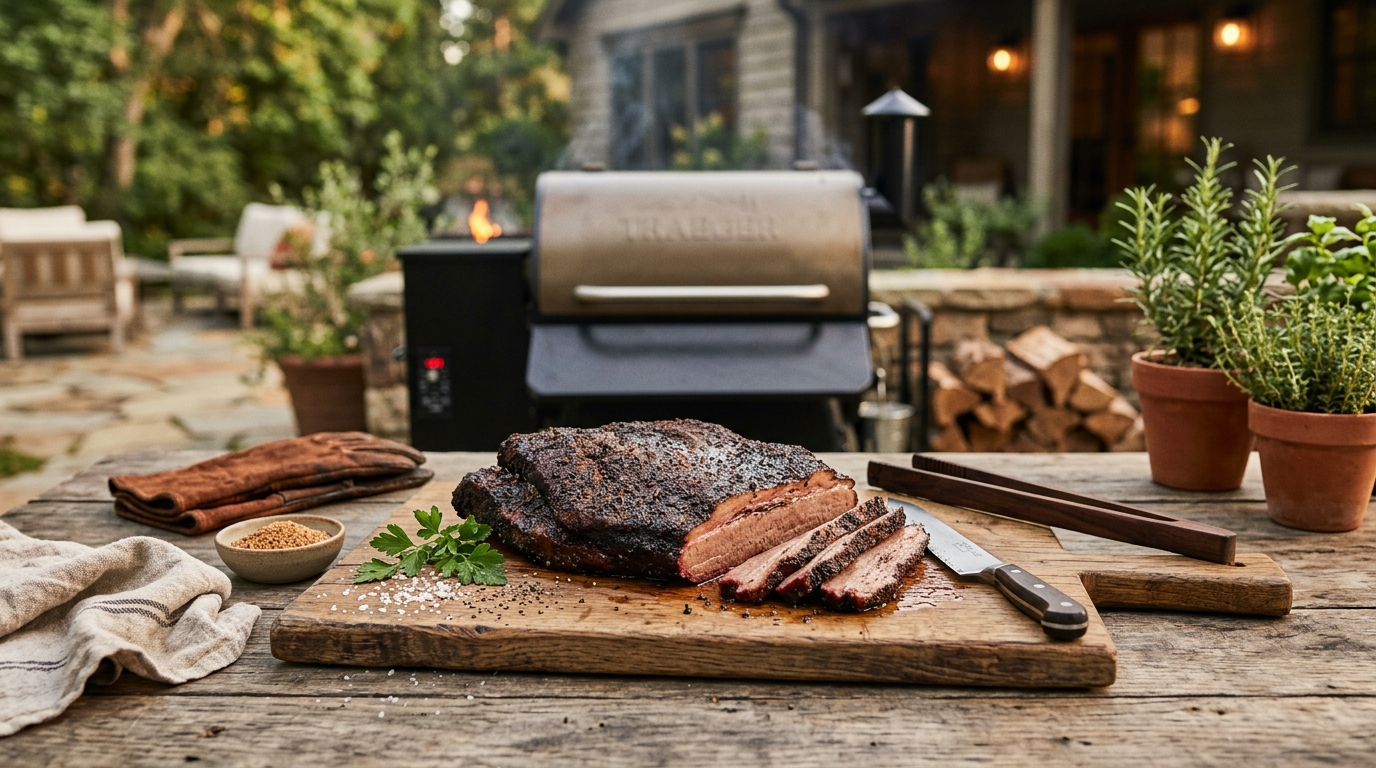
Smoke a brisket flat at 225°F, inject with beef tallow or a butter-based mixture before it goes on, wrap in pink butcher paper when the internal temperature stalls around 160–165°F, and pull at 200–205°F confirmed by probe tenderness. Plan for 1.25 to 1.5 hours per pound — and rest for at least 90 minutes before slicing.
What is a brisket flat and why smoke one?
A whole packer brisket consists of two connected muscles: the point (thick, heavily marbled, and forgiving) and the flat (thinner, leaner, and more demanding). When you buy just the flat — also called the first cut or flat cut — you get the rectangular, uniform piece without the fattier deckle attached.
There are real reasons to smoke just the flat rather than the whole packer. It fits in smaller smokers, costs less, takes fewer hours, and produces clean, uniform slices ideal for sandwiches and brisket platters. The tradeoff is straightforward: with no fatty point protecting it during the cook, every decision matters more. A well-smoked flat has a deep, dark bark, a visible pink smoke ring, and slices that hold together without falling apart or tasting dry. A poorly managed flat is the dry, grey slab that gave smoked brisket a bad reputation among people who only ever bought the flat.
How to choose a brisket flat
The flat you select determines your ceiling before you light the smoker.
Thickness: Look for a flat that is at least 2 inches thick at its thinnest point. Retail flats are often trimmed aggressively into a uniform, thin shape — convenient for oven roasting but a liability for a 7 to 10 hour smoke. Thin edges will overcook long before the center is done.
Fat cap: A flat with at least one-half inch of fat cap gives you a buffer to trim down to the one-quarter-inch target. A flat with the fat cap already fully removed has no protective layer during the cook. If you cannot find a flat with a fat cap intact, plan to wrap in foil rather than butcher paper to retain maximum moisture.
Grade: USDA Choice is the minimum for a low-and-slow flat. The modest intramuscular fat in a Choice flat provides enough moisture to survive the cook with correct technique. USDA Select lacks this margin — a Select flat cooked to probe-tender doneness will often still be dry regardless of how well-managed the cook was. Prime grade is excellent and worth the premium.
Weight: Most trimmed retail flats weigh 6 to 10 pounds. At 225°F, a 6 to 8 pound flat takes roughly 7.5 to 10 hours before resting — a manageable one-day timeline.
Why injection is essential for a brisket flat
A whole packer brisket is partially self-basting: fat from the point renders and works its way through the meat during the cook. A standalone flat has no such mechanism. Injecting compensates directly for that missing fat and is the single most impactful step available for keeping a flat moist.
Beef tallow injection: Melt rendered beef tallow — ideally rendered from brisket trimmings — and inject it throughout the flat while the tallow is warm and liquid. The tallow acts as an internal baster throughout the cook. Use approximately 2 to 3 ounces of liquid tallow per pound of meat.
Butter-based injection: Melt one stick of unsalted butter per 4 pounds of flat, add a tablespoon of Worcestershire sauce, a teaspoon of beef broth concentrate, and a half teaspoon of onion powder. Cool until liquid but not solid before injecting. This approach produces a richer flavor profile alongside the added moisture.
Injection technique: Grid the flat in a pattern with injections every 1 to 1.5 inches across its length and width at several depths per insertion point. Withdraw the needle slowly while pressing the plunger to distribute liquid through the muscle fibers rather than pooling it in one spot. Work over a rimmed sheet pan — some liquid will blowback from previous needle holes.
A large-barrel meat injector handles thick liquids without clogging: meat injector for brisket on Amazon.
How to trim and season a brisket flat
Trimming:
- Start cold. Trim the flat straight from the refrigerator. Cold fat is firm and cuts cleanly; room-temperature fat tears rather than slices. A sharp boning knife handles this far more easily than a standard chef’s knife.
- Trim the fat cap to one-quarter inch. Remove the thick outer fat layer until approximately one-quarter inch remains evenly across the top surface. This layer renders during the cook and provides some surface moisture — removing it entirely eliminates that benefit.
- Remove silverskin from the underside. The shiny membrane on the bottom of the flat will not break down during cooking. Slide a knife tip under the edge and pull it away in strips so smoke can penetrate the meat directly.
- Square up the thin end. The tail end of most flats tapers to a thin edge under one inch. Trim it back until the thinnest cross-section is at least one inch thick. Save the trimmings to render into tallow for the injection.
Seasoning:
Coarse kosher salt and coarse black pepper in equal parts is the standard approach. Apply generously to every exposed surface and press it in firmly with a gloved hand. Use a thin binder coat first — yellow mustard is the most popular choice and the flavor fully cooks off, leaving no trace in the finished flat.
Apply seasoning at least 30 minutes before the flat goes on the smoker. Overnight in the refrigerator — uncovered on a wire rack — is meaningfully better. The dry-brine draws surface moisture out initially, then pulls it back in with salt dissolved into it, improving seasoning depth and leaving a drier surface at cook time that forms bark more readily.
How to set up your smoker for a brisket flat
Target 225°F for the entire cook. This is the cooler end of the brisket temperature range, and it matters specifically for a flat: 225°F gives collagen more time to convert to gelatin before the lean exterior begins losing moisture aggressively. A whole packer can handle 250°F because the point protects the flat; a standalone flat benefits from the gentler cooking environment.
Wood choice: Post oak produces a clean, balanced beef smoke and is the traditional choice for Texas brisket. Cherry wood adds a subtle sweetness and helps develop a deep mahogany bark color. Use hickory sparingly on a flat — the lean exterior absorbs smoke faster than the fattier point does, and hickory is assertive. Avoid mesquite for a cook this long; more than two to three hours of mesquite smoke on a lean flat produces harsh, bitter results.
Positioning: Place the flat fat-side up on the grate. In an offset smoker with intense radiant heat from the firebox, position the thicker end of the flat toward the heat source so the thinner tail sits in the cooler end of the cooking chamber.
Temperature monitoring: Use a dual-probe wireless thermometer — one probe at grate level, not at the dome gauge which reads 15 to 30°F higher than actual grate temperature, and one probe in the thickest part of the flat: wireless dual-probe thermometer on Amazon.
How to smoke a brisket flat: step-by-step
Step 1: Inject and season the night before. Inject the flat with beef tallow or butter-based injection, apply the rub, and refrigerate uncovered on a wire rack overnight. By morning the surface will be tacky and dry — ideal for smoke adhesion and fast bark development.
Step 2: Preheat the smoker to 225°F. Stabilize at target temperature before the flat goes on. Adding cold meat to an unstabilized smoker extends the time to settle and produces uneven smoke absorption in the early hours.
Step 3: Place the flat fat-side up and close the lid. Resist opening the cooking chamber for the first two to three hours. The smoke ring and bark formation both happen primarily in the early part of the cook when the surface is cool and porous. Every lid opening drops temperature and loses critical moisture.
Step 4: Spritz every 60 to 90 minutes after the first two hours. Because a flat lacks the fat protection of the point, surface moisture management matters more here than on a whole packer. Spritz lightly with apple cider vinegar, apple juice, or water every 60 to 90 minutes starting at the 2-hour mark. Keep sessions brief — open, spritz, close immediately.
Step 5: Wrap in pink butcher paper at 160–165°F. As soon as the internal temperature stalls around 160–165°F, wrap the flat tightly in two overlapping sheets of pink butcher paper and return it to the smoker. Wrapping a flat slightly earlier than a whole packer (which is often wrapped at 165–170°F) retains more moisture in the leaner cut. Pink butcher paper arrests evaporative cooling while remaining breathable enough to preserve bark texture. Foil wraps retain more moisture but produce a softer exterior — a good backup if the flat is cooking hot on the surface.
Step 6: Continue to probe-tender doneness at 200–205°F. After wrapping, the temperature will resume climbing. Begin probe testing when the internal temperature reaches 200°F. Insert a thin metal skewer or clean thermometer probe into the thickest part of the flat — a done flat offers zero resistance, like probing warm butter. Any resistance means the connective tissue has not fully converted and the flat needs more time regardless of what the temperature display reads.
Step 7: Rest for at least 90 minutes. Remove the flat from the smoker, add a second layer of heavy-duty foil over the butcher paper, and place it in a dry cooler padded with folded towels. A flat holds above food-safe temperature (140°F) for three or more hours in a well-insulated cooler. Minimum rest is 90 minutes; two hours produces noticeably better texture as the muscle fibers relax and the juices redistribute.
Step 8: Slice against the grain. Unwrap the flat on a cutting board and identify the direction of the muscle fibers — they run parallel to the long edge. Slice perpendicular to those fibers in strips approximately one-quarter inch thick. Slicing with the grain leaves long fibers intact and produces tough, stringy brisket regardless of how well the flat cooked.
Target temperature for a smoked brisket flat
The target internal temperature for a smoked brisket flat is 200–205°F in the thickest part of the cut. This is the range at which connective tissue has converted to gelatin and the flat reaches the texture associated with properly smoked brisket.
Temperature is a guide, not a finish line. Some flats are probe-tender at 198°F; others need 207°F. Use probe tenderness as the primary test and temperature as confirmation. A flat that reads 205°F but still resists a thin skewer is not done — it needs more time on the smoker, not a higher target temperature.
Why smoked brisket flat dries out — and how to prevent it
No injection. This is the most common reason a flat is dry. Injecting compensates for the missing deckle fat. Skipping this step removes the biggest insurance policy available for the leaner cut.
Temperature too high. Cooking at 250°F or above drives moisture out of the lean flat faster than collagen converts to gelatin. Stay at 225°F for the majority of the cook.
Wrapping too late. Waiting until 170°F to wrap a flat allows more evaporative moisture loss than necessary. Wrapping at 160–165°F cuts that exposure shorter and retains more internal moisture.
Insufficient rest. Cutting into a flat immediately after pulling it sends all the accumulated cooking juices onto the cutting board rather than redistributing through the muscle. A 90-minute rest in a towel-insulated cooler holds that moisture where it belongs.
Recommended equipment for smoking a brisket flat
Best for Multi-probe monitoring during a long smoke
ThermoWorks Signals 4-Channel BBQ Thermometer
Four probes track grate temp and up to three meat locations simultaneously with WiFi alerts so you can monitor the flat from inside without lifting the lid.
★★★★★ 4.9 · 1,240 reviews
Check current price on Amazon→Best for Injecting beef tallow or butter into a brisket flat
Meat Injector with Stainless Steel Needles
Large-capacity barrel handles thick liquids like tallow without clogging. Includes a wide-hole needle for chunky marinades and a fine needle for butter-based injections.
★★★★★ 4.7 · 2,830 reviews
Check current price on Amazon→Best for Wrapping the flat at the stall
Pink Butcher Paper Roll 18-Inch
Breathable paper arrests evaporative cooling without steaming the bark the way foil does. The 18-inch width wraps a flat comfortably in two overlapping sheets with no foil-soft exterior.
★★★★★ 4.8 · 5,640 reviews
Check current price on Amazon→FAQ
Frequently asked questions
How long does it take to smoke a brisket flat?
Should I inject a brisket flat before smoking?
At what temperature do I wrap a brisket flat?
Fat side up or fat side down for a brisket flat?
How do I know when a smoked brisket flat is done?
Can I smoke a brisket flat on a pellet grill?
Bottom line
Smoking a brisket flat well comes down to five decisions made correctly: buy a Choice or Prime flat with a fat cap intact, inject with beef tallow or butter before it goes on, cook at 225°F rather than 250°F, wrap in pink butcher paper at 160–165°F rather than waiting for 170°F, and rest for at least 90 minutes in a towel-lined cooler before slicing against the grain. The flat is less forgiving than a whole packer — but a flat treated with care produces clean, uniform slices with excellent bark and a smoke ring that makes every hour of patience obvious.
For related reading: complete brisket smoking guide for whole packers, offset vs. pellet smoker: which setup is right for you, how to use a smoker for beginners, and best instant-read thermometers for accurate readings.