guides
How to Grill Kabobs
Step-by-step guide to grilling kabobs perfectly — best meats and vegetables, threading tips, marinades, skewer types, temperatures, and cook times.
 Cole Whitaker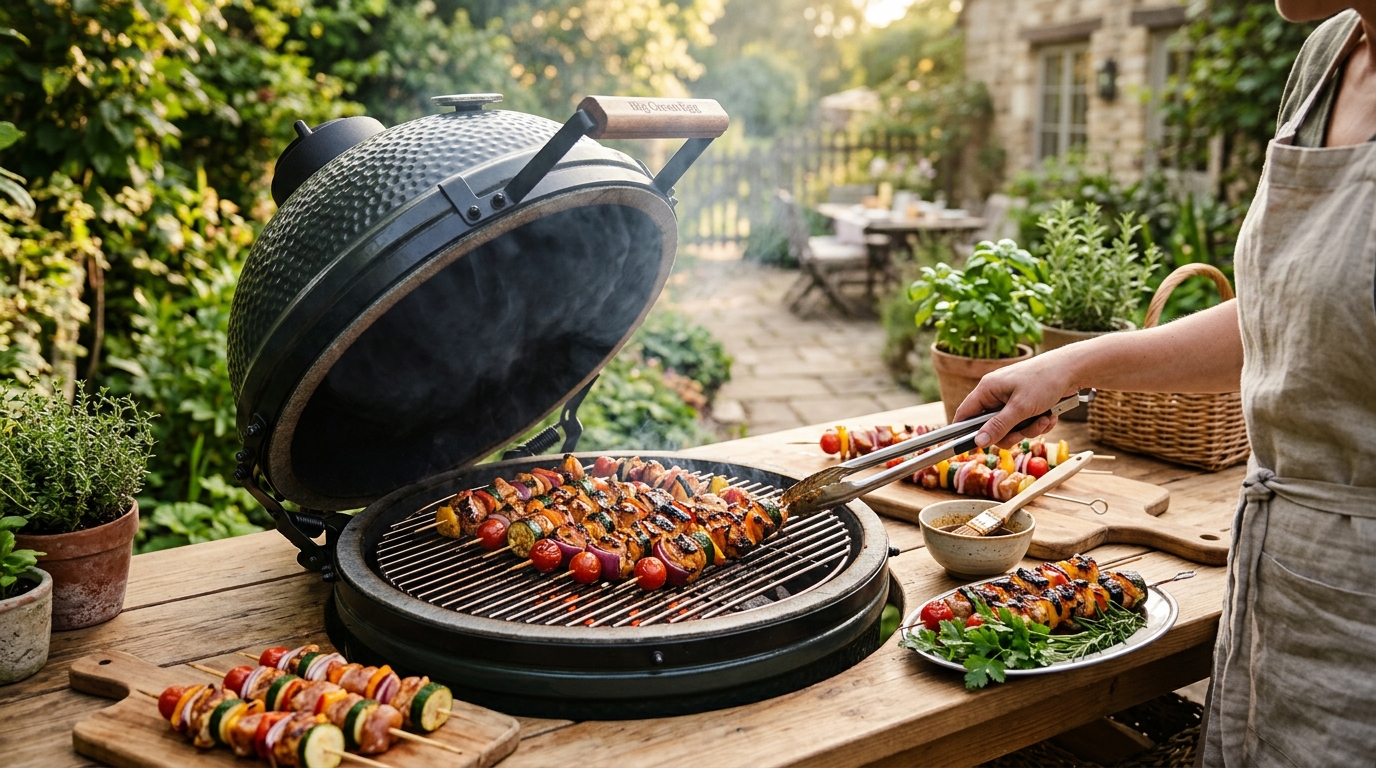
Thread kabobs onto metal or soaked wooden skewers, then grill over direct medium-high heat (400–450°F) for 10–15 minutes, turning every 3–4 minutes. Cut all protein into uniform 1-inch cubes, keep meat and vegetables on separate skewers for precise doneness control, and verify with a thermometer — chicken needs 165°F, beef and lamb 145°F for medium.
Which protein makes the best kabobs?
Different proteins behave very differently on a skewer. Fat content, moisture, and ideal doneness temperature all vary enough that knowing your meat before you start saves significant frustration at the grill.
| Product | Best for | Rating | Notes | |
|---|---|---|---|---|
| Chicken thighs | Juiciest chicken kabobs, most forgiving | ★★★★★ | Thighs have enough fat to stay moist through 165 degrees F and beyond. They hold marinade well and develop excellent char. Never use chicken breast for kabobs — it dries out before hitting the safe internal temperature and has no fat to protect it. | Check price |
| Beef sirloin | Classic kabob flavor, good medium-rare window | ★★★★★ | Well-marbled and firm enough to hold a cube shape on the skewer. Reaches medium-rare (135 degrees F) in 10 to 12 minutes at medium-high heat. Avoid tenderloin — it is too expensive for kabobs and falls apart when cubed. | Check price |
| Lamb shoulder | Deep flavor, traditional Middle Eastern kabob | ★★★★★ | High fat content keeps the meat moist and produces excellent flare-ups that add char. Pairs naturally with herbs, cumin, and garlic. Target 145 degrees F internal for medium, which takes 12 to 14 minutes at medium-high heat. | Check price |
| Shrimp (16-20 count) | Fast cook, crowd pleaser | ★★★★☆ | Done in just 4 minutes total — 2 minutes per side at direct high heat. Must be threaded on flat skewers or two parallel bamboo skewers to prevent spinning. Pull when pink and curled into a loose C-shape; a tight curl means overcooked. | Check price |
| Pork shoulder | Budget-friendly, takes bold marinades | ★★★★☆ | The fat content and collagen in pork shoulder make it better suited to kabobs than lean pork loin, which dries out quickly. Target 145 degrees F internal. A garlic-oregano-lemon marinade works extremely well. | Check price |
Avoid lean proteins on the skewer. Chicken breast, pork loin, and turkey breast are too lean for kabobs — they reach food-safe temperatures before developing meaningful char, and there is no fat to protect them from drying out. The best kabob proteins are the ones that stay moist even when cooked through: thighs over breasts, shoulder over loin.
What vegetables work best on kabobs?
Bell peppers, zucchini, red onion, mushrooms, and cherry tomatoes are the classic kabob vegetables. They share enough density and moisture to hold up to grill temperatures for 10 to 15 minutes without going completely soft.
Best kabob vegetables by density:
- Dense (most char, softens without falling apart): Red onion quarters, bell pepper cut into 1-inch squares, corn cob rounds cut 1 inch thick
- Medium density (best texture at 12 minutes): Zucchini rounds (cut 3/4 inch thick), yellow squash rounds, whole button mushrooms or portobello cut into 1.5-inch pieces
- Quick-cooking (use separate short skewers or add toward the end): Cherry tomatoes, fresh jalapeño rounds, thin asparagus spears
A note on threading vegetables separately. Vegetables cook faster than most proteins and benefit from slightly lower heat. When you thread them on the same skewer as chicken thighs, you are forced into a choice: pull at the vegetable finish time (leaving the meat undercooked) or leave everything on longer (burning the vegetables to mush). Threading them on their own skewers lets you manage each category independently — remove the vegetable skewers when they are done and keep the protein skewers over the heat.
Cut all vegetable pieces to roughly the same surface area as your protein cubes. A 1-inch pepper square will finish in about the same time as a 1-inch cube of beef sirloin. Mushroom caps smaller than 1.25 inches often shrink and fall off the skewer — use whole button mushrooms or cut larger mushrooms into bigger chunks.
How to build a great kabob marinade
A good kabob marinade has three components: acid, fat, and flavor. The acid tenderizes the surface, the fat carries flavor into the meat and promotes browning on the grill, and the aromatics deliver the seasoning.
Basic structure:
- Acid (1–2 tablespoons): lemon juice, red wine vinegar, yogurt (traditional for lamb and chicken), white wine vinegar
- Fat (3–4 tablespoons): olive oil or avocado oil
- Aromatics: garlic (2–3 cloves minced), fresh herbs (oregano, rosemary, thyme, mint, or cilantro), dry spices (cumin, paprika, coriander, sumac)
- Salt: 1 teaspoon kosher salt per pound of protein
Timing by protein:
- Chicken thighs: 2 to 4 hours minimum; up to 8 hours works well
- Beef sirloin: 2 to 6 hours
- Lamb shoulder: 4 to 8 hours — the stronger flavor of lamb handles longer marinating
- Shrimp: 15 to 30 minutes only — acid begins chemically denaturing the shrimp protein after 30 minutes, which leads to a mushy texture on the grill
For vegetables: Brush lightly with olive oil and season with salt and pepper just before threading. Long vegetable marinating saturates them with liquid they cannot cook off properly on the grill, which causes steaming instead of searing and prevents charring.
What you need to grill kabobs
The skewer choice matters more than any other equipment decision.
Flat metal skewers on Amazon — 12-inch stainless flat-blade skewers are the best kabob tool. The flat blade locks each piece in place so the meat rotates with the skewer when you turn it rather than spinning freely underneath. Reusable indefinitely and no soaking required. Buy a set of 8 to 12 so you can cook a full meal simultaneously.
Bamboo skewers 12-inch on Amazon — if using bamboo, soak in cold water for at least 30 minutes before threading. Use two parallel skewers per row of protein to prevent pieces from spinning when you flip. Buy the 100-pack — they burn and warp faster than expected.
Additional gear:
- An instant-read thermometer for confirming protein doneness — the single most important grill accessory
- Long-handled tongs (at least 12 inches) for turning skewers without reaching over the flame zone
- A rimmed sheet pan for holding threaded skewers before and after grilling
- A stiff grill brush for cleaning grates between batches
Long-handled grill tongs on Amazon — 16-inch spring-loaded tongs give you enough reach to turn kabobs safely over direct fire. Look for tongs with a locking clip so they store flat between uses.
How to grill kabobs: step-by-step
Step 1: Prepare the skewers. If using metal flat skewers, rinse and dry them. If using bamboo, submerge in a baking dish or zip-lock bag filled with cold water and soak for at least 30 minutes — a 2-hour soak is better. Dry bamboo ignites in seconds over a direct-heat fire, shortening the useful skewer length and depositing ash flavor on the kabob.
Step 2: Marinate the protein. Combine the marinade ingredients in a zip-lock bag or shallow bowl. Add the protein pieces and turn to coat every surface. Seal and refrigerate. Chicken thighs: 2 to 4 hours minimum. Beef or lamb: 2 to 6 hours. Shrimp: 15 to 30 minutes only. Remove the protein from the marinade 20 minutes before threading and let it rest at room temperature — cold protein takes longer to cook through and produces a thicker band of overcooked exterior by the time the center reaches target temperature.
Step 3: Cut the protein into uniform cubes. Pat the marinated protein dry with paper towels before threading. Any excess liquid on the surface must evaporate before browning can occur on the grill — wet protein steams rather than sears. Cut to uniform 1-inch cubes. Inconsistent sizing causes some pieces to finish early while others lag, which is the most common cause of dried-out end pieces and undercooked center pieces on the same skewer.
Step 4: Prep the vegetables. Cut all vegetables to pieces roughly matching the surface area of the protein cubes. Red onion: quarter the onion and separate the layers so each piece is 1 to 1.5 inches wide. Bell pepper: core and cut into 1-inch squares. Zucchini: cut into 3/4-inch rounds. Mushrooms: use whole button mushrooms or cut larger mushrooms into 1.5-inch chunks. Cherry tomatoes: thread whole. Brush all vegetable pieces lightly with olive oil and season with salt and pepper.
Step 5: Thread the skewers. Thread protein pieces on some skewers and vegetables on others. Leave a small gap (about 1/4 inch) between pieces — pieces touching completely trap steam and the covered contact faces cannot develop char. Thread from the pointy end, pushing pieces down toward the blunt handle end so the skewer is loaded from center to tip. Leave several inches of clear skewer at the handle end to make turning easier and keep your hand away from direct heat.
Step 6: Preheat the grill. Set up the grill for direct medium-high heat at 400 to 450 degrees F. For gas: turn all burners to medium-high and preheat with the lid closed for 10 minutes. For charcoal: light a full chimney of coals and wait until they glow orange and are covered with light grey ash, then spread them in an even single layer — no banked pile, which creates too much temperature variation across the grill surface for consistent kabob cooking. Clean and oil the grates before placing the skewers.
Step 7: Grill and rotate every 3–4 minutes. Lay the skewers across the grates at a 45-degree angle to the grill bars — this maximizes the searing contact surface and produces the most defined grill marks. Close the lid. After 3 to 4 minutes, open the lid and turn each skewer a quarter rotation. Close the lid. Repeat every 3 to 4 minutes until all four sides have spent time over direct heat. Total cook time is 10 to 15 minutes depending on protein and cube size. Shrimp kabobs finish in 4 minutes total and should be managed separately.
Avoid pressing the kabobs down onto the grate. Unlike a burger, kabobs benefit from the grate bars marking individual sides on each rotation — pressing compresses the pieces and slows the cooking.
Step 8: Check doneness and rest. Insert an instant-read thermometer into the thickest piece on each protein skewer. Chicken thighs: pull at 165 degrees F. Beef and lamb: pull at 135 degrees F for medium-rare or 145 degrees F for medium. Shrimp: pull when pink, opaque, and curled into a loose C-shape. Let protein skewers rest for 3 to 5 minutes off the heat before serving. The carry-over temperature rise is modest on kabobs due to the small piece size, but resting settles the juices and firms the texture slightly.
Common kabob mistakes to avoid
Mixing meat and vegetables on the same skewer. This is the most common home-grill mistake with kabobs. Vegetables finish in 10 to 12 minutes while chicken thighs need 13 to 15 minutes. Threading them together forces you to pull the skewer at the vegetable finish time (undercooked chicken) or leave everything on longer (overcooked, mushy vegetables). Separate skewers solve the problem completely.
Cutting pieces too large. Cubes over 1.5 inches take significantly longer to cook through, which increases the window for the exterior to char before the interior hits temperature. Keep protein pieces to 1 inch.
Skipping the gap between pieces. Tightly packed pieces have two covered sides that trap moisture and steam instead of sear. A small gap between each piece exposes all sides to grill heat and produces more consistent char and texture throughout the skewer.
Opening the lid constantly. Every time you lift the lid, the grill temperature drops and cook times lengthen. Set a timer and turn kabobs every 3 to 4 minutes on schedule rather than lifting the lid to check progress in between.
Using lean proteins. Chicken breast dries out before the interior hits 165 degrees F on a hot grill. Pork loin does the same. Choose thighs over breasts, shoulder over loin — the fat content is not incidental, it is what makes a kabob work.
FAQ
Frequently asked questions
How long do you grill kabobs?
Should you soak wooden skewers before grilling?
Can you put chicken and vegetables on the same skewer?
What temperature should kabobs be grilled at?
How do you keep kabobs from drying out?
Do you need to flip kabobs?
Bottom line
Grilling kabobs comes down to four decisions: choose the right protein (thighs and shoulder over lean cuts), use flat metal skewers, keep meat and vegetables on separate skewers, and verify doneness with a thermometer. Cut everything to uniform 1-inch cubes, leave a small gap between pieces for airflow, and grill over direct medium-high heat for 10 to 15 minutes with quarter-turn rotations every 3 to 4 minutes. Master these fundamentals and kabobs become one of the most crowd-friendly things you can cook outdoors.
For related reading: how to grill a perfect steak, how to grill vegetables perfectly, how to grill shrimp skewers, and best instant-read thermometers for the grill.