comparisons
Direct vs Indirect Grilling: Which Method for Which Food?
Direct heat sears; indirect heat cooks through. Learn which method to use for steak, chicken, ribs, and more — and how to set up a two-zone fire.
 Cole Whitaker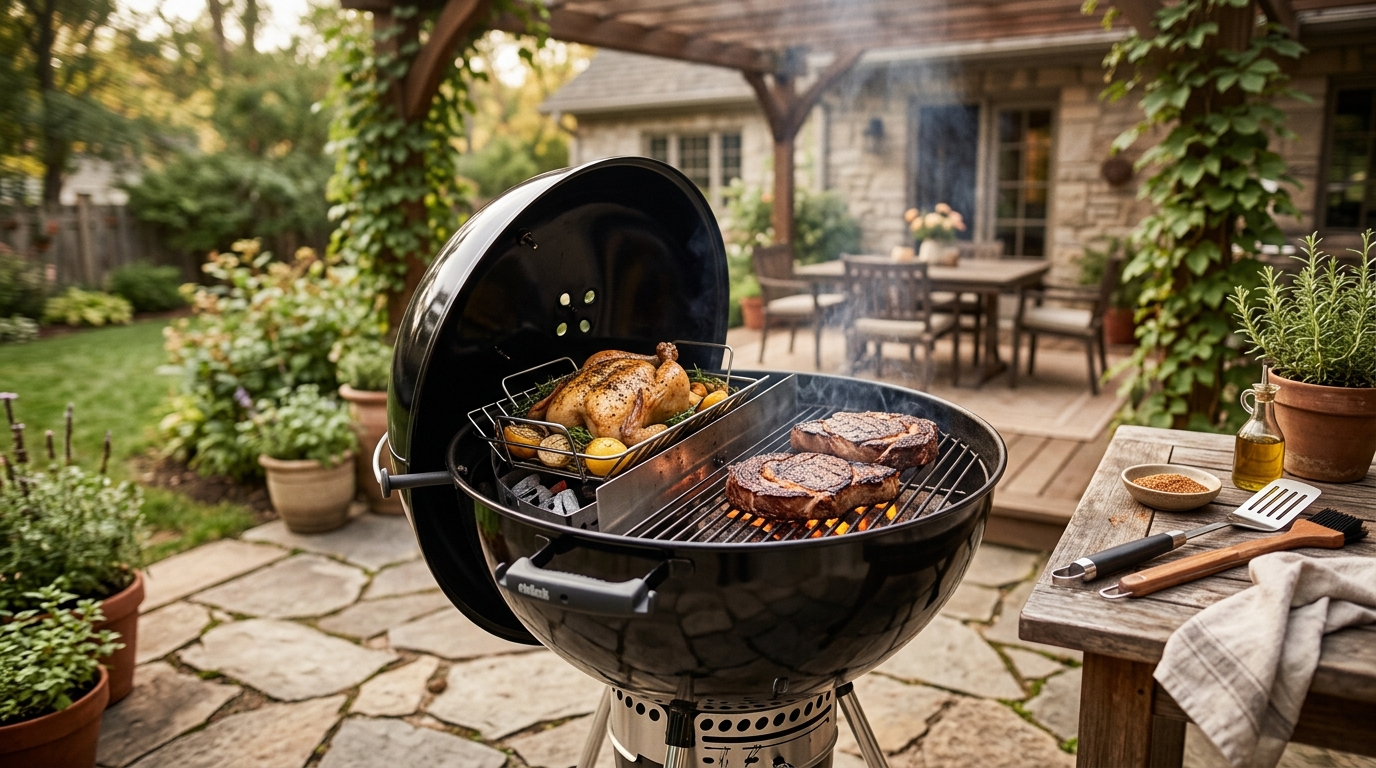
The short answer: Use direct heat for thin cuts — steaks, burgers, fish fillets, vegetables — that cook through in under 10 minutes. Use indirect heat for thick cuts and whole proteins — whole chicken, ribs, pork shoulder, brisket — that need more than 15 minutes to cook through safely without burning the exterior.
Direct vs indirect grilling: side-by-side comparison
| Product | Best for | Rating | Notes | |
|---|---|---|---|---|
| Heat source position | Direct: flame directly below the food. Indirect: flame to the side. | — | Indirect creates a convective oven environment when the lid is closed. | — |
| Best food types | Direct: steaks, burgers, fish, veggies. Indirect: whole chicken, ribs, roasts. | — | Thickness and total cook time determine which method is correct. | — |
| Lid position | Direct: lid up for thin cuts, down for thicker. Indirect: lid always closed. | — | Leaving the lid up on indirect cooks defeats the method entirely. | — |
| Typical cook time | Direct: 2-12 minutes total. Indirect: 30 minutes to several hours. | — | Indirect cooks rely on internal temperature, not time alone. | — |
| Temperature at grate | Direct: 450-700°F+. Indirect: 225-375°F depending on fire size. | — | Indirect temperature is controlled by vent dampers or burner knobs. | — |
| Hands-on attention | Direct: high (frequent flipping). Indirect: low (check every 30-45 min). | — | Indirect cooks are more forgiving once dialed in. | — |
| Risk of burning exterior | Direct: high for thick cuts. Indirect: very low. | — | Thick cuts on direct heat burn outside before cooking through. | — |
| Thermometer required | Direct: optional. Indirect: essential. | — | Internal temperature is the only reliable guide on indirect cooks. | — |
What is direct heat grilling?
Direct heat grilling means the food sits directly above the heat source — charcoal or gas burners — with flame or radiant heat immediately below. Temperatures at the grate surface typically run 450°F to 700°F or higher. The Maillard reaction happens fast at these temperatures: a hamburger patty goes from raw to a proper crust in 3-4 minutes per side.
What foods belong on direct heat
Direct heat is the right choice for:
- Steaks up to 1 inch thick: Skirt steak, flank steak, flatiron, hanger steak — thin cuts that benefit from aggressive surface caramelization
- Hamburgers and smash burgers: A 3/4-inch patty cooks through in 8 minutes total with a proper crust on a 500°F grill
- Boneless chicken breasts and thighs: Under 3/4 inch thickness goes direct — flip every 2-3 minutes to prevent char
- Fish fillets and shrimp: Salmon, mahi-mahi, and shrimp cook in 3-6 minutes total at high heat
- Vegetables: Asparagus, zucchini, bell peppers, corn — direct heat caramelizes sugars and creates char marks in 4-5 minutes
- Hot dogs and bratwurst: Direct heat crisps casings in 5-8 minutes with minimal attention
The rule of thumb: if the food can finish before the outside burns, it belongs on direct heat.
Best for Maximizing direct heat sear marks and reducing flare-ups
GrillGrates Raised Rail Grill Grates
Aluminum rail grates concentrate heat into focused strips and redirect flare-ups away from food. The result is steakhouse-quality grill marks and faster Maillard crust development at lower grill temperatures. Compatible with gas and charcoal grills from 14 to 72 inches wide.
★★★★★ 4.7
Check current price on Amazon→Pros
- Concentrates heat for better grill marks and faster searing
- Redirects flare-ups so fat drips harmlessly between rails
- Compatible with most gas and charcoal grill sizes
- Aluminum construction cleans quickly and resists rust
Cons
- Additional upfront cost on top of grill purchase
- Takes a few cooks to learn optimal positioning and heat timing
- Retains slightly less heat than cast iron in very cold weather
What is indirect heat grilling?
Indirect heat grilling means no heat source directly below the food. On a charcoal grill, you pile all coals to one or both sides of the grill with an empty zone in the center. On a gas grill, you run the outer burners and leave the center burner off. You close the lid, and the grill becomes a convection oven — heat circulates around the food from the sides rather than radiating up from below.
Cooking temperatures in indirect mode depend on how much charcoal you use or how high you set the gas burners. A full chimney of charcoal banked to one side produces 350-375°F in the indirect zone. A half chimney spread thin produces 225-250°F — low-and-slow smoking territory.
What foods belong on indirect heat
Indirect heat is the right choice for:
- Whole chicken and turkey: Thighs and breasts cook at different rates — indirect heat evens this out without burning the skin before the interior is safe
- Bone-in chicken pieces: Thighs and drumsticks need 40-50 minutes at 350°F to hit 175°F internally without charring
- Rack of ribs: Baby back ribs spend 4-5 hours at 250-275°F indirect; spare ribs need 5-6 hours
- Thick steaks (1.5 inches and above): A 2-inch ribeye placed directly over high heat burns the exterior in 12-15 minutes before the center reaches 130°F — indirect brings the interior up first
- Pork shoulder and brisket: Low-and-slow indirect is the only method that renders collagen into gelatin over 8-12 hours
- Cedar plank salmon: The plank smolders and the fish steams gently over indirect heat for 20-25 minutes
How to set up indirect heat on a charcoal grill: step by step
- Fill a chimney starter with briquettes — about 80-100 for standard indirect heat; 40-50 for low-and-slow
- Wait 15-20 minutes until the top coals are fully lit and glowing with a gray ash coat
- Bank the coals to one side of the grill, leaving a coal-free zone that is at least as wide as your food
- Place a drip pan in the empty zone beneath where the food will sit — catch drippings and add water to help regulate temperature on long cooks
- Insert a probe thermometer into the thickest part of the food and place it on the grate over the empty zone
- Close the lid with the top vent positioned over the food, not the coals — this draws heat and smoke across the food before exiting
- Monitor every 30-45 minutes; on cooks over 2 hours, add 8-10 unlit briquettes to the pile to maintain stable temperature
How to set up indirect heat on a gas grill
On a three-burner gas grill: light the left and right burners, leave the center burner off. Place food over the center burner. Adjust the lit burners to hit your target temperature — medium setting typically produces 325-350°F in the indirect zone.
On a two-burner gas grill: light one burner, leave the other off. Place food over the unlit burner. One burner on medium usually produces 300-325°F indirect.
Best for Checking doneness on both direct and indirect cooks
ThermoWorks Thermapen ONE Instant-Read Thermometer
One-second temperature readings eliminate guesswork on every cook. A reliable instant-read thermometer is the single tool that most improves results across all grilling methods — it is non-negotiable for indirect cooks where the exterior gives no doneness cues. The Thermapen ONE reads to 0.7°F accuracy in a single second.
★★★★★ 4.9
Check current price on Amazon→Pros
- One-second readings at 0.7°F accuracy — the fastest in its class
- Foldable probe that auto-powers on and off with the fold
- Large backlit display readable in direct sunlight and rain
- IP67 water-resistant rating survives accidental splashes and drops
Cons
- $105 price point is a significant investment over budget options
- No wireless probe for monitoring long indirect cooks through the lid
- Overkill for cooks who only grill burgers and hot dogs over direct heat
The two-zone fire: using both methods on one grill
The two-zone fire is the most versatile configuration in backyard grilling. It gives you a direct zone for searing and an indirect zone for finishing — both available at the same time without adjusting anything mid-cook.
How to build a two-zone charcoal fire
Light a full chimney of briquettes and pour all of them onto one half of the kettle grill. The coal side is your direct zone; the empty side is your indirect zone. A full chimney banked to one side produces:
- Direct zone: 500-600°F at grate level
- Indirect zone: 350-400°F when the lid is closed
This setup lets you sear burgers and steaks over the hot side, then slide them to the cool side to finish without burning. It also lets you run two different foods simultaneously — direct vegetables and indirect chicken thighs at the same time.
The reverse sear: the best technique for thick steaks
The reverse sear uses both zones in sequence and consistently produces better results on steaks 1.5 inches and thicker than direct heat alone:
- Season the steak with salt and pepper at least 45 minutes before cooking, or the night before
- Start on the indirect side at 225-250°F until the internal temperature reaches 115-120°F — roughly 30-40 minutes for a 2-inch ribeye
- Move immediately to direct heat over the hot coals and sear 60-90 seconds per side until internal temperature reaches 130-132°F for medium-rare
- Rest 5 minutes before slicing — the steak is already at temperature, so only a short rest is needed
The reverse sear produces an even cook edge-to-edge with a thicker, crispier crust than the traditional sear-first approach. The slow indirect phase dries the surface, which then evaporates instantly when the steak hits the hot zone, giving the sear an aggressive head start.
Best for Turning a standard kettle grill into a reliable two-zone and low-and-slow machine
Slow N Sear Plus Charcoal Basket Insert
A stainless steel insert for the 22-inch and 26-inch Weber Kettle that holds charcoal in a tight basket on one side with a built-in water reservoir to stabilize temperature on long cooks. The Slow N Sear is the most effective single upgrade for a kettle grill — it turns a basic setup into a credible low-and-slow smoker.
★★★★★ 4.7
Check current price on Amazon→Pros
- Creates a reliable two-zone fire with minimal charcoal fiddling or reorganizing
- Built-in water reservoir maintains stable indirect temperature for 6-8 hour cooks
- Stainless steel construction survives years of high-heat use without warping
- Compatible with both 22-inch and 26-inch Weber Kettle grills
Cons
- Requires a Weber Kettle grill — not compatible with other grill shapes or brands
- Price of $100+ equals half the cost of the kettle itself
- Water reservoir needs refilling on cooks longer than 4 hours
A food-by-food guide: direct vs indirect at a glance
| Food | Approx. Thickness | Method | Target Internal Temp |
|---|---|---|---|
| Skirt or flank steak | 1/2 inch | Direct | 130°F (medium-rare) |
| Ribeye or strip steak | Up to 1 inch | Direct | 130°F |
| Thick ribeye or strip | 1.5 inches+ | Reverse sear (indirect then direct) | 130°F |
| Hamburger patty | 3/4 inch | Direct | 160°F |
| Boneless chicken breast | 3/4 inch | Direct | 165°F |
| Bone-in chicken thigh | — | Indirect at 350°F | 175°F |
| Whole chicken | — | Indirect at 375°F | 165°F breast / 175°F thigh |
| Baby back ribs | — | Indirect at 250-275°F | 195-203°F (probe tender) |
| Pork shoulder | — | Indirect at 225-250°F | 195-205°F |
| Salmon fillet | 1 inch | Direct, 2-3 min per side | 125-130°F |
| Asparagus and zucchini | — | Direct | Visual char, 3-4 minutes |
What to skip with each method
Common direct heat mistakes:
- Putting thick cuts (a 2-inch ribeye, a whole split chicken breast) on direct heat without a finish on the indirect zone — the exterior burns before the interior is safe
- Pressing down on burgers during the cook — squeezes out juice and causes aggressive flare-ups
- Walking away — thin cuts at 500°F need attention every 2-3 minutes
Common indirect heat mistakes:
- Opening the lid repeatedly to check — each opening drops grill temperature by 50°F and can add 10-15 minutes to a long cook
- Running indirect with too few coals and not monitoring — temperature can fall below 200°F, turning a 5-hour rib cook into a 7-hour one
- Skipping the thermometer and judging by time — indirect cook times vary by 30-60 minutes depending on grill temperature, ambient temperature, and wind
FAQ
Frequently asked questions
What is the main difference between direct and indirect grilling?
Do you close the lid for direct grilling?
How do you control temperature during indirect grilling on charcoal?
What temperature is indirect grilling?
Can you do indirect grilling on a small grill?
When should I use both direct and indirect in the same cook?
Bottom line
Direct heat is for thin, fast-cooking proteins and vegetables. Indirect heat is for thick cuts, whole birds, and anything where burning the outside before finishing the inside is the primary risk. The two-zone fire gives you both methods simultaneously and is worth setting up by default on most charcoal sessions.
If you take one thing from this guide: every cook benefits from a probe thermometer, but indirect cooks absolutely require one. Internal temperature is the only reliable doneness signal when there is no crust or surface texture to guide you.
Go deeper: how to grill a perfect steak, how to use a smoker, gas vs charcoal grill, and offset vs pellet smoker.