guides
How to Grill Lobster Tails
Grill perfect lobster tails every time: butterfly technique, direct vs indirect heat, timing, seasoning, and the mistakes that ruin them.
 Cole Whitaker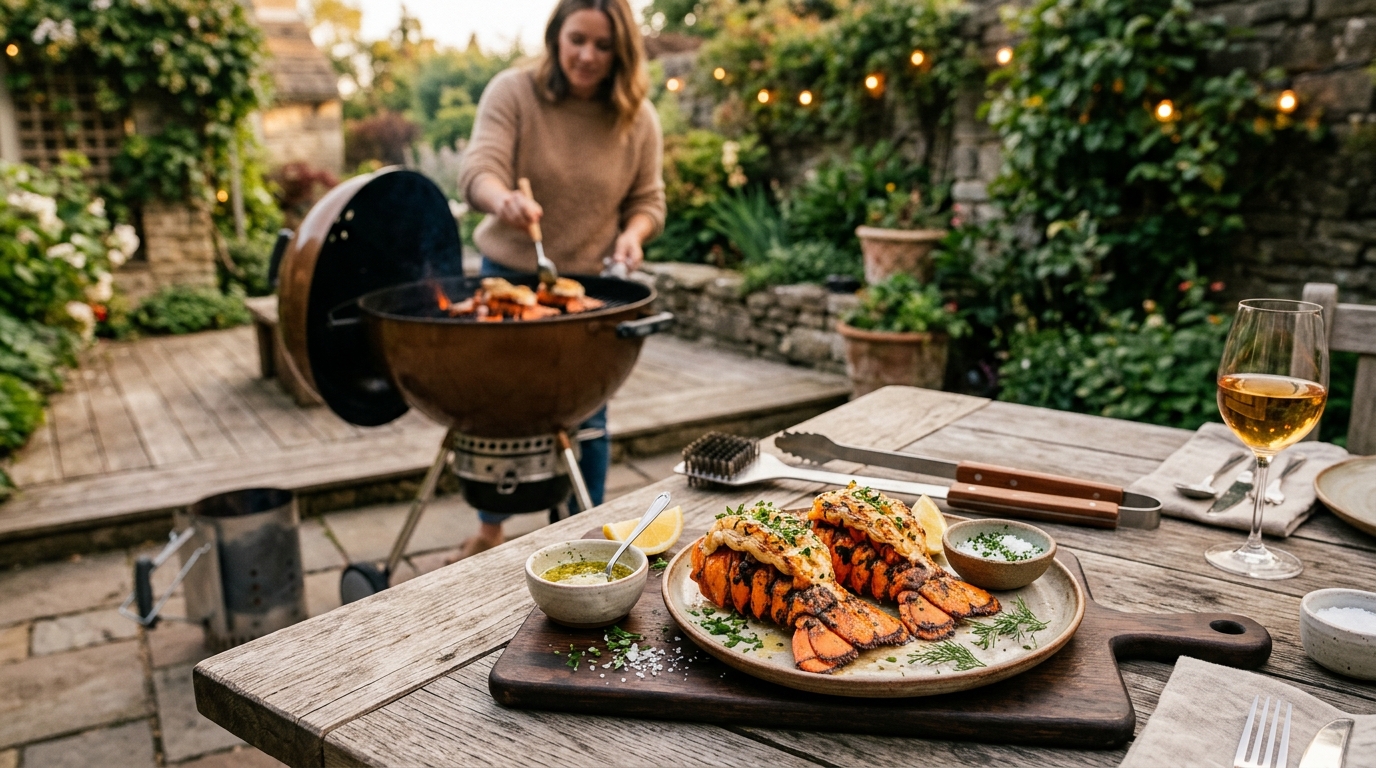
Butterfly the shell with kitchen shears, pull the meat up and rest it on top, then grill flesh-side down over direct high heat (450°F) for 5–6 minutes before flipping to finish shell-side down. An 8-ounce lobster tail reaches 140°F in about 10 minutes total. The butterfly method gives you grill marks on the meat and makes doneness easy to judge.
Which lobster tails are best for grilling?
Lobster tails from different species and sizes cook differently. Knowing what you are buying determines which technique to use and how much time you have before the meat goes past its peak.
Cold-water tails (Maine or Canadian) are the best choice for grilling. Cold-water lobsters — primarily Homarus americanus from the North Atlantic — have denser, sweeter meat with lower water content than their warm-water counterparts. That lower moisture means they develop better char marks on the grill without releasing liquid and steaming. They are also more forgiving across a range of internal temperatures, staying tender even if you pull them a few degrees past the target. Cold-water tails are seasonally available fresh from June through December and can be found frozen year-round.
Warm-water tails are widely available and a solid choice with careful timing. Caribbean spiny lobster and Brazilian tails are sold frozen at most grocery stores and seafood counters at a lower price point. The meat is slightly softer with higher water content, which means it cooks faster and goes rubbery more quickly if you overshoot the temperature. Pull warm-water tails at the low end of the doneness range (135–140°F) and move quickly once they come off the grill.
| Product | Best for | Rating | Notes | |
|---|---|---|---|---|
| Cold-water tails (Maine/Canadian) | Best flavor and most forgiving | ★★★★★ | Dense, sweet meat that holds up well to direct high heat. Lower moisture means better grill marks and less steaming. More expensive per pound but noticeably superior texture. Available fresh in season or frozen year-round. | — |
| Warm-water Caribbean spiny tails | Most widely available, best value | ★★★★☆ | Sold frozen at most grocery stores. Good flavor but softer texture that overcooks quickly. Pull at 135–140 degrees F for best results. Lower price makes them the practical choice for larger groups. | — |
| Rock lobster tails (Australian/South African) | Premium option for special occasions | ★★★★★ | Exceptionally sweet flavor, firm meat, and impressive size. Often sold in the 10–16 ounce range. Grill the same way as cold-water tails but adjust time for the larger size. Outstanding if the budget allows. | — |
| Langostino tails | Not suitable for the grill method | ★★★☆☆ | Small, shrimp-like crustacean sometimes sold as lobster tails. No shell structure to butterfly and too small for direct grilling — overcooks in under 2 minutes over high heat. Better used in pasta or warm butter preparations. | — |
What size to buy: Tails in the 6–10 ounce range are the sweet spot for grilling. Large enough to develop grill marks without overcooking the center, small enough to cook through in 10–12 minutes over direct heat. Tails above 12 ounces benefit from starting on direct heat then moving to indirect heat to avoid scorching the exterior before the center reaches temperature.
Fresh vs. frozen: Frozen tails are often more consistent than fresh in most markets because they are flash-frozen immediately after harvest at sea. If buying frozen, thaw completely in the refrigerator — overnight for 8-ounce tails, up to 24 hours for anything larger. Never thaw in hot water or at room temperature, which degrades the texture and encourages uneven cooking. After thawing, pat dry immediately.
What tools do you need to grill lobster tails?
You do not need specialized equipment for lobster tails, but two tools — kitchen shears and an instant-read thermometer — are genuinely non-negotiable.
Kitchen shears for butterflying. A sharp chef’s knife can work, but heavy-duty kitchen shears cut through the top shell cleanly, in a straight line, and safely. Look for shears long enough to travel from the wide base of the tail to the fan in one continuous pass without stopping.
Kitchen shears on Amazon — choose shears rated for poultry or shellfish. Disassemble-for-cleaning models are easier to keep sanitary after working with raw shellfish.
An instant-read thermometer. Lobster doneness lives in a 10-degree window (135–145°F). The meat turns white before it reaches a safe internal temperature, so color alone is an unreliable guide. A fast thermometer removes all guesswork and pays for itself after the first lobster tail you rescue from overcooking.
Instant-read thermometer on Amazon — look for models that read in 2–3 seconds. Insert the probe from the open side of the butterflied tail into the thickest part of the meat, not straight through the seared surface.
Long-handled tongs. You need at least 12-inch tongs to flip lobster tails over direct high heat without putting your forearm over the flame zone. Spring-loaded models are easier to use with one hand while the other holds the basting brush.
Long-handled grill tongs on Amazon — 16-inch tongs are the right length for work over a full chimney of charcoal or a gas grill running on high.
A small saucepan or heat-safe bowl for basting butter. You will melt butter and hold it warm near the grill for basting during the cook. A small 1-quart saucepan set on a side burner works perfectly. A heat-safe silicone bowl also works if your grill lacks a side burner.
How to butterfly lobster tails for the grill
Butterflying is the single most important prep step. It exposes the meat to direct heat, creates a surface for grill marks, and gives you a cavity to fill with butter and seasoning during the cook.
1. Position the tail shell-side up. Hold the tail firmly with the tail fan pointing away from you. The hard, segmented top shell faces up; the soft, pale underside faces down on your cutting board.
2. Cut through the top shell with kitchen shears. Insert one blade of the kitchen shears between the top shell and the meat at the wide end where the tail connects to the body. Cut straight down the center of the top shell toward the tail fan, stopping just before you reach the fan. The fan holds the butterfly together and looks better on the plate — do not cut through it.
3. Crack the shell open. Press the sides of the shell apart and downward with your thumbs until the shell hinges open and lies flat. You will hear a distinct crack as the cartilage gives way.
4. Lift the meat out and rest it on top of the shell. Work your fingers under the meat at the wide end and gently loosen it from the inner shell surface, keeping the tail-fan end still attached. Lift the meat upward, then set it down so it rests on top of the open shell halves. The meat now sits fully exposed above the shell, ready for the grill.
5. Pat the meat dry and season immediately. Press paper towels firmly against all exposed meat surfaces to absorb surface moisture. Brush with melted butter or a high-smoke-point oil and season with kosher salt and cracked black pepper just before grilling — salt draws out moisture over time, so season right at the grill.
How to grill lobster tails: step-by-step
1. Preheat to direct high heat. Target 450–500°F at grate level. For gas grills, set all burners to high and close the lid for 12–15 minutes. For charcoal, light a full chimney of briquettes or lump charcoal and spread the coals evenly when fully ashed over. High heat is essential — a medium-temperature grill produces pale, steamed lobster meat with no grill character.
2. Clean and oil the grate. Scrub the grate with a grill brush to remove any residue from previous cooks. Fold a paper towel into a dense pad, soak it in avocado or canola oil, grip it with long tongs, and wipe the grate bars twice before the tails go on.
3. Place the tails flesh-side down. Set the butterflied tails on the grate with the exposed meat facing down, shell side up. Listen for an immediate, loud sizzle — that sound confirms the grate is at temperature. If you hear nothing, give the grill another 3–5 minutes.
4. Grill flesh-side down for 5–6 minutes without moving. Close the lid and set a timer. For 6-ounce tails, check at 4 minutes; for 10-ounce tails, go the full 6 minutes. The meat releases cleanly from the grate once a crust forms — if it resists when you test it, give it another 30–60 seconds and test again.
5. Flip to shell-side down and baste. Once the tails release, flip them so the charred shells face down and the meat faces up. Immediately spoon or brush garlic herb butter generously over the exposed meat so it pools into the cavity. Close the lid.
6. Finish shell-side down for 3–4 minutes. The shell acts as a heat shield, protecting the now-seared meat from direct flame while the grill heat above finishes the center. The butter you basted into the cavity infuses the meat with flavor during this phase.
7. Check the internal temperature. Insert an instant-read thermometer from the open side of the tail into the thickest portion of the meat. Pull the tails at 140°F. The meat will be opaque white and just barely firm to the touch. At 145°F (the FDA minimum) the texture is still acceptable. Above 150°F the lobster becomes chewy and releases moisture as it cools.
8. Rest for 2 minutes and serve with extra butter. Set the finished tails on a warm platter and rest for 2 minutes — this allows internal temperatures to equalize and juices to redistribute slightly. Serve immediately with extra melted garlic butter and lemon wedges.
What temperature should you grill lobster tails at?
Grill lobster tails at 450–500°F over direct high heat. This range is necessary to char the shell, produce grill marks on the meat, and cook through a 6–10 ounce tail in 8–12 minutes. Lower heat means more time on the grill, which dries out the lean meat before the center reaches temperature.
Internal temperature targets by result:
- 135–140°F — ideal; the center just finishes from carryover heat, silky texture
- 140–145°F — fully opaque, FDA-safe minimum, still tender if you pull quickly
- Above 150°F — avoid; meat turns tough and releases water as it cools on the plate
Lobster tail has an even narrower doneness window than shrimp or scallops. Use an instant-read thermometer every single time.
Garlic herb butter and seasoning ideas
Simple preparations show off lobster rather than masking it. The sweet, briny flavor of the meat needs enhancement, not competition.
Classic garlic herb butter: Melt 4 tablespoons of unsalted butter with 3 cloves of finely minced garlic over low heat. Remove from heat and stir in 1 tablespoon of fresh flat-leaf parsley, 1 teaspoon of fresh chives, a squeeze of lemon juice, and 1/4 teaspoon of kosher salt. Keep warm near the grill and use for basting during the shell-side-down phase and again as a finishing sauce at the table.
Cajun spice rub: Combine 1 teaspoon smoked paprika, 1/2 teaspoon garlic powder, 1/2 teaspoon onion powder, 1/4 teaspoon cayenne, 1/4 teaspoon dried thyme, and 1 teaspoon kosher salt. Dust over the meat side before the initial flesh-down sear. Baste with plain melted butter during the final shell-side-down phase so the spice infuses into the cavity.
Lemon herb oil: Whisk together 3 tablespoons of olive oil, the zest of one lemon, 1 tablespoon of fresh thyme leaves, and salt and pepper. Brush over the meat just before grilling instead of butter. The oil has a higher smoke point and adds clean brightness without the richness of butter.
Finishing flaky sea salt on Amazon — a small pinch of Maldon or similar flaky finishing salt over the plated tails just before serving adds crunch and a clean salt burst that table salt or kosher salt cannot replicate.
What mistakes ruin grilled lobster tails?
Grilling from frozen. Even a partially frozen tail cooks unevenly — the outer layer overcooks before the center reaches temperature. Thaw completely in the refrigerator before grilling. There is no safe shortcut.
Skipping the butterfly. Tails grilled flat in the shell cook slowly and unevenly, with the meat steaming inside the shell cavity rather than searing. Butterflying takes less than two minutes and is the single biggest difference between restaurant-quality grill marks and pale, steamed meat.
Using medium heat. High heat (450°F or above) is required to char the shell and produce grill marks on the exposed meat. Medium heat requires more time on the grill, which dries out the lean meat before any browning occurs. Push the temperature and keep the lid closed between checks.
Overcooking past 150°F. Lobster meat is mostly protein with very little fat, so it has almost no margin once it passes the ideal temperature window. Use a thermometer on every cook and pull at 140°F rather than waiting for visual cues that arrive too late.
Forgetting to baste. Lobster meat is lean and dries out quickly over high heat. Butter basted into the cavity during the shell-side-down phase keeps the meat moist and carries flavor directly into the exposed surface. Skipping the baste produces noticeably drier, less flavorful tails.
Overcrowding the grill. Lobster tails placed too close together trap steam between them and drop the grate temperature. Leave at least 2 inches of space between tails. If grilling for a large group, cook in batches rather than jamming everything onto the grate at once.
FAQ
Frequently asked questions
How long do you grill lobster tails?
Should you grill lobster tails flesh-side down or shell-side down first?
Do you need to butterfly lobster tails before grilling?
What temperature is a lobster tail done at?
Can you grill frozen lobster tails?
How do you keep grilled lobster tails from drying out?
Can you grill lobster tails on a gas grill?
Bottom line
Grilling lobster tails comes down to three things done right: butterfly the tail to expose the meat, use direct high heat (450–500°F) to char the shell and mark the meat, and pull at 140°F before the lean protein dries out. Start flesh-side down for 5–6 minutes to develop grill marks, flip shell-side down for 3–4 minutes while basting with garlic herb butter, and rest for 2 minutes before serving. Every common grilled lobster failure — rubbery texture, pale meat, dry interior — traces to insufficient heat, skipping the butterfly, or overcooked temperature. Nail those three variables and a 10-minute cook delivers restaurant-quality results at home.
For more seafood and grilling guides: how to grill scallops, how to grill salmon, how to grill shrimp skewers, and best instant-read thermometers for the grill.