roundups
Best Charcoal for Weber Grills in 2026
Best charcoal for Weber Kettle, Performer, and Master-Touch grills. Weber Briquettes, Jealous Devil, Kingsford, and Royal Oak ranked for Weber use.
 Cole Whitaker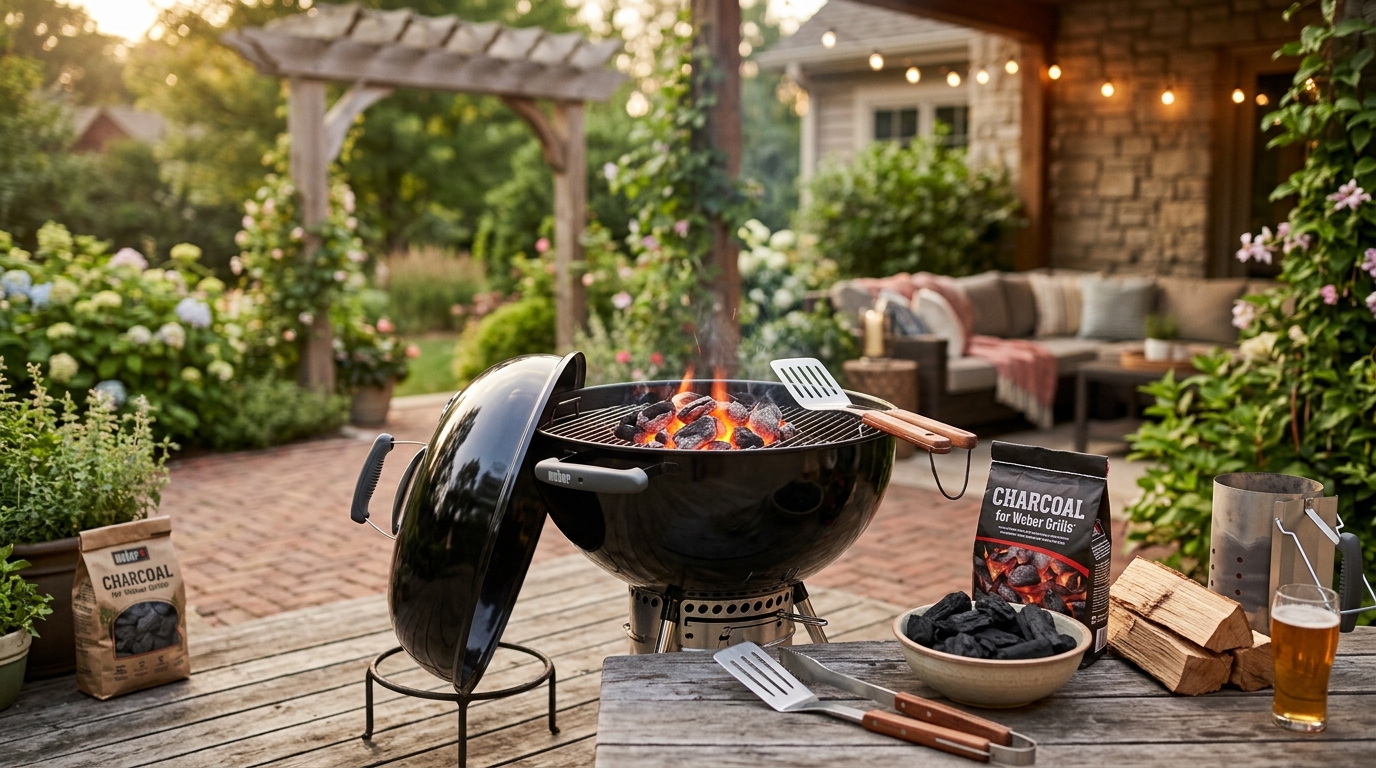
For a Weber Kettle, the best charcoal is Weber Briquettes for long low-and-slow sessions and Jealous Devil Hardwood Lump for high-heat searing. Kingsford Original is the best everyday pick available at any hardware store. The Weber Kettle’s damper system and ceramic-coated interior are specifically tuned for briquette fuel, but quality lump charcoal outperforms on direct-heat steaks and burgers where peak temperature matters.
Weber grills are not all the same. A 22-inch Kettle used for weekend burgers has different charcoal needs than a Weber Performer Deluxe running a 10-hour pork shoulder. Charcoal type determines how long your fire holds, how hot the grate gets, and how much ash accumulates in the bowl between cooks. Weber’s own briquettes are engineered for the kettle’s geometry — but three other charcoals consistently outperform the Weber house brand depending on the cook type. Here is what actually works.
Quick comparison
| Product | Best for | Rating | Notes | |
|---|---|---|---|---|
| Weber Briquettes Charcoal | best for low-and-slow on Weber; 8-hour snake arrangement without refueling | ★★★★★ | $20-28 for 15 lb. Engineered for Weber Kettle geometry. Longer burn than Kingsford. | Check price |
| Jealous Devil Hardwood Lump Charcoal | best for high-heat searing; 1,200°F+ for steakhouse-grade crust on Weber | ★★★★★ | $22-28 for 20 lb. South American marabu hardwood. Minimal debris ratio. | Check price |
| Kingsford Original Charcoal Briquettes | best everyday pick; consistent temperature, available at any hardware store | ★★★★★ | $18-25 for 18 lb. The standard briquette. Burns 45-60 min per full chimney. | Check price |
| Royal Oak All Natural Hardwood Lump | best value lump; hardwood performance at Home Depot prices | ★★★★★ | $15-22 for 15.4 lb. Red oak, hickory, maple blend. Wide retail availability. | Check price |
The picks
Best for Weber low-and-slow: Weber Briquettes Charcoal
Best for anyone running low-and-slow cooks on a Weber Kettle who needs an 8-hour snake arrangement without manual refueling
Weber Briquettes Charcoal (15 lb)
Weber Briquettes are the only charcoal on this list designed specifically for the Weber Kettle's dimensions and damper system. The briquette geometry is denser and more uniform than Kingsford — this matters for the charcoal snake technique, where briquettes arranged in a single or double row along the kettle's inner edge need to ignite sequentially for steady, slow-moving heat. With Weber Briquettes in a 22-inch kettle, a snake of 70-80 briquettes holds 225-250°F for a full 8 hours before the fire drops below cooking temperature. The same arrangement with Kingsford typically requires adding more charcoal at the 5-6 hour mark. Weber Briquettes also produce less ash per pound than Kingsford — important on long cooks where ash accumulation in the bowl can insulate the charcoal from the air supply and stall the temperature. The price ($20-28 for 15 lb) is higher per pound than Kingsford, but the extended burn duration means fewer pounds per cook-hour on 6-10 hour sessions. For anyone who regularly uses their Weber Kettle for pork shoulder, brisket, or full racks of ribs, Weber Briquettes are the logical first choice — not because of brand loyalty, but because the burn profile matches the equipment's design.
★★★★★ 4.7 · 5,400 reviews
Check current price on Amazon→Pros
- Snake arrangement holds 225-250°F for 8 hours in a 22-inch Weber Kettle without refueling
- 30-40% longer burn duration per briquette than Kingsford — fewer pounds needed per cook-hour
- Lower ash output than Kingsford; less vent clogging on long sessions
- Uniform shape makes snake arrangements consistent and predictable every time
- Lower lighting odor than Kingsford during startup — no mineral coal binder smell
Cons
- $20-28 for 15 lb is the highest per-pound cost among briquette options
- Not available at most grocery stores; typically online or at Weber dealers
- Ash-over time slightly longer than Kingsford — adds 5-10 minutes to lighting
- Not optimized for high-heat searing; Jealous Devil lump peaks 200°F+ higher for steaks
Best for high-heat searing on Weber: Jealous Devil Hardwood Lump Charcoal
Best for Weber Kettle owners who want the hottest possible fire for steaks, reverse-sear finishes, and high-heat chicken
Jealous Devil All Natural Hardwood Lump Charcoal (20 lb)
The Weber Kettle is one of the best searing tools available when loaded with the right charcoal — and Jealous Devil is that charcoal. Made from South American marabu hardwood, which is denser than North American oak or hickory, Jealous Devil peaks at 1,200-1,400°F in a chimney starter and sustains 900-1,100°F at the cooking grate. That is 200-300°F higher than any briquette, including Weber's own brand. On a 22-inch kettle with a Jealous Devil fire banked to one side and the Sear Grate accessory or standard grates over it, you can achieve a steakhouse-quality crust on a ribeye in 90-120 seconds per side — the kind of hard, brown, caramelized surface that is physically impossible at briquette temperatures. The bag quality is exceptional: Jealous Devil runs roughly 5-10% fine pieces and debris by weight versus 20-30% for most lump brands, which means less charcoal falling through the grate and more consistent fire from a full chimney load. At $22-28 for 20 lb the per-pound cost is similar to Weber Briquettes, but the higher burn temperature and re-lightable nature of lump (unused pieces re-ignite reliably at the next session) make the economics competitive for frequent users. For Weber Kettle owners who primarily cook steaks, burgers, and direct-heat proteins, Jealous Devil is the better fuel than any briquette.
★★★★★ 4.8 · 14,200 reviews
Check current price on Amazon→Pros
- Peaks 1,200-1,400°F — 200-300°F hotter than any briquette for true high-heat searing
- Exceptional bag quality with just 5-10% fine pieces and debris by weight
- Large, dense marabu hardwood chunks hold form on the grate rather than falling through
- Re-lights between cooks; unused charcoal is recovered, not wasted like briquettes
- Clean smoke with no mineral coal or binder off-flavors during lighting
Cons
- $22-28 for 20 lb — premium price not available at most retail stores without ordering online
- Burns faster than briquettes at high temp; plan on more charcoal per cook for long sessions
- High heat requires active airflow management — beginners may overshoot target temperatures
- Not ideal for snake arrangements; irregular lump shape does not pack evenly for slow smoldering
Best everyday charcoal for Weber: Kingsford Original Charcoal Briquettes
Best for everyday Weber Kettle use where predictable temperature, nationwide availability, and forgiving burn characteristics matter most
Kingsford Original Charcoal Briquettes
Kingsford Original is the charcoal that shipped in the box when your neighbors bought their first Weber Kettle, and it earns that association: consistent burn, consistent temperature, available at every grocery store and hardware chain in the country. A full chimney of Kingsford in a Weber Kettle produces 450-500°F direct-zone temperature for 45-60 minutes — reliably, every time, without guessing. The pillow shape lights evenly in a chimney starter in 20-25 minutes, and the uniform size makes two-zone fire setups straightforward: bank left side, cool right side, move food between them as needed. Kingsford's trade-offs are real but mostly invisible for casual use: it produces more ash per cook than Weber Briquettes or quality lump, the binders emit a faint chemical smell for the first 10-15 minutes of lighting (fully dissipated before cooking), and peak temperature is lower than hardwood lump. For anyone grilling burgers and chicken thighs on weekends without interest in low-and-slow technique, Kingsford Original is the right charcoal — it is consistently available, consistently behaves, and costs $18-25 for 18 lb at any hardware store.
★★★★★ 4.7 · 32,800 reviews
Check current price on Amazon→Pros
- Available at every grocery store, gas station, and hardware chain — no planning required
- Predictable burn curve: full chimney delivers 450-500°F direct heat for 45-60 minutes
- Lights reliably in 20-25 minutes — the most forgiving ignition of any charcoal on this list
- Industry-standard benchmark for 80+ years — proven track record
- Competitively priced at $18-25 for 18 lb; frequently on sale in summer
Cons
- Higher ash output than Weber Briquettes or lump; empty the ash catcher more frequently
- Binders emit a faint chemical odor for 10-15 minutes during lighting — wait until fully ashed over
- Peak temperature capped around 800-900°F — cannot match lump charcoal for steakhouse-grade searing
- Does not re-light reliably between cooks; partially burned briquettes are single-use
Best value lump for Weber: Royal Oak All Natural Hardwood Lump
Best for Weber Kettle owners who want real hardwood lump performance at near-briquette prices, available at Home Depot without online ordering
Royal Oak All Natural Hardwood Lump Charcoal
Royal Oak is the most accessible hardwood lump charcoal in the US market — it sits on shelves at Home Depot, Walmart, and most regional hardware stores year-round at $15-22 for a 15.4 lb bag. For Weber Kettle owners who want to try lump charcoal without committing to premium online pricing, Royal Oak is the logical first step. The hardwood blend — red oak, hickory, and maple — burns at 900-1,000°F peak temperature on a Weber grate, noticeably hotter than Kingsford and sufficient for a proper sear crust on most steaks. The smoke contribution from the wood blend is mild and pleasant without overpowering leaner proteins. The honest trade-off versus Jealous Devil is consistency: Royal Oak's production scale means bag-to-batch quality varies — some bags run clean with large, uniform pieces; others include more bark, dust, and small fragments that fall through the Weber grate. This variance isn't a cook-ruining problem, but it explains why serious sear cooks prefer Jealous Devil's guaranteed piece quality. For weekend grilling and casual experimentation with lump charcoal on a Weber Kettle, Royal Oak delivers a real upgrade from briquettes at a price point that doesn't require justification.
★★★★★ 4.6 · 11,700 reviews
Check current price on Amazon→Pros
- Available at Home Depot and Walmart year-round — no online ordering required
- $15-22 for 15.4 lb — lump charcoal at near-briquette pricing
- Red oak, hickory, maple blend burns 900-1,000°F on a Weber grate — clear searing upgrade over briquettes
- Re-lights between cooks; unused pieces are not wasted like single-use briquettes
- Mild, balanced wood smoke without overpowering lighter proteins
Cons
- Batch-to-batch consistency varies at this production scale — bag quality less predictable than Jealous Devil
- Higher bark and small-piece debris ratio than premium lump brands; some pieces fall through the grate
- Peak temperature lower than South American marabu-based lump — good for most applications, not optimal for ultra-high-heat work
- Not engineered for snake arrangements; irregular size complicates low-and-slow kettle technique
What to skip for Weber grills
Matchlight and instant-light charcoal. Weber Kettle surfaces — the ceramic-coated bowl, the cooking grate, and the vents — concentrate lighter fluid vapors more than open grill designs. The petroleum smell that pre-soaked briquettes emit during the first 20-30 minutes lingers in the kettle environment and transfers to food even after the charcoal is fully ashed over, particularly on chicken skin and fish fillets where surface area is high. A $15-25 chimney starter eliminates this problem completely. It is the single best upgrade for any Weber Kettle owner.
Generic “charcoal” with unlisted ingredients. Bags at $5-9 for 10 lbs that do not specify “hardwood” or “natural wood” typically contain a significant mineral coal byproduct fraction. The ash output is heavy and gray, clogs Weber’s bottom vents faster than wood ash, and requires more frequent cleaning. Weber’s venting system is designed for wood-based ash; mineral coal ash accumulates differently and can stall temperature control on longer cooks.
Restaurant Depot binchotan for backyard Weber use. Binchotan burns at extreme temperatures with almost no flame or smoke and requires a specific direct-flame lighting method for 30-45 minutes before use — a chimney starter does not work. On a Weber Kettle, the setup complexity and $80-120 price per bag add no practical advantage over Jealous Devil at a third of the cost. Reserve binchotan for traditional yakitori grills where it belongs.
FAQ
Frequently asked questions
How much charcoal do I need for a Weber 22-inch Kettle?
Are Weber Briquettes worth the extra cost over Kingsford?
Can I use lump charcoal in a Weber Kettle for slow smoking?
How do I use the charcoal snake method on a Weber Kettle?
Does the type of charcoal affect smoke flavor on a Weber?
What is the best charcoal for a Weber Performer Deluxe?
Bottom line
The best charcoal for a Weber grill depends on how you cook: Weber Briquettes ($20-28 for 15 lb) for low-and-slow sessions where an 8-hour snake arrangement needs to hold temperature without intervention. Jealous Devil Hardwood Lump ($22-28 for 20 lb) for high-heat direct grilling where searing temperature matters — it peaks 200-300°F hotter than any briquette. Kingsford Original ($18-25 for 18 lb) for everyday backyard cooking where consistency and availability outrank peak performance. Royal Oak Lump ($15-22 for 15.4 lb) for anyone who wants to upgrade from briquettes without ordering online.
Most serious Weber Kettle owners keep two bags: Weber Briquettes or Kingsford for weekend ribs and chicken, and a bag of Jealous Devil for the days when the ribeyes come out of the freezer. The two fuel types serve genuinely different purposes, and having both on the shelf costs less than one moderately priced steak.
Related reading: best charcoal grills, charcoal vs lump charcoal, how to light a charcoal grill, best charcoal chimney starters.