roundups
Best Charcoal Chimney Starters 2026
Top charcoal chimney starters ranked by capacity, heat-up time, and safety — from the Weber Rapidfire to budget picks that light coals just as fast.
 Cole Whitaker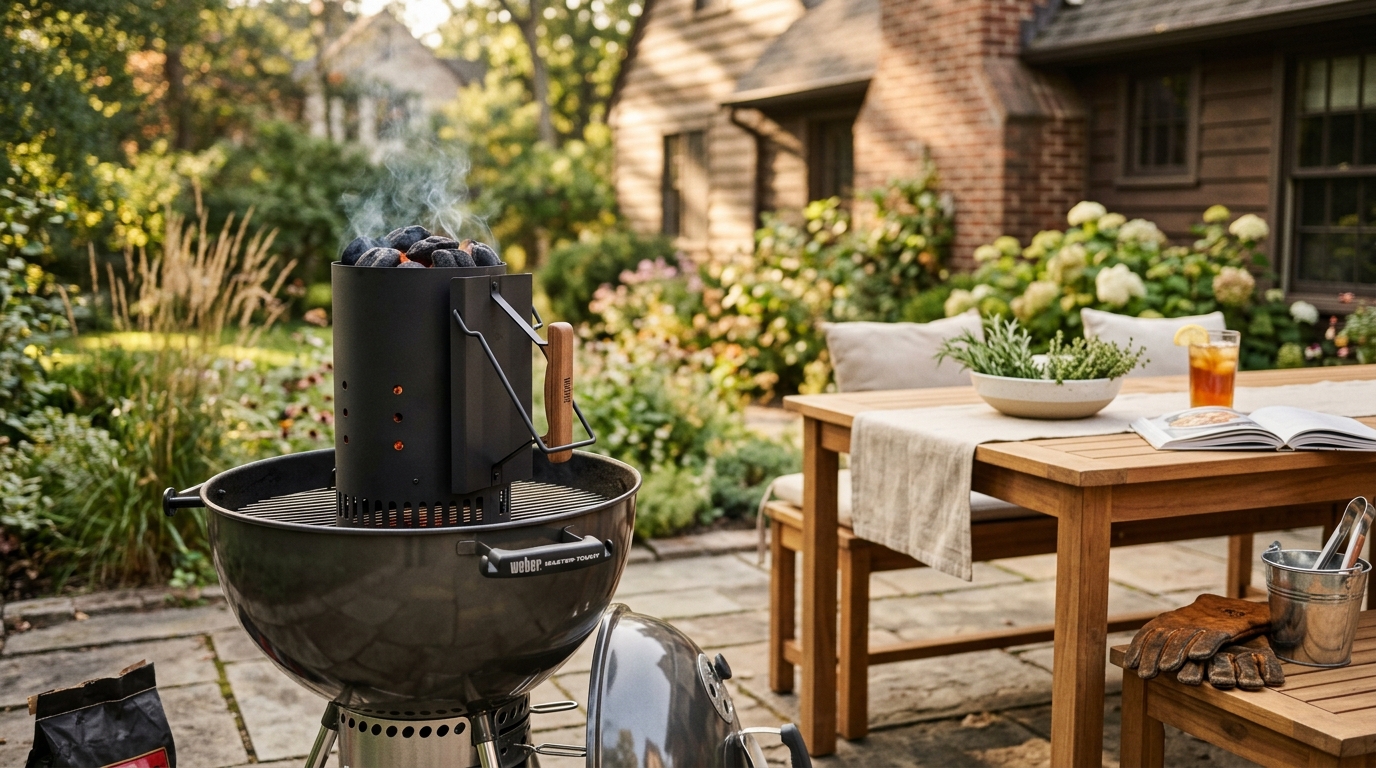
The best charcoal chimney starter is the Weber Rapidfire — it holds 100 briquettes, lights coals in 15-20 minutes using only newspaper, and costs under $25. For large kamado or kettle cooks that need more coal volume, the Char-Griller XL Chimney handles a full 4.5 quarts of charcoal without a second batch.
Fluid-free charcoal lighting starts with a chimney starter. These metal tubes draw heat upward through the charcoal, using convection to ignite the entire load from a single sheet of crumpled newspaper underneath. The coal is ready when the top layer shows gray ash around the edges — typically 15-20 minutes after lighting. No lighter fluid, no chemical taste, no standing over the grill squirting accelerant at half-lit coals. The five picks below cover every grill size and budget from under $15 to $35.
Quick comparison
| Product | Best for | Rating | Notes | |
|---|---|---|---|---|
| Weber Rapidfire Chimney Starter | best overall — most popular chimney in the category by a wide margin | ★★★★★ | Under $25. Holds 100 briquettes. Steel with wooden handle. Lights in 15-20 min. | Check price |
| Weber Premium Rapidfire Chimney Starter | best safety upgrade — heat-shield handle extension reduces burn risk | ★★★★★ | Under $30. Same capacity as standard Rapidfire. Lid-rest notch. Thermoplastic heat shield. | Check price |
| Char-Griller XL Charcoal Chimney Starter | best XL — 4.5-quart capacity for large-format grills and offset smokers | ★★★★★ | Under $30. Largest consumer chimney available. Dual handle design. Heavy steel gauge. | Check price |
| GrillPro Charcoal Chimney Starter | best budget — reliable charcoal lighting under $15 for occasional grillers | ★★★★☆ | Under $15. Smaller capacity than Weber. Functional steel construction. Basic handle. | Check price |
| Kingsford Deluxe Charcoal Chimney Starter | best wide mouth — easiest chimney to fill cleanly without spilling briquettes | ★★★★★ | Under $25. Wider top opening than the Weber. Insulated handle. Vent holes around base. | Check price |
The picks
Best overall: Weber Rapidfire Chimney Starter
Best for any charcoal griller who wants a reliable, durable chimney that lights fast and handles every grill session without a second thought
Weber Rapidfire Chimney Starter
The Weber Rapidfire is the most popular charcoal chimney starter in the category because it does its one job — lighting charcoal — faster and more consistently than anything else at its price. The canister holds 100 briquettes or an equivalent volume of lump charcoal, which is the right amount for a full coal bed in a standard 22-inch Weber kettle or equivalent. Steel construction handles the repeated thermal cycling that destroys cheap chimneys after one season. The wooden handle stays cool enough to pour without gloves — the standard complaint about competing metal-handle designs is the heat transfer from a full load of glowing coals, which the Rapidfire avoids by keeping the wood grip well back from the cone. A wide bottom opening with two rows of ventilation holes draws air efficiently upward through the coal column. The newspaper cup below ignites from one or two sheets of crumpled newsprint without the need for fire starters, lighter fluid, or an electric charcoal starter. At under $25, the Weber Rapidfire is the chimney most experienced charcoal grillers reach for first — and typically the last chimney they need to buy.
★★★★★ 4.8 · 28,000 reviews
Check current price on Amazon→Pros
- 100-briquette capacity handles a full 22-inch kettle coal bed in a single batch
- Steel construction survives seasons of repeated heating and cooling without warping
- Wooden handle stays cool enough to hold without gloves while pouring a full load
- Wide ventilation base lights with one or two sheets of newspaper — no fire starters needed
- Under $25 — best value chimney available at any price point
Cons
- No heat shield — handle heats up with prolonged use beyond the initial pour
- Capacity may be insufficient for extra-large kamado or offset smoker grates in one batch
- Wooden handle collar can char with very frequent use over multiple seasons
Best safety upgrade: Weber Premium Rapidfire Chimney Starter
Best for grillers who have burned themselves holding a standard chimney handle and want a heat-shielded upgrade without switching brands
Weber Premium Rapidfire Chimney Starter
The Premium Rapidfire is the standard Rapidfire with two meaningful improvements: a thermoplastic heat-shield extension on the handle and a lid-rest notch on the top edge. The heat shield is the main reason to pay the extra $5-10 over the standard model. When a chimney starter is full of 800-degree coals and you are tilting it 45 degrees to pour, the metal canister radiates heat upward into the wooden handle collar. The heat shield extends 3 inches below the wooden grip, blocking that radiant heat transfer and letting you pour with bare hands at any pour angle without the urgency that a heating handle creates. The lid-rest notch is a minor quality-of-life feature — you can rest the chimney upside-down on a kettle lid to catch ash rather than setting it directly on the concrete or deck. Capacity and lighting performance are identical to the standard Rapidfire — the same 100-briquette volume, the same steel canister, the same ventilation base design. For households with children nearby at the grill, or for cooks who want an extra margin of safety during the pour, the Premium Rapidfire is the right version to buy.
★★★★★ 4.7 · 9,400 reviews
Check current price on Amazon→Pros
- Thermoplastic heat shield extends 3 inches below the grip — meaningful burn protection during pouring
- Lid-rest notch lets you rest the chimney on a kettle lid to catch falling ash
- Identical 100-briquette capacity and steel construction to the standard Rapidfire
- Same ventilation design and newspaper-lighting reliability as the base model
- $5-10 premium over the standard Rapidfire is justified by the safety improvement
Cons
- Still not rated for prolonged holding — set the chimney down after pouring, not before
- Lid-rest notch only works with Weber kettle lids — no value for kamado or offset users
- Costs slightly more than the standard Rapidfire for a narrowly focused safety improvement
Best XL: Char-Griller XL Charcoal Chimney Starter
Best for cooks who run large kamado grills, 26-inch kettles, or offset smokers and need a full coal load without running a second chimney batch
Char-Griller XL Charcoal Chimney Starter
The Char-Griller XL holds 4.5 quarts of charcoal — roughly 40% more volume than a standard Weber Rapidfire. For a large-format cook on a 26-inch Weber Master-Touch, a Big Green Egg XL, or a wide offset smoker, this extra capacity eliminates the most tedious charcoal management problem: running out of fully lit coals mid-spread and waiting for a second chimney to come up to temperature while the first load starts to cool. The dual handle design includes both a long side handle and a top loop, which gives you two grip options during the pour — the long side handle for a controlled tilt into a tight cooking space, the top loop for a straight overhead pour into a large firebox. Heavy steel gauge handles the expanded thermal load of 4.5 quarts of coal at full heat without the barrel warping that plagued earlier large-format chimneys. Lighting follows the same newspaper-under-the-ventilation-base method as the Weber. At under $30, the Char-Griller XL is the only large-format chimney in this category that combines genuine 4.5-quart capacity with build quality that survives regular use through multiple seasons.
★★★★★ 4.6 · 6,200 reviews
Check current price on Amazon→Pros
- 4.5-quart capacity — largest consumer chimney available, eliminates the second-batch problem
- Dual handle design offers both a side grip and a top loop for flexible pour angles
- Heavy steel gauge resists warping under the increased thermal load of a full XL load
- Same newspaper-lighting method as standard chimneys — no extra consumables required
- Under $30 — large-format capacity at a standard chimney price point
Cons
- 4.5 quarts of lit coal is extremely heavy — requires both hands and good positioning before pouring
- Larger barrel takes slightly longer to light than a standard chimney — budget an extra 5 minutes
- Top loop handle gets hot faster than a side handle during an extended hold — wear gloves for the loop
Best budget: GrillPro Charcoal Chimney Starter
Best for occasional grillers who want to eliminate lighter fluid without spending more than $15 on a chimney
GrillPro Charcoal Chimney Starter
The GrillPro handles the core job of a chimney starter — getting charcoal lit without lighter fluid — for under $15, and it does it without the catastrophic compromise that typically comes with the lowest-priced option in a category. Steel construction is lighter gauge than the Weber, which means it will not last ten years of weekly use, but for a household that grills once or twice a week through summer and occasional weekends otherwise, the GrillPro holds up through multiple seasons without warping or handle failure. Capacity is smaller than the Weber Rapidfire — closer to 75 briquettes than 100 — which is adequate for a standard 18-inch kettle grill or a partial load in a 22-inch. The basic handle runs warmer than the Weber during pouring, so gloves are recommended rather than optional. Ventilation holes in the base draw air adequately for newspaper lighting in most conditions; in wind, a long lighter provides a more reliable ignition than a single match. For a household making its first chimney purchase, or for a secondary chimney kept at a vacation property or camping kit, the GrillPro costs little enough that the upgrade from lighter fluid pays for the chimney itself in one season of lighter fluid savings.
★★★★☆ 4.3 · 3,100 reviews
Check current price on Amazon→Pros
- Under $15 — the lowest-cost entry into fluid-free charcoal lighting
- Steel construction holds up through multiple seasons of occasional use
- Newspaper-lighting method eliminates lighter fluid and its chemical aftertaste
- Compact size is easy to store in a cabinet below the grill or in a camping kit
Cons
- Lighter steel gauge than Weber — will warp with weekly use over multiple seasons
- Handle runs warm during pouring — heat-resistant gloves recommended rather than optional
- 75-briquette capacity is adequate for an 18-inch grill but tight for a full 22-inch spread
- Ventilation base struggles in wind — use a long lighter rather than a paper match
Best wide mouth: Kingsford Deluxe Charcoal Chimney Starter
Best for grillers who regularly spill briquettes loading a standard chimney and want a wider top opening to make filling cleaner
Kingsford Deluxe Charcoal Chimney Starter
Most charcoal chimneys share the same narrow-top silhouette inherited from the original Weber design — effective for lighting but awkward to fill without briquettes rolling off the edge and scattering across the grate. The Kingsford Deluxe widens the top opening by roughly 25% compared to a standard chimney, which makes the loading step substantially cleaner when working with 100 loose briquettes from a bag. A partial rubber coating on the handle provides insulation beyond what bare metal or wood offers; combined with the vent holes arrayed around the circumference of the base rather than concentrated at the bottom, the design allows for a slightly cooler handle than competing metal-handle designs. Capacity is similar to the Weber Rapidfire. The wider base also sits more stably on a concrete pad or patio brick than narrower chimneys, which matters when you are filling and igniting on an uneven surface. For grillers who consider filling the chimney to be the most annoying step in the charcoal lighting process, the wider mouth is a tangible improvement that is worth the marginal price premium over the GrillPro.
★★★★★ 4.5 · 5,800 reviews
Check current price on Amazon→Pros
- Widest top opening in the category — loads briquettes cleanly without spilling
- Vent holes around the circumference rather than concentrated at the base — more even airflow
- Rubber-coated handle section provides more insulation than bare metal handles
- Wider base sits more stably on uneven surfaces while filling and lighting
- Similar capacity to the Weber Rapidfire at a comparable price point
Cons
- Wider opening makes the chimney bulkier to store under or beside the grill
- Rubber handle coating can degrade with prolonged direct heat exposure over seasons
- Wider base is slightly harder to aim precisely when pouring into a narrow firebox
What to skip
Electric charcoal starters. These heating coil devices push into a coal bed and heat the charcoal from within. They take longer than a chimney — typically 15-30 minutes versus 15-20 for a chimney — and require an outdoor electrical outlet within extension cord reach. They also heat only the coals directly touching the coil, requiring manual spreading after removal. The only advantage over a chimney is the elimination of newspaper, which is not a meaningful trade-off given how little newspaper a chimney needs.
Lighter fluid. The chemical case against lighter fluid is often overstated — the petroleum distillates burn off before the charcoal is ready for cooking, assuming you wait for the ash-grey stage and do not add more fluid after ignition. The practical case against it is the pour: a chimney starter uses controlled convection; lighter fluid means squirting an accelerant onto partially arranged charcoal, then waiting a minute before lighting, then waiting again for the flames to die down before cooking begins. The chimney method is faster, more consistent, and requires no consumable beyond newspaper. Once you have cooked over a chimney-lit coal bed, lighter fluid becomes a backup rather than a first choice.
Fire starters sold alongside chimneys. Paraffin wax cubes, compressed sawdust blocks, and similar solid fire starters are marketed as newspaper replacements for chimneys. They are also more expensive per use than the free newspaper you already have, and they do not light the charcoal any faster. If newspaper is unavailable, a single sheet of a paper bag works just as well. The only scenario where fire starters justify the cost is lighting a chimney in sustained rain, where newspaper dampens before ignition.
FAQ
Frequently asked questions
How long does a charcoal chimney take to light?
How much charcoal does a chimney starter hold?
Do I need lighter fluid with a chimney starter?
Is lump charcoal or briquettes better for chimney lighting?
How do I pour charcoal safely from a chimney starter?
Can I use a chimney starter on a gas grill?
Bottom line
Best overall: Weber Rapidfire Chimney Starter (under $25) for the most reliable, well-proven chimney in the category. Best safety upgrade: Weber Premium Rapidfire (under $30) for a heat-shield handle that makes pouring safer at any angle. Best XL: Char-Griller XL Chimney (under $30) for large-format grills that need a full 4.5-quart coal batch in one run. Best budget: GrillPro Charcoal Chimney (under $15) for occasional grillers making their first chimney purchase. Best wide mouth: Kingsford Deluxe Chimney (under $25) for grillers who spill briquettes loading a narrow-top chimney.
For most backyard charcoal grillers, the Weber Rapidfire at under $25 is the only chimney you need. It lights faster and more consistently than anything at its price, and it outlasts every cheaper alternative by years.
Stock your charcoal toolkit: how to light a charcoal grill, gas vs charcoal grill, best charcoal grills, how to grill a perfect steak.