comparisons
Gas vs Pellet Grill: Which Is Better for Beginners?
Not sure whether to buy a gas or pellet grill? Compare startup cost, flavor, ease of use, and maintenance for new backyard cooks.
 Cole Whitaker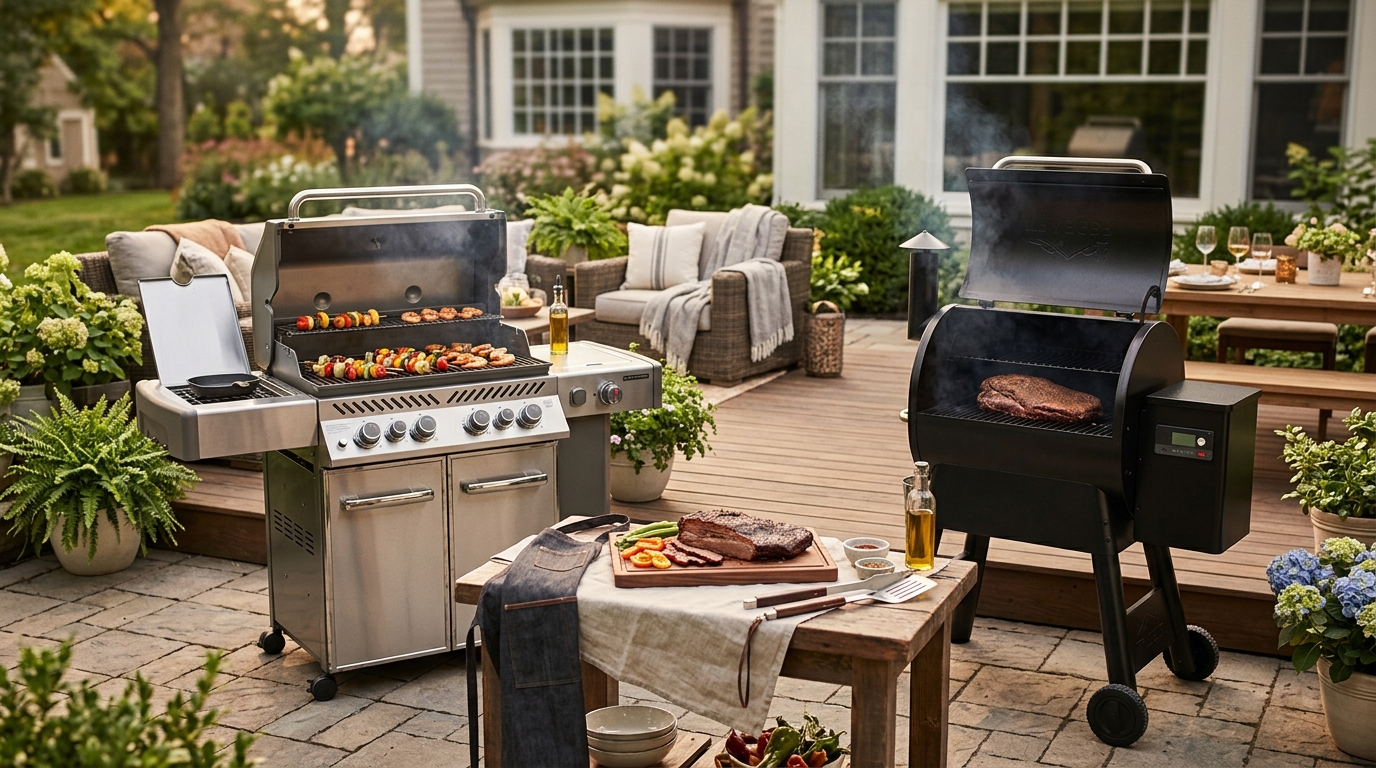
Gas vs pellet verdict: For fast, casual weeknight cooking, choose gas — the Weber Spirit II E-310 delivers reliable heat in under 10 minutes. For real wood smoke flavor and set-and-forget convenience on ribs and brisket, choose a pellet grill — the Traeger Pro 575 is the standard starting point for beginners who want smoke without managing a fire.
How gas and pellet grills compare across 7 key dimensions
| Product | Best for | Rating | Notes | |
|---|---|---|---|---|
| Preheat time | Gas: 5-10 min. Pellet: 10-15 min. | — | Pellet grills need time for the auger to feed pellets and the firepot to ignite before the fan can stabilize temperature. | — |
| Smoke and flavor | Pellet: 7/10. Gas: 1/10. | — | Pellet grills burn wood pellets and produce real smoke compounds. Gas burners produce heat only — no combustion smoke. | — |
| Temperature control | Pellet: 9/10 (digital PID). Gas: 8/10 (manual knobs). | — | Pellet accuracy is typically plus or minus 5 degrees F. Gas knobs give fast manual adjustment across multiple zones. | — |
| High-heat grilling | Gas: 8/10. Pellet: 5/10. | — | Most pellet grills top out at 450-500 degrees F. Gas grills hit 600 degrees F, better for a proper sear on thick steaks. | — |
| Ease of use | Pellet wins for smoking; gas wins for quick weeknight cooks. | — | Pellet grills are genuinely set-and-forget for long cooks. Gas is faster for spontaneous 20-minute meals. | — |
| Running costs | Gas: $0.50-1.50 per cook. Pellet: $1-3 per cook. | — | Wood pellets run about $1 per pound; a pellet grill uses 1-2 pounds per hour at typical smoking temperatures. | — |
| Entry price | Gas from $400 (Weber Spirit II). Pellet from $450 (Pit Boss 700). | — | Pellet grills need more mechanical parts — auger motor, combustion fan, digital controller — which raises the floor price. | — |
When to choose a gas grill
A gas grill is the right pick if you cook on weeknights and want food on the table quickly without any preparation. With no fire setup, no pellet loading, and no waiting for combustion to stabilize, a gas grill removes every barrier to a spontaneous cook.
What gas does best
- Speed: Turn the knob, press the igniter, and you are grilling in under 10 minutes — no fire prep of any kind
- Multi-zone cooking: A three-burner gas grill creates a hot sear zone and a cooler indirect zone simultaneously, useful for cooking bone-in chicken pieces through without burning the exterior
- Temperature precision: Manual knobs give instant adjustment — pulling a zone from high to low takes one second
- Cleanup: No ash, no pellet dust — brush the grates after each cook and you are done in under two minutes
- No electricity required: Gas grills operate with propane or natural gas and work during power outages without any issue
The honest limitation of gas
Gas grills do not produce real smoke. Wood chip boxes placed on a gas burner produce a thin surface smoke film that adds minimal flavor. Smoke rings on ribs, bark on brisket, and genuinely smoked chicken all require combustion of solid fuel. Gas combustion produces water vapor and carbon dioxide — not the phenols, guaiacols, and pyrazines that create smoked meat flavor. If smoking is your primary motivation, gas is the wrong tool.
Best for Weeknight grilling and year-round quick cooks
Weber Spirit II E-310 Gas Grill
The three-burner benchmark for entry-level gas grills. Reliable ignition that fires in cold weather, even heat distribution across all three burners, and a 10-year warranty that most budget competitors cannot match. Built to last 12-15 years with basic care — a genuinely better investment than any discount grill under $300.
★★★★★ 4.7
Check current price on Amazon→Pros
- Preheats to grilling temperature in under 10 minutes
- Three-burner layout creates hot and cool zones for versatile cooking
- 10-year warranty on most components including burners and cookbox
- Open cart design with side tables provides useful prep space
Cons
- No real smoke flavor without wood chip accessories
- Cannot reach the searing temperatures of premium gas grills
- Propane tank sold separately and not included at purchase
Best for Households grilling four or more times per week
Weber Genesis E-325s Gas Grill
Adds a dedicated sear station burner that reaches proper searing temperatures — the performance gap between Spirit and Genesis. The side burner handles sauces and side dishes while the main grill runs. Worth the upgrade if steaks and thick chops are weekly cooks.
★★★★★ 4.6
Check current price on Amazon→Pros
- Dedicated sear station burner delivers steakhouse-level crust without charcoal
- Side burner for sauces and sides while the main grill surface is in use
- Large cooking area handles big family cooks and simultaneous proteins
- Compatible with iGrill wireless temperature probes for hands-off monitoring
Cons
- Significantly higher price than the Spirit II for incremental improvement
- Larger footprint requires more patio or deck space
- Still no genuine smoke flavor capability regardless of accessories
When to choose a pellet grill
A pellet grill is the right pick if you want real wood smoke flavor and the ability to smoke low-and-slow without watching a fire for hours. The digital PID controller maintains temperature automatically — you set 225 degrees F, load the pellet hopper, and the grill feeds fuel and adjusts airflow to hold that temperature for 8 hours while you go about your day.
What pellet grills do best
- Set-and-forget smoking: PID controllers hold temperature within plus or minus 5 degrees F for hours without any manual adjustment — essential for long brisket and pork shoulder cooks
- Real wood smoke: Burning wood pellets (available in hickory, apple, cherry, mesquite, and competition blends) produces genuine smoke compounds that penetrate the food throughout the cook
- Versatility: A pellet grill can grill, smoke, bake, roast, and braise — the temperature range of 180-500 degrees F covers nearly every outdoor cooking technique
- Beginner-friendly for smoking: Learning to smoke on a charcoal smoker takes months of fire management practice. A pellet grill compresses that learning curve significantly — a beginner can produce excellent smoked ribs on their first cook
The honest limitations of pellet grills
Pellet grills need electricity to run the auger motor, combustion fan, and digital controller. They cannot operate during a power outage and require an outdoor outlet within reach of the cooking position. The peak temperature on most pellet grills (450-500 degrees F) falls short of what a gas grill achieves at 600 degrees F — pellet-cooked steaks are good, but the crust formation at lower peak temperatures is less aggressive. Pellet grills also carry more components that can fail over time: the auger can jam if moisture-damaged pellets are loaded, and the firepot and igniter rod require periodic cleaning for consistent ignition.
Best for Beginners who want wood smoke and set-and-forget convenience
Traeger Pro 575 Pellet Grill
The industry-standard pellet grill for new and intermediate outdoor cooks. The WiFIRE controller connects to an app for remote temperature monitoring, the Pro D2 drivetrain runs quieter and more reliably than earlier Traeger motors, and the 575 square inch cooking area handles a full brisket flat or four racks of ribs in a single load. Traeger pellets are available at most major hardware and home improvement stores.
★★★★★ 4.6
Check current price on Amazon→Pros
- WiFIRE app lets you monitor and adjust temperature remotely from a phone
- Consistent smoke production across the full low-to-high temperature range
- 575 square inch cooking area fits a full brisket flat or four racks of ribs
- Replacement parts and Traeger pellets available at major retailers nationwide
Cons
- Higher entry price than comparable gas grills with similar cooking surface area
- Requires a nearby outdoor electrical outlet to operate at all
- Peak temperature of 500 degrees F is lower than most gas grills
Best for Budget-conscious beginners who still want real wood smoke
Pit Boss 700FB Wood Pellet Grill
At around $400-450, the Pit Boss 700FB delivers real wood-fire flavor at a price close to entry-level gas grills. The flame broiler slider opens a direct-flame port for searing mode — an uncommon feature at this price point. The 700 square inch cooking area is larger than most comparably priced pellet grills.
★★★★☆ 4.4
Check current price on Amazon→Pros
- Flame broiler slider enables direct-flame searing mode at a budget price
- 700 square inch cooking area is larger than most competitors at this price
- Compatible with all major wood pellet brands, not just proprietary ones
- Solid build quality relative to its price point
Cons
- Digital controller is less precise than Traeger and Camp Chef units at higher prices
- Hopper holds fewer pellets, requiring more frequent refills on long overnight cooks
- No app connectivity on the base model
Which is easier for a beginner?
For quick weeknight grilling, gas is genuinely easier. Open the lid, turn the knob, press the igniter — your grill is hot in 10 minutes and you need zero knowledge of fire management, combustion mechanics, or temperature theory.
For smoking and low-and-slow cooking, a pellet grill is easier than any alternative. Learning to smoke on a charcoal kettle or an offset smoker involves manually managing airflow for 6-12 hours per cook. A pellet grill replaces that with a thermostat — set the target temperature and the machine handles the rest for hours. A first-time cook can produce excellent smoked baby back ribs on their first attempt.
If you want to do both — casual weeknight grills and proper weekend smokes — the pellet grill is the more versatile single purchase. It handles quick grilling adequately at 400-450 degrees F, though it does so somewhat less conveniently than a dedicated gas grill.
Total cost of ownership over 3 years
For a household grilling twice per week:
Gas grill (Weber Spirit II E-310)
- Grill: ~$450
- Propane (two 20-pound tank exchanges per year at $25 each): ~$150 over 3 years
- Grates and cleaning supplies: ~$60 over 3 years
- Total: ~$660
Pellet grill (Traeger Pro 575)
- Grill: ~$650
- Wood pellets (20 pounds per month at $1 per pound): ~$720 over 3 years
- Grill cleaning supplies: ~$40 over 3 years
- Total: ~$1,410
Gas is meaningfully cheaper to own over 3 years, primarily because of wood pellet cost. If you smoke more than twice per week, pellet fuel cost increases proportionally. Gas is the more economical choice for households focused on quick grilling with occasional smoking sessions on weekends.
FAQ
Frequently asked questions
Can a pellet grill replace a gas grill?
Does a pellet grill produce enough smoke for ribs and brisket?
What wood pellet flavor is best for a beginner?
Can I use a pellet grill without Wi-Fi connectivity?
What is the best pellet grill for a first-time buyer on a budget?
How do I store wood pellets to keep them fresh?
Bottom line
Choose a gas grill if quick, spontaneous weeknight cooking is your primary use case — the Weber Spirit II E-310 at around $450 is the benchmark entry point and will serve most households well for over a decade. Choose a pellet grill if wood smoke flavor and set-and-forget low-and-slow cooking matter to you — the Traeger Pro 575 at around $650 is the standard beginner recommendation, and the Pit Boss 700FB is a solid $200 savings for budget buyers.
If you can only own one grill, a pellet grill is the more versatile choice — it handles both smoking and everyday grilling, even if it does the latter slightly less conveniently than a dedicated gas grill.
Browse related guides: best pellet grills, best gas grills, offset vs pellet smoker, and gas vs charcoal grill.