guides
How to Grill Swordfish: Step-by-Step Guide
Learn how to grill swordfish to juicy perfection — the right cut, marinade, heat setup, timing, and temperature for restaurant-quality results.
 Cole Whitaker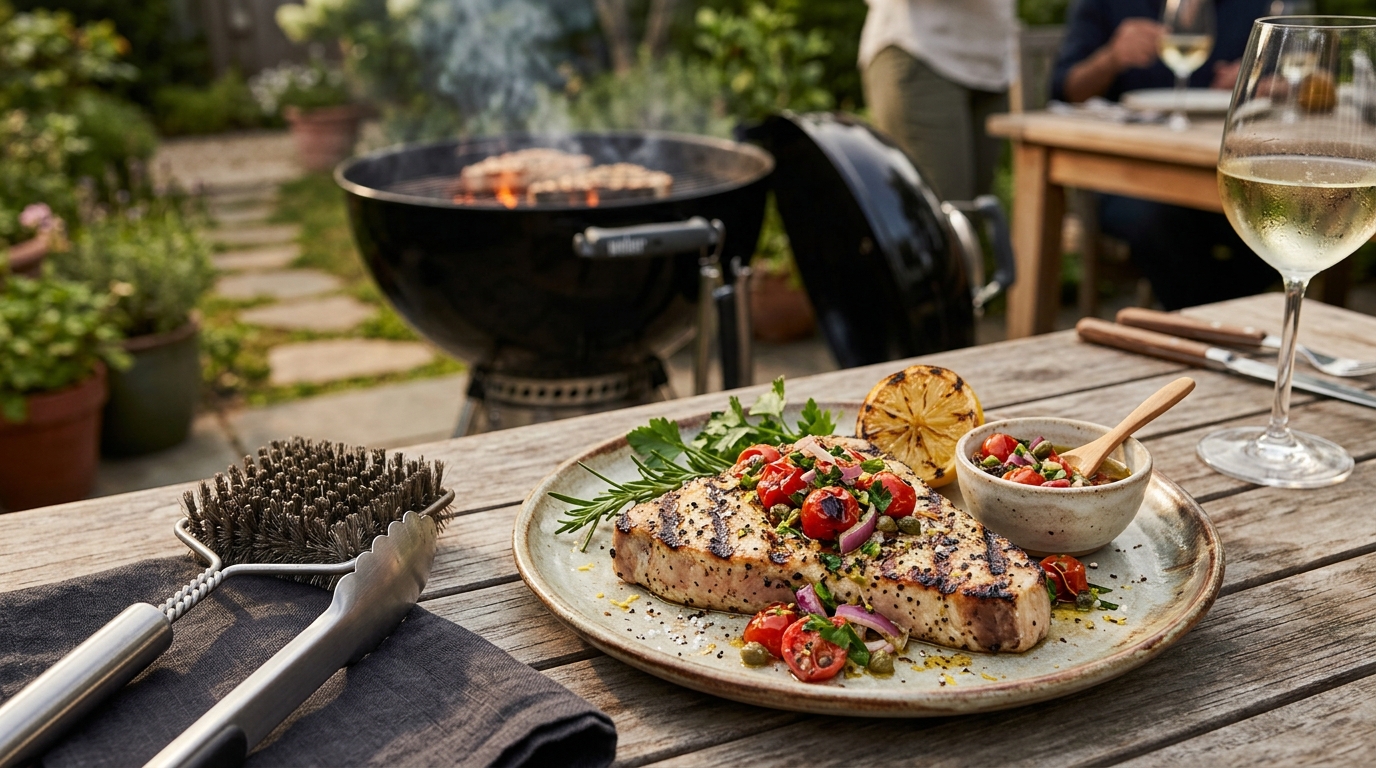
Grill swordfish at 400–450°F over direct heat for 4 to 5 minutes per side — that is it. A 1-inch steak goes from grill to plate in under 12 minutes. Swordfish is arguably the easiest fish to grill: its dense, meaty texture holds together, flips cleanly, and tolerates high direct heat that would destroy a more delicate fillet.
What swordfish should you buy for grilling?
Swordfish is sold almost exclusively as steaks, which makes it one of the most straightforward fish to buy for grilling. The key variables are thickness and freshness — species variations at the market are minimal.
Thickness: Target 1 to 1.25 inches. This is the sweet spot that gives you enough time to build a proper sear before the interior overcooks. Steaks under ¾ inch cook through before the exterior develops any color. Steaks over 1.5 inches need a longer cook time that pushes toward dryness unless you move to indirect heat partway through.
Freshness: Fresh swordfish should be pale to light pink or ivory in color with a clean ocean smell — not fishy or ammonia-like. The flesh should look moist but not wet, with no browning at the edges. Swordfish labeled “previously frozen” at the counter is perfectly acceptable and often fresher in quality than fish that has been sitting three to four days.
How much to buy: Swordfish steaks are sold boneless and are nearly all edible. Plan on 6 to 8 ounces per person for a main course. A standard market steak runs 8 to 12 ounces, so one steak per person with a shared side is typically the right amount.
Where to look: Ask the fishmonger for steaks cut from the center of the loin — they are the most even in thickness and cook most predictably. Avoid end cuts, which taper dramatically and cook unevenly on direct heat.
What equipment do you need to grill swordfish?
The list is shorter than for delicate fish because swordfish is structurally forgiving. You do not need a fish basket or cedar plank — direct grates work well.
Essential gear:
- A grill capable of holding 400–450°F
- A wide fish spatula — swordfish is firm but a wide thin blade still makes flipping cleaner and reduces the chance of tearing the sear
- An instant-read thermometer — swordfish goes from perfectly done to dry in a narrow temperature window; a thermometer removes the guesswork entirely
Useful but not required:
- Long-handled grilling tongs for managing the grill setup and rotating steaks
- A grill brush or scraper for thorough pre-cook cleaning
- A squeeze bottle of high-smoke-point oil for quick grate oiling
How to prep swordfish before grilling
Good preparation prevents the two most common failures: sticking and drying out.
Step 1: Pat completely dry. Remove the swordfish steaks from the refrigerator and pat every surface — top, bottom, and edges — completely dry with paper towels. Surface moisture creates steam between the steak and the hot grate. Steam prevents browning, delays the crust formation that helps the steak release cleanly, and extends the cook time into territory where the interior dries out.
Step 2: Trim the skin if present. Some swordfish steaks come with a thin strip of dark skin and subcutaneous fat along one edge. This skin does not render or crisp the way salmon skin does — it stays rubbery and chewy. Trim it off with a sharp knife before marinating or seasoning.
Step 3: Marinade or season. Swordfish has enough natural richness to stand up to bold seasoning, but it is also excellent with nothing more than olive oil, salt, pepper, and lemon. A short marinade of 20 to 30 minutes adds moisture and flavor without changing the texture. Do not marinate longer than 45 minutes in an acid-based marinade — citrus and vinegar begin breaking down the surface proteins and make the texture mushy.
Simple lemon-garlic marinade:
- 3 tablespoons olive oil
- 2 tablespoons fresh lemon juice
- 2 minced garlic cloves
- 1 teaspoon kosher salt
- ½ teaspoon black pepper
- 1 tablespoon fresh parsley or oregano (optional)
Combine, coat the steaks on all sides, and rest at room temperature for 20 to 30 minutes before grilling.
Dry rub option (no marinade):
- 1 teaspoon smoked paprika
- 1 teaspoon garlic powder
- ½ teaspoon ground cumin
- ½ teaspoon kosher salt
- ¼ teaspoon black pepper
Apply 15 minutes before the grill is ready. This creates a lightly spiced crust and pairs well with a chimichurri or salsa verde finish at the table.
Step 4: Bring close to room temperature. Leave the marinated or seasoned steaks out for 15 minutes before placing them on the grill. A cold steak from the refrigerator takes longer to cook through, increasing the risk of an overcooked exterior before the interior reaches temperature.
How to set up your grill for swordfish
Gas grill: Preheat all burners on high for 10 to 15 minutes until the grill reaches 400–450°F. Clean the grates thoroughly with a grill brush — leftover debris from previous cooks is a primary cause of sticking. Then oil the grates: fold several sheets of paper towel, soak in canola or vegetable oil, hold with long tongs, and wipe the full grate surface. Repeat once. Both the heat level and the oil application are non-negotiable for clean releases.
Charcoal grill: Light a full chimney of charcoal and wait until all coals are covered with a grey ash coating — about 15 to 20 minutes after lighting. Spread the coals in an even layer across the entire charcoal grate for direct-heat cooking. Replace the cooking grate and let it heat for 5 minutes. Clean and oil as described above. The target is 400–450°F at the cooking grate — you should only be able to hold your hand 6 inches above the grates for 2 to 3 seconds.
Two-zone setup for thick steaks: If your steaks are 1.5 inches or thicker, consider a two-zone setup: direct heat on one side and indirect on the other. Sear over direct heat for 2 to 3 minutes per side to build color, then move to the indirect zone and cook with the lid closed until the internal temperature reaches 130–135°F. This approach gives you the grill marks and crust without the risk of drying out a thicker steak over sustained direct heat.
How to grill swordfish: step-by-step
Step 1: Verify grill temperature. Confirm the grates have reached 400 to 450°F before adding the fish. On a gas grill, the lid thermometer should read in this range. On charcoal, the two-to-three-second hand test at 6 inches is the quick check. If the grill is not up to temperature, close the lid and wait — placing swordfish on an under-heated grate is the single most common cause of sticking.
Step 2: Oil the steaks right before placing them. Brush or rub both sides and the edges of the swordfish with a high-smoke-point oil — canola, avocado, or refined sunflower oil all work. This is in addition to oiling the grates. The extra surface oil helps the exterior sear develop quickly and evenly.
Step 3: Place steaks presentation-side down at a 45-degree angle. Set the steaks directly over the heat at a 45-degree angle to the grate bars. This orientation creates the crosshatch grill marks that are characteristic of a well-grilled swordfish steak. Close the lid. Do not touch or move the steaks.
Step 4: Cook for 4 to 5 minutes without moving. Let the grill do the work. Swordfish will stick initially, then release as the crust forms and bonds break between the protein and the metal. Resist the urge to check or lift early — premature movement tears the surface and costs you the sear. At the 4-minute mark, test gently by pressing a thin spatula underneath one corner. If the steak lifts cleanly, it is ready to flip. If it pulls back, wait 30 to 60 seconds and try again.
Step 5: Rotate 90 degrees for crosshatch marks (optional), then flip. For restaurant-style crosshatch marks: after 2 minutes on the first side, rotate the steak 90 degrees on the same side and cook 2 more minutes, then flip. For a simple even sear without the diamond pattern, flip directly after 4 to 5 minutes.
Step 6: Cook the second side for 4 to 5 minutes. The second side cooks slightly faster because the steak is already warm throughout. Start checking the internal temperature at 3 minutes into the second side. Pull the steaks when the instant-read thermometer reads 130 to 135°F at the thickest point.
Step 7: Rest for 3 minutes. Transfer to a clean plate or cutting board. Tent loosely with foil and rest for 3 minutes. Carry-over cooking will raise the internal temperature another 3 to 5°F. Swordfish at 130 to 135°F pull temperature finishes at 133 to 140°F after rest — fully opaque and moist throughout.
Step 8: Finish and serve. Squeeze fresh lemon over the steaks immediately before plating. Finish with a drizzle of good olive oil, a pinch of flaky sea salt, and chopped fresh herbs — parsley, basil, or oregano are all excellent. Serve immediately; swordfish holds heat well but does not improve with waiting.
Doneness temperature guide
| Doneness | Pull temperature | Final temp after rest | Texture |
|---|---|---|---|
| Medium | 125–130°F | 128–135°F | Slightly translucent at center, very moist |
| Medium-well (recommended) | 130–135°F | 135–140°F | Fully opaque, moist, clean flake |
| Well-done (FDA safe minimum) | 140°F | 143–145°F | Firm, fully set, minimal moisture |
Most experienced grillers and professional kitchens target 130 to 135°F as the pull temperature for swordfish. At this range the steak is fully opaque with a tender, moist texture that is not rubbery or dry. The FDA safe minimum of 145°F for fish produces a firmer result — correct from a food safety perspective and the right choice for anyone in a higher-risk group.
Sauces and finishes that work
Swordfish has enough richness to handle bold flavors that would overwhelm a more delicate fish. These are the pairings that reliably work:
Lemon-caper butter: Melt 2 tablespoons butter with 1 tablespoon capers, 1 tablespoon lemon juice, and 1 teaspoon lemon zest. Spoon over the steaks as they come off the grill. The classic Italian steakhouse treatment.
Chimichurri: The bright acidity of parsley, garlic, and red wine vinegar cuts through the richness of swordfish cleanly. Make it ahead and spoon on generously at serving time.
Soy-ginger glaze: Mix 2 tablespoons soy sauce, 1 tablespoon sesame oil, 1 teaspoon freshly grated ginger, and 1 teaspoon honey. Brush on during the final 2 minutes of grilling — not earlier, as the sugars will burn at full direct heat. Excellent with steamed rice and grilled bok choy.
Sicilian tomato-olive relish: Combine halved cherry tomatoes, sliced Castelvetrano olives, capers, fresh basil, and a drizzle of olive oil. No cooking required — rest at room temperature and spoon over the grilled steaks at service. The brininess and acid balance the richness of the fish without adding heat.
Avocado-lime salsa: Diced avocado, red onion, jalapeño, cilantro, lime juice, and salt. Works especially well when the swordfish is seasoned with the smoked paprika dry rub — the smoke spice and the fresh salsa are a natural pairing.
FAQ
Frequently asked questions
How long does it take to grill swordfish?
What temperature should you grill swordfish at?
How do you keep swordfish from drying out on the grill?
Should you marinate swordfish before grilling?
Do you flip swordfish when grilling?
Can you grill swordfish from frozen?
Is swordfish good for grilling compared to other fish?
Bottom line
Grilling swordfish is more forgiving than almost any other fish: the dense steak holds together, flips cleanly, and tolerates the kind of high direct heat that produces proper grill marks. Get a steak at least 1 inch thick, preheat the grill to 400–450°F, oil both the grates and the fish, and cook 4 to 5 minutes per side without touching it. Pull at 130–135°F and rest 3 minutes. A lemon-garlic marinade and a finish of capers and butter turn this into a restaurant-quality plate with about 15 minutes of active work.
For related reading: how to grill salmon, how to grill scallops, how to grill a perfect steak, and best instant-read thermometers for grilling.