guides
Gas Tank Refill for Your Grill: Exchange vs Refill Explained
Propane exchange programs deliver only 15 lbs, not 20. Learn refill vs exchange, how to check tank level, and the accessories every griller needs.
 Cole Whitaker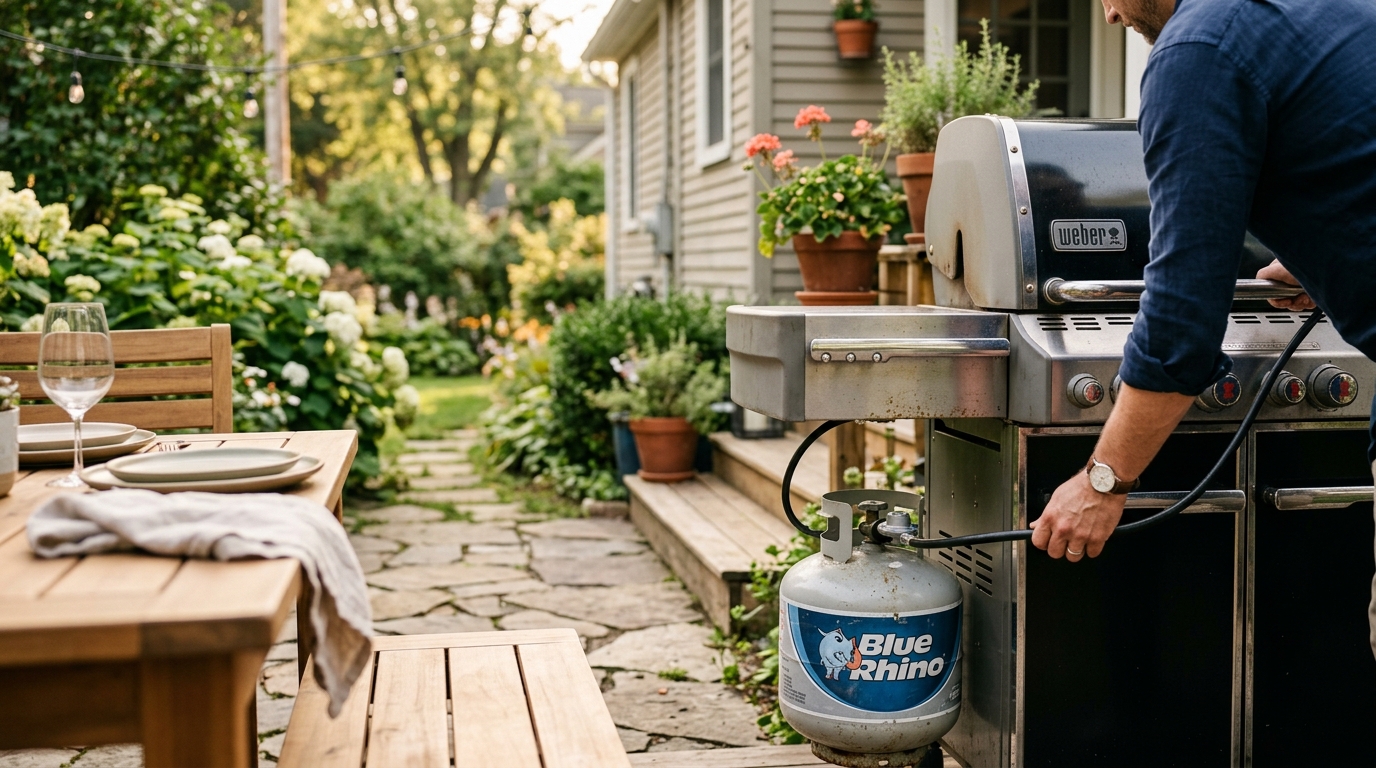
For a standard backyard gas grill, a 20-pound propane tank is the universal fuel supply: it holds 4.7 gallons of propane, delivers about 18 to 20 hours of grilling at medium heat, and is sold at virtually every hardware store, grocery chain, and gas station. Exchange your empty tank through a Blue Rhino or AmeriGas cage for speed, or take it to a u-fill station to save money and receive a full 20-pound fill instead of the 15 pounds that most exchange programs actually deliver.
What size propane tank does a gas grill use?
The overwhelming majority of residential gas grills run on a 20-pound BBQ cylinder — the standard propane tank sold at every hardware store and exchange cage. The fitting, OPD (overfill prevention device) valve, and physical dimensions are standardized across all brands. A Weber Spirit, Char-Broil, Napoleon, and any big-box house-brand grill all connect to the same 20-pound tank using an identical Type 1 left-hand-threaded fitting. There is no such thing as a brand-specific propane cylinder for consumer grills.
The tare weight (empty weight) is stamped on the collar and typically reads 17 to 18 pounds. When full, the tank weighs 37 to 38 pounds. When you pick up a tank and it feels close to that tare weight, the fuel is nearly gone.
Other propane tank sizes exist but are far less common for backyard grills:
- 1-pound disposable cylinders (Coleman-style): designed for camp stoves and tabletop grills, not compatible with full-size gas grills
- 30-pound and 40-pound tanks: used on large multi-burner grills and outdoor kitchens that see heavy daily use
- 100-pound horizontal tanks: permanent installations for built-in outdoor kitchens or high-BTU commercial burners
For most backyard grillers, the 20-pound cylinder is the right answer — portable, refillable, and universally available.
Propane exchange vs. propane refill: what is the real difference?
This is the decision most grillers make without fully understanding the gap. Exchange is fast and convenient; refilling is cheaper and delivers more fuel. The comparison table below shows the practical difference.
| Product | Best for | Rating | Notes | |
|---|---|---|---|---|
| Blue Rhino / AmeriGas Exchange | Convenience, zero hassle | ★★★★☆ | Swap an empty tank for a pre-filled one at exchange cages located at hardware stores, grocery stores, and gas stations. No skill required and takes under two minutes. The catch: most exchange programs fill to 15 pounds, not the full 20-pound capacity — you receive 25 percent less propane than the tank holds, at the same or higher retail price than a full refill. | Check price |
| U-Fill Refill Station | Full 20-pound fill, lowest cost per pound | ★★★★★ | You keep your own tank and pay only for the propane added. Cost runs $3 to $5 per gallon at most stations, putting a complete 20-pound refill at $15 to $20 — compared to $20 to $25 for an exchange that delivers only 15 pounds. Requires transporting an empty tank to a filling station (hardware stores, propane dealers, and RV centers all commonly offer this service). | Check price |
| Hardware Store In-Store Refill | Single-stop refill on a routine errand | ★★★★☆ | Many Home Depot, Lowes, and Ace Hardware locations operate an outdoor propane kiosk or refill at the service counter. Full 20-pound fills are available. Pricing falls between dedicated u-fill stations and exchange programs — typically $18 to $22 for a full fill. You keep your own tank and confirm the filled weight before leaving. | Check price |
The practical setup most experienced grillers use: buy two 20-pound tanks. Keep one connected to the grill and one stored full outdoors as a backup. When the active tank runs low, swap to the reserve and take the empty one for a full refill — not an exchange — at the next opportunity. This rotation means you never cook into an empty tank and always know the exact fuel level on the grill.
Where can you refill a propane tank?
Propane refill stations are more accessible than most people realize. Places to look:
Hardware and home improvement stores — Home Depot, Lowes, and Ace Hardware often operate outdoor propane kiosks or in-store refill at customer service. Pricing is typically $16 to $22 for a full 20-pound fill depending on current propane prices.
Propane dealers and gas companies — U-fill stations run by AmeriGas, Ferrellgas, Suburban Propane, and independent local propane dealers. These offer the lowest per-gallon pricing (often $2.50 to $4 per gallon) and always fill to the full 20-pound capacity. To find one nearby, search Google Maps for “propane refill near me” — the results will distinguish between exchange cages (swap only) and fill stations (refill your own cylinder).
RV parks and campgrounds — Most on-site propane services at RV facilities fill 20-pound cylinders alongside larger RV tanks. Pricing varies, but they reliably fill to capacity.
Gas stations and convenience stores — Most operate Blue Rhino or AmeriGas exchange cages only. You swap your empty cylinder for a pre-filled one; these are not refill stations and will not top off your own tank.
Grocery stores — Exchange cages only, located near the entrance of Walmart, Kroger, and similar chains.
For the best per-pound cost, a dedicated propane dealer will almost always beat hardware store pricing. For convenience on a quick errand, the hardware store kiosk is the next best option.
How do you know when your propane tank is empty?
Three methods work reliably — no guessing required:
The weight method is the most precise. Read the tare weight (TW) stamped on the collar of your tank. Weigh the full tank on any kitchen or postal scale. Subtract the tare weight from the current weight: the difference is the remaining propane in pounds. A full 20-pound tank reads tare weight plus 20. A tank showing tare weight plus 2 pounds has very little fuel left.
The hot-water test works without a scale. Pour a cup of hot tap water slowly down the side of the tank. Run your palm down the side immediately afterward. The metal above the propane level feels warm from the water; the metal at and below the propane level feels noticeably cooler because the liquid propane inside absorbs the heat rapidly. The transition line is the approximate fill level.
An inline propane gauge is the simplest long-term solution. These gauges thread between the tank valve and the grill regulator in under a minute and display remaining fuel as a dial reading or a color-coded indicator. A quality model gives accurate enough readings to plan cooks without the weight-and-math exercise before every session — inline propane gauge for grill on Amazon.
Do not shake the tank to estimate fuel level — liquid propane behaves differently than water and the sloshing feedback is unreliable as a quantitative estimate.
How long does a 20-pound propane tank last on a gas grill?
A full 20-pound tank contains approximately 430,000 BTUs of energy. Burn rate depends entirely on your grill’s total BTU output and how many burners you run.
A typical two-burner gas grill produces 20,000 to 30,000 BTU total. Running both burners at medium heat (about 55 percent output) uses roughly 12,000 to 17,000 BTU per hour. At that rate, a full 20-pound tank lasts approximately 20 to 24 hours of active grilling time.
A four-burner grill with 60,000 total BTU running all burners on high will exhaust a 20-pound tank in roughly 7 hours. Running two burners at medium heat on the same grill stretches the same tank to 18 to 20 hours.
Real-world estimates for common scenarios:
- Weekend burger session (1.5 hours, two burners at medium): roughly 2 to 3 pounds of propane
- Full pork shoulder smoke (10 hours, medium-low): roughly 5 to 7 pounds of propane
- Full grilling season (20 sessions at 1.5 hours each): typically 2 to 3 complete 20-pound tank fills
Any cook running more than four hours should start with a full tank confirmed by weight. Keep a second full tank on hand as backup — a propane emergency at hour six of a brisket is entirely avoidable.
Propane accessories worth having
Inline propane gauge or level indicator — The single most useful accessory for any grill owner. A quality inline gauge threads between your tank valve and the grill regulator in under a minute and gives a continuous read on remaining fuel. No hot-water test before every session, no mid-cook surprises — inline propane gauge for grill on Amazon.
Propane tank cover — Propane cylinders are built for outdoor exposure but prolonged UV exposure accelerates coating fade and valve corrosion. A UV-resistant, waterproof tank cover keeps the cylinder in better condition and is especially useful for tanks stored on a grill cart year-round — propane tank cover 20 lb on Amazon.
Extended supply hose — The standard hose on most grills runs 3 to 5 feet. An extended 10-foot hose with a built-in regulator lets you position the tank away from the grill, run a separate side burner or camp stove from the same tank, or connect to a larger remote tank for long cooks — extended propane hose 10 foot grill on Amazon.
Propane tank safety rules every griller should know
Keep tanks upright at all times. Propane is stored as a pressurized liquid. Laying a cylinder on its side allows liquid propane to reach the valve opening. An open valve on a liquid-filled tank releases propane as a rapidly expanding liquid rather than vapor — a serious explosion and fire risk. Upright storage and transport is non-negotiable.
Store propane tanks outdoors only. A full 20-pound cylinder stored in a garage, basement, or enclosed porch is a fire and explosion hazard. Store tanks upright on a flat outdoor surface away from the structure, in a shaded or covered location to reduce temperature extremes. This applies to spare tanks as well as the one connected to the grill.
Check the manufacture date on the collar. The date stamp appears in month-year format (for example, 04-14 means April 2014). Propane cylinders carry a 12-year service life from manufacture. Exchange programs and refill stations will refuse an expired tank until it has been inspected and recertified by a licensed propane dealer. Recertification adds 5 years to the service life. After two recertifications, cylinders are permanently retired.
Inspect the OPD valve before connecting. The handwheel-style valve with a triangular stem is the overfill prevention device. If the stem spins without building resistance when opening, or if the valve shows visible cracks or corrosion, do not connect the tank to any appliance. Bring it to a propane dealer for inspection.
Transport upright with valve closed and the vehicle ventilated. Secure the tank upright in the truck bed or trunk with the valve fully closed. Crack a window or keep the cargo area open to the air. Never leave a propane tank in a closed, parked vehicle in warm weather — temperatures inside a closed vehicle can exceed 120°F on a hot day and pressure in the tank rises with temperature.
FAQ
Frequently asked questions
How much does it cost to refill a 20-pound propane tank?
Why does my grill seem to run out of propane faster than it should?
How do I know if my propane tank is expired?
Can I use a 30-pound propane tank on a standard gas grill?
Is it safe to leave a propane tank connected to the grill between uses?
Bottom line
For most backyard grillers, a standard 20-pound propane tank is all the fuel infrastructure you need — but knowing the exchange vs. refill gap saves real money over a season. Exchange programs are fast but consistently deliver 15 pounds instead of 20 at a higher per-pound price. Refilling at a hardware store kiosk or dedicated propane dealer fills the tank to full capacity at lower cost. Add an inline gauge to eliminate pre-cook guessing, run a two-tank rotation so you never cook into an empty cylinder, and check the collar date annually to stay ahead of expiration. The details are simple once you know them.
For related reading: best gas grills for every backyard budget, charcoal vs pellet vs gas: which grill type is right for you, gas vs charcoal grill: an honest comparison, and best grill thermometers for accurate readings.