roundups
Best Meat Injectors of 2026
The best meat injectors of 2026: stainless syringes and pump guns ranked for capacity, ease of use, and build quality for BBQ and smoking.
 Cole Whitaker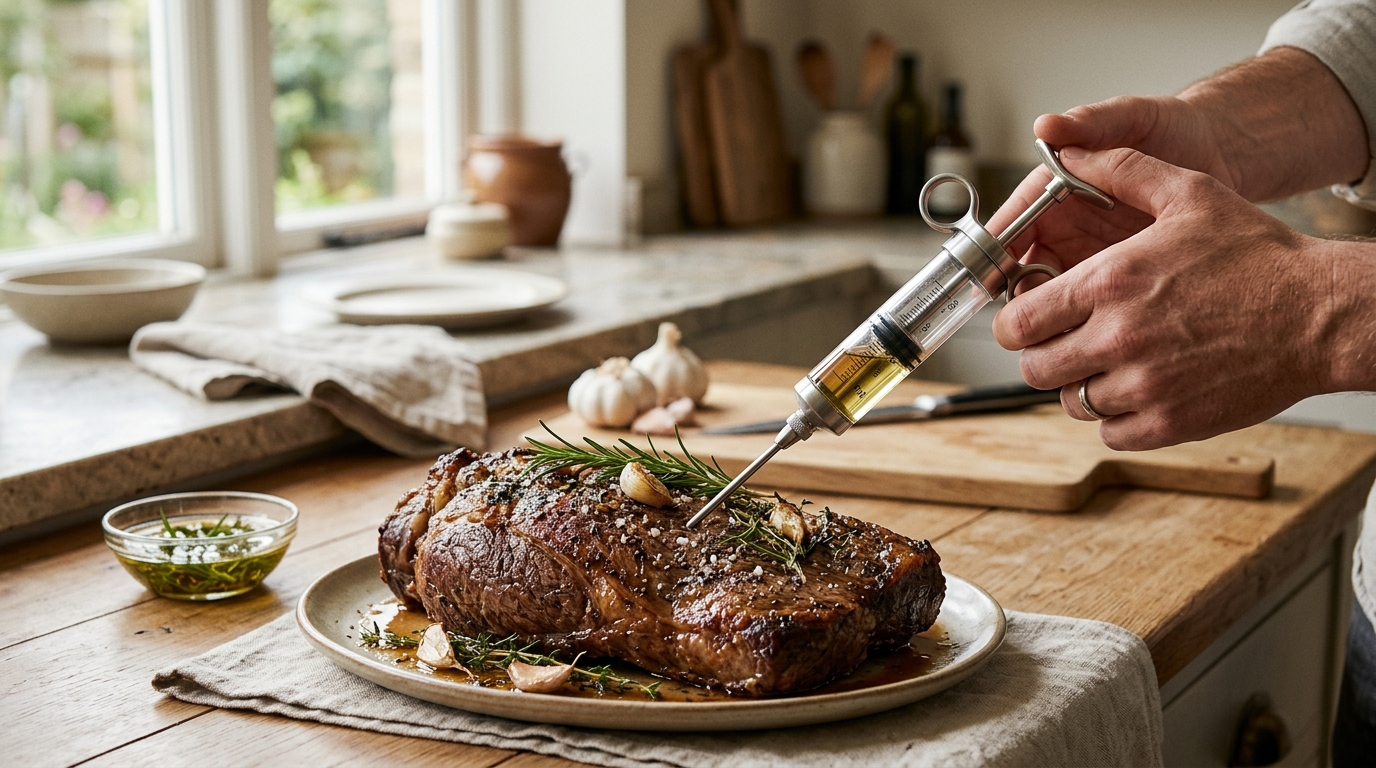
Most briskets are seasoned on the outside. A rub sits on the bark, smoke penetrates a quarter inch in, and the center of a 15-pound flat is exactly as flavorless as the day you bought it. Meat injection solves this at the biology level: marinade delivered directly into the muscle tissue from the inside out, reaching the parts that surface-applied seasoning never touches. The difference shows up on the fork — slices that stay moist through a 14-hour cook, pork shoulder that doesn’t need a gallon of finishing sauce, chicken breast with actual flavor at the thickest part. The technique is simple. The tool matters more than most people assume.
Injectors split into two formats. Syringe-style injectors are the standard: a barrel, plunger, and needle operated one push at a time. They’re compact, easy to clean, and precise for targeted placement. Pump guns use a pistol-grip mechanism with a reservoir and repeated trigger pulls for rapid high-volume injecting across a large cut. For a backyard brisket once a month, a syringe covers everything. For competition-level quantities — six pork butts at once — a pump gun is worth the step up in price. The right needle matters as much as the barrel: large-bore for butter-based marinades with particulates; perforated for distributing injection over a wider area; thin-bore for aromatic broth infusions that would clog a wider tip. This guide covers the best pick at each approach across price tiers.
Quick comparison
| Product | Best for | Rating | Notes | |
|---|---|---|---|---|
| Ofargo 2oz Stainless Steel Meat Injector | best overall; 3 needles, full 304 stainless, dishwasher-safe | ★★★★★ | $20-25. 2oz barrel. Large-bore, standard, and perforated needles included. | Check price |
| SpitJack Magnum Meat Injector Gun | best for large cooks; pump-action for rapid high-volume injecting | ★★★★★ | $40-55. Pistol-grip pump. Large-bore 3mm needle. Stainless steel. | Check price |
| Premiala Awesome Meat Injector | best for chunky marinades; clear barrel shows fill level | ★★★★★ | $20-30. Clear silicone barrel. 4mm and 2mm needles. Stainless plunger. | Check price |
| Grill Beast 304 Stainless Injector | best budget kit; stainless steel with cleaning brush included | ★★★★★ | $15-20. 2oz. 304 stainless. 3 needles, dedicated cleaning brush. | Check price |
| Cajun Injector Creole Butter Kit | best starter kit; injector plus famous injectable marinades | ★★★★★ | $15-25. 1-2oz injector. Creole Butter and herb marinades included. | Check price |
The picks
Best overall: Ofargo 2oz Stainless Steel Meat Injector
Best for backyard cooks who want a precision stainless injector with multiple needles at a price that doesn't require deliberation
Ofargo 2oz Stainless Steel Meat Injector Syringe Kit
The Ofargo injector has become the default recommendation in the backyard BBQ community for good reason. The 2oz barrel hits the practical sweet spot — large enough to inject a whole chicken without constantly refilling, compact enough for precision work on smaller cuts like pork tenderloins. Three needles ship with every kit: a 16-gauge large-bore needle for butter-based marinades and anything with small particulates, a standard needle for everyday thin-liquid use, and a perforated needle with side holes that distribute the injection in a 360-degree spread rather than a single jet. All three needles thread onto the same barrel via the same connector. The barrel, plunger, and needles are full 304 stainless steel — not chrome-plated, not stainless-coated aluminum. The unit fully disassembles in under 30 seconds and runs through a dishwasher without degrading. At \$20-25, it outperforms injectors at twice the price on the criteria that actually matter: easy loading, no plunger slip during injection, and no marinade blowback. The one constraint is volume — large cuts require multiple refills at 2oz per barrel. For a backyard cook doing one or two large proteins at a time, that's a non-issue.
★★★★★ 4.7 · 8,400 reviews
Check current price on Amazon→Pros
- Three needles cover different marinade viscosities and injection patterns in one kit
- Full 304 stainless steel throughout — no chrome-plated or coated-aluminum construction
- Fully disassembles in 30 seconds; every component is dishwasher-safe
- 2oz capacity is the practical sweet spot for most backyard injection tasks
- Plunger seal holds without leaking or slipping mid-stroke
Cons
- 2oz barrel requires 6-8 refills on a 15-pound brisket — manageable but repetitive on very large cuts
- Each injection requires a deliberate plunger push — no pump-action speed for high-volume sessions
- O-ring on the plunger may need replacement after a full season of heavy weekly use
Best for large cooks: SpitJack Magnum Meat Injector Gun
Best for competition-style cooks and anyone injecting multiple large cuts who wants pump-action speed and a wide-bore needle that handles thick marinades
SpitJack Magnum Meat Injector Gun
SpitJack is a BBQ-focused brand and the Magnum is built for serious volume work. The pistol-grip mechanism delivers repeated injections across a large cut without repositioning your hand between each shot — grip the handle, squeeze the trigger, move the needle an inch, squeeze again. On a 15-pound brisket, the difference between a pump gun and a syringe is roughly eight minutes versus twenty-five. The large-bore 3mm needle handles marinades that clog a narrower tip: rendered beef tallow with garlic and black pepper, butter-based injection with coarsely ground herbs, or pineapple juice marinades with actual fruit fiber. The stainless steel needle and trigger mechanism are durable enough for repeated competition use. The main trade-off is cleaning complexity — flushing a pump mechanism is more involved than rinsing a two-piece syringe, and the reservoir needs full disassembly to scrub thoroughly. At \$40-55, the SpitJack is the right call for anyone regularly injecting large quantities. For a once-a-month backyard brisket, the Ofargo at half the price does the same job.
★★★★★ 4.6 · 2,800 reviews
Check current price on Amazon→Pros
- Pump-action trigger is dramatically faster than a syringe for large cuts and multiple proteins
- Large-bore 3mm needle handles butter, tallow, and chunky herb marinades without clogging
- Pistol grip stays comfortable through extended injection sessions with large quantities
- Stainless steel needle and trigger mechanism built for repeated competition-level use
- Reservoir design allows continuous injection without stopping to refill every 2oz
Cons
- $40-55 is twice the cost of a high-quality syringe injector
- More components means more thorough cleaning — pump mechanism must fully disassemble
- Trigger requires more deliberate force than a syringe plunger push on light-viscosity liquids
- Larger footprint stores less easily in a kitchen drawer between cooks
Best for chunky marinades: Premiala Awesome Meat Injector
Best for cooks who inject herb-butter mixtures, garlic paste, or any marinade with visible particulate that would wedge inside a narrow steel barrel
Premiala Awesome Meat Injector
The Premiala's defining feature is its clear silicone barrel, which solves two real problems: you can see exactly how much marinade is left during injection without guessing, and the wider-diameter bore accommodates marinades with actual texture — garlic paste, herb-and-butter mixtures, creamy chipotle blends, anything with visible particulate that stops a standard steel plunger cold. The silicone material is food-safe, flexible, and easier to clean than a rigid steel tube because the barrel bends enough to reach all interior surfaces during handwashing. Two needles ship with the kit: a wide 4mm large-bore needle for chunky marinades and a standard 2mm needle for thinner liquids. The plunger is stainless steel, not plastic, which keeps injection force consistent across a full barrel rather than flexing under load. At \$20-30, it's priced at the same tier as the Ofargo syringe but solves the specific problem of textured marinades. If your injection recipes include anything beyond a thin liquid — compound butters, herb-forward rubs emulsified with broth, or anything with real garlic bits — the Premiala is the right pick.
★★★★★ 4.6 · 3,600 reviews
Check current price on Amazon→Pros
- Clear silicone barrel shows fill level at a glance — no guessing how much is left mid-inject
- Wide bore handles garlic paste, herb-butter mixtures, and chunky marinades that jam steel barrels
- Silicone flexes during cleaning to reach interior surfaces that rigid steel tubes can't
- Stainless steel plunger maintains consistent injection force across the full barrel
- Food-safe silicone doesn't pick up metallic taste from acidic or citrus-heavy marinades
Cons
- Silicone barrel is hand-wash only — not suitable for dishwasher high-heat cycles
- Fewer needle options than the Ofargo 3-needle kit; wide-bore focus limits precision on thin cuts
- Slightly less injection control than a rigid stainless barrel due to barrel flex under firm pressure
Best budget: Grill Beast 304 Stainless Steel Meat Injector
Best for cost-conscious buyers who want real 304 stainless construction and a dedicated cleaning brush without the Ofargo price
Grill Beast 304 Stainless Steel Meat Injector Kit
The Grill Beast injector is the right pick when budget is the primary constraint and you want a full stainless kit rather than a bargain-tier plastic syringe. The 2oz 304 stainless barrel and plunger match the Ofargo's material quality at a slightly lower price point — typically \$15-20. Three needles are included along with a dedicated cleaning brush, which matters because the interior of a stainless needle is nearly impossible to scrub clean without a purpose-built tool after a butter or herb injection. Performance is comparable to the Ofargo for standard backyard use: the plunger moves smoothly, the needle-to-barrel connection is solid, and the 2oz capacity handles most injection tasks without being unwieldy. The area where it trails the Ofargo is needle machining precision — the tolerances are slightly looser, which shows up occasionally as minor resistance during high-viscosity injections. This rarely matters in practice for standard backyard marinades. At \$15-20 for a complete stainless kit with cleaning brush, the Grill Beast is the best option when you want stainless functionality without spending \$25.
★★★★★ 4.5 · 4,100 reviews
Check current price on Amazon→Pros
- 304 stainless steel barrel and plunger — not plastic, not coated aluminum, at the budget price tier
- Cleaning brush included — the most overlooked accessory in budget kits and genuinely essential
- Three needles provide the same range as the Ofargo at a lower price point
- 2oz capacity covers most backyard injection tasks without requiring a pump gun
- Fully disassembles for thorough hand or machine cleaning
Cons
- Needle machining is slightly below Ofargo — minor resistance can appear with high-viscosity marinades
- Plunger O-ring may require replacement within one season of heavy weekly use
- Smaller review base than Ofargo means less accumulated troubleshooting knowledge online
Best starter kit with marinades: Cajun Injector Creole Butter Kit
Best for first-time injectors who want proven marinade flavors bundled with the tool so there's no guesswork on the first cook
Cajun Injector Creole Butter Injectable Marinade Kit
The Cajun Injector brand from Chef Williams in Louisiana has been the reference standard for injectable marinades for decades. Their Creole Butter — a butter-based marinade with garlic, black pepper, and cayenne — has been the default injection for Southern-style smoked turkey and chicken since the 1980s, and it earns the reputation: the flavor profile is calibrated for poultry in a way that a homemade butter injection often isn't on the first attempt. The kit bundles the stainless steel syringe with bottles of Creole Butter and optionally other regional marinades (garlic and herb, Cajun butter, roasted garlic), eliminating the recipe-development work on the first cook. The injector itself is functional — 1-2oz capacity, two needles, metal plunger — performing adequately for the task without the refinement of the Ofargo's plunger feel or needle machining. At \$15-25 for a bundled kit, it's the right pick for someone new to injection who wants to start with tested flavors. Once you've learned the technique with Cajun marinades, adapting to custom recipes in a better injector is straightforward.
★★★★★ 4.5 · 6,200 reviews
Check current price on Amazon→Pros
- Famous Creole Butter marinade is proven on poultry — no recipe guesswork on your first cook
- Multiple marinade flavors available in the product line (Creole Butter, garlic herb, Cajun butter)
- Entry-level price makes it low-risk as a first injection kit
- Calibrated flavor profiles for Southern-style smoked turkey and chicken
- Widely available — easy to find replacement marinade bottles after the first kit runs out
Cons
- Injector quality is entry-level — plunger feel and needle precision trail the Ofargo noticeably
- Marinades contain sodium and preservatives — the injection adds significant saltiness to a dry-brined cook
- 1oz capacity is smaller than most injectors — more refills required on large birds and roasts
- Regional Cajun flavor profiles aren't versatile across every BBQ application
What to skip
-
Plastic syringe injectors. At $5-10, these have a polypropylene barrel and plastic plunger that warps when exposed to hot butter, cracks at the barrel-needle junction with repeated use, and retains marinade odors season after season. The plastic plunger doesn’t maintain consistent pressure against the barrel wall — it slips, backfills, and delivers an uncontrolled injection. A $20 stainless steel kit outperforms plastic in every dimension and lasts years instead of one season. Don’t start with plastic.
-
Single-needle kits. Some injectors ship with one needle, leaving you unable to switch between a wide-bore needle for chunky marinades and a standard needle for thinner liquids. A single needle is a compromise in both directions — too wide for aromatic herb broths, too narrow for garlic butter. Any kit worth buying ships with at least two needles; three is the practical minimum for varied use across different recipes and cut sizes.
-
2-in-1 injector/baster combos. These tools try to function as both a marinade injector and a basting bulb. The needle end is too narrow for effective basting; the barrel is too long and awkward for one-handed injecting. Both functions end up compromised. A dedicated stainless injector costs $20; a silicone basting brush costs $5. Buy both separately rather than paying $15 for a tool that handles neither task well.
FAQ
Frequently asked questions
When should I inject meat before smoking?
What liquids work best for meat injection?
How do I clean a meat injector after use?
Does injection work on smaller cuts or just large ones?
How many injection sites and how deep should I inject?
Can I use an injector for brining, or is that a different tool?
Bottom line
Best overall: Ofargo 2oz Stainless Steel Meat Injector ($20-25) for three-needle coverage, full 304 stainless construction, and dishwasher-safe components at a price that requires no deliberation. Best for large cooks: SpitJack Magnum ($40-55) when you’re injecting competition-level quantities and pump-action speed is worth the premium. Best for chunky marinades: Premiala Awesome Meat Injector ($20-30) when your recipe includes herb paste, garlic, or anything that jams a standard steel barrel. Best budget kit: Grill Beast 304 Stainless ($15-20) with cleaning brush included. Best starter kit: Cajun Injector Creole Butter Kit ($15-25) when you want proven regional marinades alongside the tool on your first inject.
Injection is a 15-minute step that pays dividends over 10+ hours of smoking. The difference shows up at the table, not the grill.
Round out the outdoor cooking setup: best smokers, best charcoal grills, best grill thermometers, or best BBQ tool sets.